Category
page 1Nine Lyric Poets

Sappho
thumb|right|Kalpis painting of Sappho by the [[Sappho Painter ( 510BC)|alt=Vase painting of a woman holding a lyre.]]

Pindar
Pindar (; ; ; ) was an Ancient Greek lyric poet from Thebes. Of the canonical nine lyric poets of ancient Greece, his work is the best preserved. Quintilian wrote, "Of the nine lyric poets, Pindar is by far the greatest, in virtue of his inspired magnificence, the beauty of his thoughts and figures, the rich exuberance of his language and matter, and his rolling flood of eloquence, characteristics which, as Horace rightly held, make him inimitable." His poems can also, however, seem difficult and even peculiar. The Athenian comic playwright Eupolis once remarked that they "are already reduced

Anacreon
Anacreon ( BC) was an Ancient Greek lyric poet, notable for his drinking songs and erotic poems. Later Greeks included him in the canonical list of Nine Lyric Poets. Anacreon wrote all of his poetry in the ancient Ionic dialect. Like all early lyric poetry, it was composed to be sung or recited to the accompaniment of music, usually the lyre. Anacreon's poetry touched on universal themes of love, infatuation, disappointment, revelry, parties, festivals, and the observations of everyday people and life.

Alcaeus of Mytilene
thumb|Alcaeus and Sappho, Attic red-figure calathus, c. 470 BC, [[Staatliche Antikensammlungen (Inv. 2416)]]
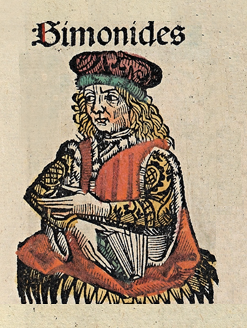
Simonides of Ceos
Greek lyric poet (c. 556–468 BC)
.jpg)
Alcman
thumb|Roman-period mosaic portrait of Alcman from Gerasa, 3rd century AD
Alcman (; Alkmán; fl. 7th century BC) was an Ancient Greek choral lyric poet from Sparta. He is the earliest representative of the Alexandrian canon of the Nine Lyric Poets. He wrote six books of choral poetry, most of which is now lost; his poetry survives in quotation from other ancient authors and on fragmentary papyri discovered in Egypt. His poetry was composed in the local Doric dialect with Homeric influences. Based on his surviving fragments, his poetry was mostly hymns, and seems to have been composed in long sta

Bacchylides
right|thumb|A Musician by Albert Joseph Moore
Bacchylides (; Bakkhulides; – ) was a Greek lyric poet. Later Greeks included him in the canonical list of Nine Lyric Poets, which included his uncle Simonides. The elegance and polished style of his lyrics have been noted in Bacchylidean scholarship since at least Longinus. Some scholars have characterized these qualities as superficial charm. He has often been compared unfavourably with his contemporary, Pindar, as "a kind of Boccherini to Pindar's Haydn". However, the differences in their styles do not allow for easy comparison, and translator R

Stesichorus
upright=1.25|thumb|A scene from the Tabula Iliaca, bearing the inscription "Sack of Troy according to Stesichorus"
Stesichorus (; , Stēsichoros; c. 630 – 555 BC) was a Greek lyric poet native of Metauros (Gioia Tauro today). He is best known for telling epic stories in lyric metres, and for some ancient traditions about his life, such as his opposition to the tyrant Phalaris, and the blindness he is said to have incurred and cured by composing verses first insulting and then flattering to Helen of Troy.

Ibycus
Ibycus (; ; ) was an Ancient Greek lyric poet, a citizen of Rhegium in Magna Graecia, probably active at Samos during the reign of the tyrant Polycrates and numbered by the scholars of Hellenistic Alexandria in the canonical list of nine lyric poets. He was mainly remembered in antiquity for pederastic verses, but he also composed lyrical narratives on mythological themes in the manner of Stesichorus. His work survives today only as quotations by ancient scholars or recorded on fragments of papyrus recovered from archaeological sites in Egypt, yet his extant verses include what are considered
Nine lyric poets
group of humans