Category
page 1Nuclear weapons policy
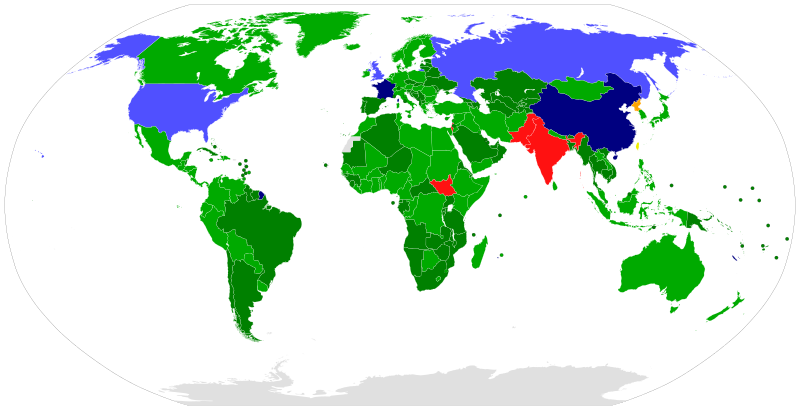
Treaty on the Non-Proliferation of Nuclear Weapons
international treaty

List of states with nuclear weapons
There are currently nine sovereign states that are generally understood to possess nuclear weapons, though only eight formally acknowledge possessing them. In order of first successful nuclear test, the world's nine nuclear-armed states are the United States (1945), Russia (1949), the United Kingdom (1952), France (1960), China (1964), India (1974), Pakistan (1998), and North Korea (2006); Israel is believed to have acquired nuclear weapons around 1967, but has never openly tested or formally acknowledged having them. Under the Non-Proliferation Treaty (NPT), the United States, Russia, the United Kingdom, France, and China are recognized "nuclear-weapons states" (NWS). They are also the five permanent members of the United Nations Security Council. Israel, India, and Pakistan never signed the NPT, while North Korea acceded to it in 1985 before announcing withdrawal in 2003.

Outer Space Treaty
treaty that forms the basis of international space law

Treaty on the Prohibition of Nuclear Weapons
legally binding international agreement to prohibit nuclear weapons

Intermediate-Range Nuclear Forces Treaty
arms control agreement between the United States and the Soviet Union

Joint Comprehensive Plan of Action
International agreement on the nuclear program of Iran
Partial Nuclear Test Ban Treaty
1963 limited test ban treaty
Comprehensive Nuclear-Test-Ban Treaty
international treaty to ban nuclear explosions

David Lange
Prime Minister of New Zealand from 1984 to 1989
Russell–Einstein Manifesto
manifesto issued in London on 9 July 1955 by Bertrand Russell in the midst of the Cold War; highlighted the dangers posed by nuclear weapons and called for world leaders to seek peaceful resolutions to international conflict
nuclear proliferation
spread of nuclear weapons

RDS-1
The RDS-1 (), also known as First Lightning (), was the first nuclear weapons test that was conducted by the Soviet Union. It was detonated on 29 August 1949 at 7:00 a.m. Kazakhstan Time (decree time) (UTC+06:00), at the Semipalatinsk Test Site in the Kazakh Soviet Socialist Republic, and yielded 22 kilotons of TNT.
anti-nuclear movement
social movement that opposes nuclear technologies
Treaty of Tlatelolco
treaty to prohibit and prevent the testing, use, production, storage or acquisition of any nuclear weapons in Latin America and the Caribbean
nuclear sharing
concept in NATO's policy of nuclear deterrence
Bulletin of the Atomic Scientists
academic journal
United Nations Security Council Resolution 255
United Nations Security Council resolution
United Nations Office for Disarmament Affairs
Office of the United Nations Secretariat
United Nations Security Council Resolution 1540
United Nations Security Council resolution
United Nations Institute for Disarmament Research
research institute of the United Nations
International Day against Nuclear Tests
It is observed on August 29 every Year
Quebec Agreement
joint agreement between the United Kingdom and United States primarily for nuclear energy
United Nations Security Council Resolution 984
United Nations Security Council resolution
France and weapons of mass destruction
projects and lists of French weapons of mass destruction
Three Non-Nuclear Principles
Japan's peacetime nuclear strategy, announced in 1967 with consideration for some LDP supporters
United Nations Security Council Resolution 1977
United Nations Security Council resolution

Nuclear Security Summit
a world summit aimed at preventing nuclear terrorism around the globe

Central Asian Nuclear Weapon Free Zone
Treaty in force

nuclear umbrella
type of international nuclear weapons policy
Emergency Committee of Atomic Scientists
Einstein's committee of atomic scientists (1946-1951)
Albert Einstein Peace Prize
peace prize awarded annually since 1980 by the Albert Einstein Peace Prize Foundation
RDS-2
The RDS-2 (Russian: РДС-2) was a second nuclear bomb developed by the Soviet Union as an improved version of the RDS-1. It included new explosive lenses along with a new core design to decrease the probability of pre-detonation or 'fizzle'. The levitated core increased implosion efficiency by allowing for an empty space between the "flying layer" and the core, thereby allowing rapid acceleration of the shock wave before it impacted the core.

United Nations Security Council Resolution 2055
United Nations Security Council resolution

Spencer R. Weart
American physicist and historian
2014 Nuclear Security Summit
Angela Kane
German diplomat
Joint Statement of the Leaders of the Five Nuclear-Weapon States on Preventing Nuclear War and Avoiding Arms Races
January 2022 statement
2012 Nuclear Security Summit
2012 Nuclear Security Summit held in Seoul, South Korea
nuclear weapons debate
controversies surrounding nuclear weapons
International Court of Justice advisory opinion on the Legality of the Threat or Use of Nuclear Weapons
advisory opinion stating that there is no source of law, customary or treaty, that explicitly prohibits the possession or even use of nuclear weapons
2010 Nuclear Security Summit
Nuclear Security Summit in Washington DC
Nuclear Terrorism Convention
2005 United Nations treaty

list of weapons of mass destruction treaties
Wikimedia list article
Massimo Aparo
Italian nuclear engineer,
Mongolian Nuclear-Weapons-Free Status
Plutonium Management and Disposition Agreement
treaty
Mainau Declarations
Wikimedia disambiguation page
Brazilian–Argentine Agency for Accounting and Control of Nuclear Materials
intergovernment agency
Global Zero
organization
Project Vela
system developed by the United States to monitor compliance with the Partial Test Ban Treaty
nuclear-free zone
area in which nuclear weapons and power plants are banned
Institute for Science and International Security
nonprofit non-governmental institution dedicated to nuclear nonproliferation
IAEA safeguards
system of inspection and verification of the peaceful uses of nuclear materials as part of the Nuclear Non-Proliferation Treaty (NPT), supervised by the International Atomic Energy Agency
Nuclear Information and Resource Service
organization