Category
page 1Obsolete writing systems

cuneiform
Cuneiform is a logo-syllabic writing system that was used to write several languages of the ancient Near East. The script was in active use from the early Bronze Age until the 1st century BC. Cuneiform scripts are marked by and named for the characteristic wedge-shaped impressions () which form their signs. Cuneiform is the earliest known writing system and was originally developed to write the Sumerian language of southern Mesopotamia (modern Iraq).

Phoenician script
abjad found in Canaanite and Aramaic inscriptions across the Mediterranean from the 11th–2nd centuries BCE

runic script

Brahmi
ancient script of Central and South Asia

Glagolitic
oldest known Slavic alphabet

Aramaic alphabet
semitic alphabet used to write Aramaic languages
%20(14760479206).jpg)
Ogham
Ogham (also ogam and ogom, , Modern Irish: ; , later ) is an Early Medieval alphabet used primarily to write the early Irish language (in the "orthodox" inscriptions, 4th to 6th centuries AD), and later the Old Irish language (scholastic ogham, 6th to 9th centuries). There are roughly 400 surviving orthodox inscriptions on stone monuments throughout Ireland and western Britain, the bulk of which are in southern areas of the Irish province of Munster. The Munster counties of Cork and Kerry contain 60% of all Irish ogham stones. The largest number outside Ireland are in Pembrokeshire, Wales.

Linear B
ancient syllabary for Mycenaean Greek used ca. 1400 BCE – 1200 BCE

Egyptian Demotic
ancient Egyptian script

Linear A
undeciphered writing system from Crete

Egyptian hieratic
Hieratic (; ) is the name given to a cursive writing system used for Ancient Egyptian and the principal script used to write that language from its development in the third millennium BCE until the rise of Demotic in the mid-first millennium BCE. It was primarily written in ink with a reed brush on papyrus.

Gothic script
unicameral alphabet created in the 4th century by Ulfilas for the purpose of translating the Bible to the Gothic language

Old Turkic
writing system

Kharoṣṭhī
Kharosthi script (), also known as the Gandhari script (), was an ancient Indic script originally developed in the Gandhara Region of the north-western Indian subcontinent, between the 5th and 3rd century BCE. Primarily used by the people of Gandhara in various parts of South Asia and Central Asia, Kharosthi remained in use until it died out in its homeland around the 5th century CE. It was also in use in Bactria, the Kushan Empire, Sogdia, and along the Silk Road. There is some evidence it may have survived until the 7th century in Khotan and Niya, both cities in Tarim Basin.

oracle bone script
precursor of Chinese characters
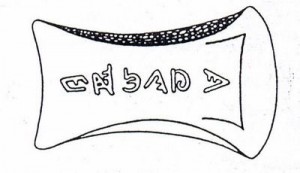
Old Hungarian
alphabetic writing system used by the Hungarians from the Middle Ages
Old Uyghur alphabet
historic Sogdian-based alphabet
Ugaritic alphabet
Cuneiform consonantal alphabet of 30 letters
Old South Arabian script
abjad used for writing Old South Arabian languages
Pahlavi scripts
abjad-based writing systems used for Middle Iranian languages
Meroitic script
writing system
Avestan
alphabet mainly used in Zoroastrian scriptures to transcribe the old Avestan language
Old Permic alphabet
writing system
ʼPhags-pa
Tibeto-Mongol alphasyllabary/abugida used in China during Yuan Dynasty
Cypriot syllabary
Cypriot syllabary writing system
Pallava
Brahmic writing system
Nabataean script
abjad
Kawi script
ancient Javanese abugida
Paleo-Hebrew alphabet
abjad found in Canaanite inscriptions from the region of biblical Israel and Judah used to write Hebrew, later replaced by the modern Hebrew square script

Kaithi
Kaithi (, ), also called Kayathi (), Kayasthi (, ), Kayastani, or Kaite Lipi () in Nepali, is a Brahmic script historically used across parts of Northern and Eastern India. It was prevalent in regions corresponding to modern-day Uttar Pradesh, Bihar, and Jharkhand. The script was primarily utilized for legal, administrative, and private records and was adapted for a variety of Indo-Aryan languages, including Angika, Awadhi, Bhojpuri, Hindustani, Surjapuri, Maithili, Magahi, and Nagpuri.
Aztec script
mixed ideographic/phonetic writing system for Nahuatl
Sogdian
alphabet used for the Sogdian language of central Asia
Cypro-Minoan script
syllabary script, undeciphered, used on the island of Cyprus during the late Bronze Age (ca. 1550–1050 BCE)
Osmanya
script used for writing Somali
Anatolian Hieroglyphs
writing system
Old Italic
group of similar ancient pre-Roman alphabets used on the Italian peninsula (Etruscan, Oscan, Umbrian, South Picene, North Italic, Venetic, etc.)
Soyombo
abugida used for Mongolian
Manichaean
abjad-based writing system associated with the spread of Manichaean religion
Jurchen
writing system of Jurchen people
Tangut script
script used for writing the extinct Tangut language
Ahom
abugida used to write the Ahom language
Old Persian cuneiform
unicameral cuneiform semi-syllabary used to write the Old Persian language
Byblos
undeciphered writing system
Takri
Brahmic abugida or family of abuguidas used historically for Western Pahari languages, and as part of recent revival efforts
Lycian
alphabet used to write the Lycian language
small seal script
form of Chinese characters standardized and promulgated by the Qin dynasty
Elbasan alphabet
alphabet used for writing the Albanian language
Caucasian Albanian script
alphabetic writing system formerly used by the Caucasian Albanians
Celtiberian
ancient writing system from the Iberian peninsula
Elamite cuneiform
cuneiform writing of the Elamite language
Mi'kmaq hieroglyphic writing
defunct writing system of Canada's Mi'kmaq First Nation
Linear Elamite
writing system from Elam
Palmyrene script
abjad used to write the Palmyrene dialect of Aramaic
Vithkuqi alphabet
alphabet invented by Naum Veqilharxhi in the early 19th century for writing the Albanian language
Lydian
alphabet used to write the Lydian language

Nandinagari
thumb|upright=1.2|A 16th century CE Sanskrit record of Sadasiva Raya in Nandināgarī script engraved on copper plates. Manuscripts and records in Nandināgarī were created and preserved historically by creating inscriptions on metal plates, specially treated palm leaves, slabs of stone and paper.
Dogra
abugida for the Dogri language
Tocharian alphabet
script used to write the Tocharian languages
Sui
pictographic writing system for the Sui language
Mahajani
Mahajani is a Laṇḍā mercantile script that was historically used in northern India for writing accounts and financial records in Marwari, Hindi and Punjabi. It is a Brahmic script and is written left-to-right. Mahajani refers to the Hindi word for 'bankers' or 'moneylenders', also known as 'sarrafi' or 'kothival' (merchant).