Category
page 1Olympian deities

Muse
thumb|Muse, perhaps Clio, reading a scroll (Attic red-figure [[lekythos, Boeotia, )]]
In ancient Greek religion and mythology, the Muses (, ; singular: , Moúsa, ; , ) were the inspirational goddesses of literature, science, and the arts. They were considered the source of the knowledge embodied in the poetry, lyric songs, and myths that were related orally for centuries in ancient Greek culture.

Heracles

Prometheus
In Greek mythology, Prometheus (; ) is a Titan responsible for creating or aiding humanity in its earliest days. He defied the Olympian gods by taking fire from them and giving it to humanity in the form of technology, knowledge and, more generally, civilization.
%20(14783769792).jpg)
Eros
Eros (, ; ) is the Greek god of love and sex. The Romans referred to him as Cupid or Amor. In the earliest account, he is a primordial god, while in later accounts he is the child of Aphrodite.
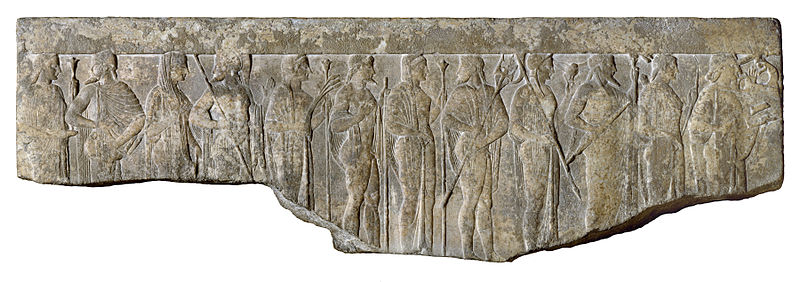
Twelve Olympians
major deities of the Greco-Roman pantheon

Asclepius
Asclepius (; ; ) is a hero and god of medicine in ancient Greek religion and mythology. He is the son of Apollo and Coronis, or Arsinoe, or of Apollo alone. Asclepius represents the healing aspect of the medical arts; his daughters, the , are: Hygieia ("Health, Healthiness"), Iaso (from ἴασις "healing, recovering, recuperation", the goddess of recuperation from illness), Aceso (from ἄκεσις "healing", the goddess of the healing process), Aegle (the goddess of good health) and Panacea (the goddess of universal remedy). He has several sons as well. He was associated with the Roman/Etruscan god Ve

Themis
In Greek mythology and religion, Themis (; ) is the goddess and personification of justice, divine order, law, and custom. She is one of the twelve Titan children of Gaia and Uranus, and the second wife of Zeus. She is associated with oracles and prophecies, including the Oracle of Delphi.

Nike
goddess of victory in Greek mythology

Ganymede
son of Tros in Greek mythology

Leto
In ancient Greek mythology and religion, Leto (; ) is a childhood goddess, the daughter of the Titans Coeus and Phoebe, the sister of Asteria, and the mother of Apollo and Artemis.

Hebe
ancient Greek goddess of youth

Ariadne
In Greek mythology, Ariadne (; ) was a Cretan princess, the daughter of King Minos of Crete. There are variations of Ariadne's myth, but she is known for helping Theseus escape from the Minotaur and being abandoned by him (or herself dying) on the island of Naxos. There, Dionysus saw Ariadne sleeping, fell in love with her, and later married her. Many versions of the myth recount Dionysus throwing Ariadne's jeweled crown into the sky to create a constellation, the Corona Borealis.

Iris
the personification of the rainbow in ancient Greek religion and mythology
.jpg)
Charites
thumb|300x300px|The Three Graces in a fresco at [[Pompeii, 1–50 AD]]
.jpg)
Semele
In Greek mythology, Semele (; ), or Thyone (; ), was the youngest daughter of Cadmus and Harmonia, and the mother of Dionysus by Zeus (her own great-grandfather).

Horae
thumb|upright=1.3|Dionysus leads the Horae. Dionysus carries his [[thyrsus, and the middle Hora hold ears of wheat. Neo-Attic Roman relief, c. 50–25 BC.]]
In Greek mythology, the Horae (), Horai () or Hours (, ) were the goddesses of the seasons and the natural portions of time.

Hyacinth
mythological prince, loved by Apollo

Eileithyia
Eileithyia or Ilithyia (; , ; (Eleuthyia, ) in Crete, also (Eleuthia, ) or (Elysia, ) in Laconia and Messene, and (Eleuthō) in literature) was the Greek goddess of childbirth and midwifery, and the daughter of Zeus and Hera.

Dione
Greek goddess, mother of Aphrodite

Kratos
God from Greek mythology
Bia
ancient Greek goddess, personification of force

Enyo
In Greek mythology, Enyo (; ) is a war-goddess, frequently associated with the war-god Ares. The Romans identified her with Bellona.
Zelus
In Greek mythology, Zelus or Zelos (; ) was the daimon that personifies dedication, emulation, eager rivalry, envy, jealousy, and zeal. The English word "zeal" is derived from his name.

Asteria
In Greek mythology, Asteria or Asterie ( ; ) is a daughter of the Titans Phoebe and Coeus (Polus) and the sister of Leto. According to Hesiod, by the Titan Perses she had a single child, a daughter named Hecate, the goddess of witchcraft. Other authors made Asteria the mother of the fourth Heracles and Hecate by Zeus.

Anteros
In Greek mythology, Anteros (; ) is the god of requited love (literally "love returned" or "counter-love") and also the punisher of those who scorn love and the advances of others, or the avenger of unrequited love.

Erotes
thumb|Two Erotes, depicted on a Campanian [[hydria by the Danaid Painter, c. 340–320 BC]]
In Ancient Greek religion and mythology, the Erotes (; , érōtes) are a collective of winged gods associated with love and sexual intercourse. They are part of Aphrodite's retinue, along with the Charites. Erotes is the plural of Eros ("Love, Desire"), who as a singular deity has a more complex mythology.

Himeros
In Greek mythology and ancient Greek religion, Himeros () is a winged love deity who is part of Aphrodite's procession. Often described as "sweet", he is the god and personification of desire and lust.
Paean (god)
Greek deity, physician of Olympian gods