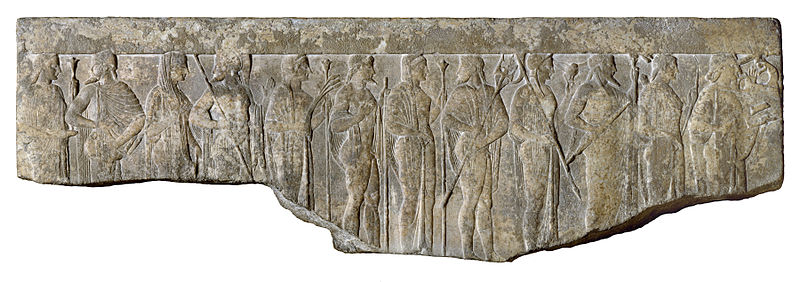
File:Greek_-_Procession_of_Twelve_Gods_and_Goddesses_-_Walters_2340.jpg · Wikimedia Commons · See Wikimedia Commons
Twelve Olympians
Sign in to saveAlso known as Dodekatheon, gods of olympus, The 12 Olympians, 12 Greek Gods and Goddesses, The 12 Olympian Gods
major deities of the Greco-Roman pantheon
The Twelve Olympians are the principal gods and goddesses of ancient Greek religion, including figures like Zeus, Athena, and Apollo who were believed to reside on Mount Olympus. These deities were central to Greek culture and mythology, influencing everything from religious practices to art and literature throughout the ancient world.
AI-generated from the Wikipedia summary — may contain errors.
In the Vinony graph
Within Vinony's link graph, Twelve Olympians is referenced by 1,691 other articles, and connects out to Eris, Homer and Artemis.
Vinony files it under 12 (number), Cultural lists and Mount Olympus.
Its subject is documented across 89 Wikipedia language editions.
Wikidata facts
- Has part
- Hestia
- Image
- Olympians.jpg
Show 3 more facts
- native label
- Δώδεκα θεοί του Ολύμπου
- Commons category
- Twelve Olympians
- topic's main category
- Category:Twelve Olympians
Sources (3)
via Wikidata · CC0
~11 min read
Encyclopedic overview
Fragment of a Hellenistic relief (1st century BC–1st century AD) depicting the twelve Olympians carrying their attributes in procession; from left to right: Hestia (scepter), Hermes (winged cap and staff), Aphrodite (veiled), Ares (helmet and spear), Demeter (scepter and wheat sheaf), Hephaestus (staff), Hera (scepter), Poseidon (trident), Athena (owl and helmet), Zeus (thunderbolt and staff), Artemis (bow and quiver) and Apollo (lyre) from the Walters Art Museum.
In ancient Greek religion and mythology, the twelve Olympians are the major deities of the Greek pantheon, commonly considered to be Zeus, Poseidon, Hera, Demeter, Aphrodite, Athena, Artemis, Apollo, Ares, Hephaestus, Hermes, and either Hestia or Dionysus. They were called Olympians because, according to tradition, they resided on Mount Olympus.
Excerpted from Wikipedia’s “Twelve Olympians” article, available under the CC BY-SA 4.0 licence.
Gallery (12)
Available in 89 languages
- Español
- Français
- Deutsch
- 中文
- 日本語
- Русский
- Português
- Italiano
- العربية
- Afrikaans
- Armenian
- Assamese
- Asturian
- Azerbaijani
- Bahasa Indonesia
- Bangla
- Basque
- be_x_old
Show 70 more
- Belarusian
- Bosnian
- Breton
- Bulgarian
- Burmese
- Catalan
- Croatian
- Czech
- Danish
- Esperanto
- Estonian
- Filipino
- Finnish
- Galician
- Georgian
- Greek
- Hebrew
- Hungarian
- Icelandic
- Ido
- Irish
- Javanese
- Kazakh
- Kurdish
- Latin
- Latvian
- Lithuanian
- Low German
- Luxembourgish
- Macedonian
- Malay
- Manipuri
- Marathi
- Mazanderani
- Nederlands
- Newari
- Northern Frisian
- Norwegian
- Norwegian Nynorsk
- Occitan
- Pashto
- Polski
- Romanian
- rsk
- Serbian
- Serbian (Latin)
- Sicilian
- simple
- Sinhala
- Slovak
- Slovenian
- Svenska
- Tamil
- Tatar
- Tiếng Việt
- Türkçe
- Turkmen
- Ukrainian
- Urdu
- Uzbek
- Veps
- Welsh
- Western Panjabi
- Wu Chinese
- zh_classical
- zh_min_nan
- zh_yue
- فارسی
- ไทย
- 한국어
via Wikidata sitelinks · CC0