Category
page 1Opuntioideae

Austrocylindropuntia
Austrocylindropuntia is a genus of cacti (family Cactaceae) with eight recognized species , which were once included in the genus Opuntia. All are native to South America, although some have been introduced elsewhere.

Pterocactus
Pterocactus (from Greek pteron, "wing", referring to the saucer-shaped seed of these plants) is a genus of the cactus family (Cactaceae), comprising 9 species. All Pterocactus have tuberous roots and are endemic to South and Western Argentina. The genus has been given its own tribe, the Pterocacteae. A molecular phylogenetic analysis placed the genus in the tribe Tephrocacteae.

Pereskiopsis
Pereskiopsis is a genus of cactus (family Cactaceae) in the subfamily Opuntioideae. Unlike typical cacti, it has persistent fleshy leaves. The genus name refers to its resemblance to the genus Pereskia. Most species are found in Mexico south through Guatemala to Honduras, with one species in Bolivia. The incorrect spelling Peireskiopsis has also been used.

Opuntioideae
Opuntioideae is a subfamily of the cactus family, Cactaceae. It contains 15 genera divided into five tribes. The subfamily encompasses roughly 220–250 species, and is geographically distributed throughout the New World from Canada, to Argentina. Members of this subfamily have diverse habits, including small geophytes, hemispherical cushions, shrubs, trees, and columnar cacti consisting of indeterminate branches or determinate terete or spherical segments.

Cumulopuntia
Cumulopuntia is a genus of cactus (family Cactaceae). This is a poorly defined genus, with constant change to what species fall under it and whether it should even be a separate genus from Opuntia, which it is often interchanged with. It was defined by Friedrich Ritter in 1980 by redefining multiple species in Tephrocactus and Opuntia. Still more work needs to be done to circumscribe Cumulopuntia as it stands.

Maihueniopsis
Maihueniopsis (from Greek opsis, "view", referring to its resemblance to the unrelated Maihuenia) is a genus of the cactus family (Cactaceae), containing 18 species.

Airampoa
Airampoa is a South American genus of the cactus family (Cactaceae).
==Species==
Species of the genus Airampoa according to Plants of the World Online :
{| class="wikitable sortable"
|-
! Image !! Scientific name !! Distribution
|-
|120px ||Airampoa corrugata ||Argentina
|-
|120px ||Airampoa erectoclada ||Argentina
|-
|120px ||Airampoa soehrensii ||Argentina, Bolivia, Chile, Peru
|-
|120px ||Airampoa tilcarensis || Argentina (Jujuy)
|-
|}

Consolea
Consolea is a genus of cactus, named after Italian botanist Michelangelo Console. Members of the genus are native to the West Indies and Florida in the United States. Members of this genus consist of trees up to 10 m in height; they are dioecious or subdioecious.

Austrocylindropuntia subulata
species of plant

Austrocylindropuntia floccosa
species of plant

Austrocylindropuntia vestita
species of plant

Austrocylindropuntia cylindrica
species of plant
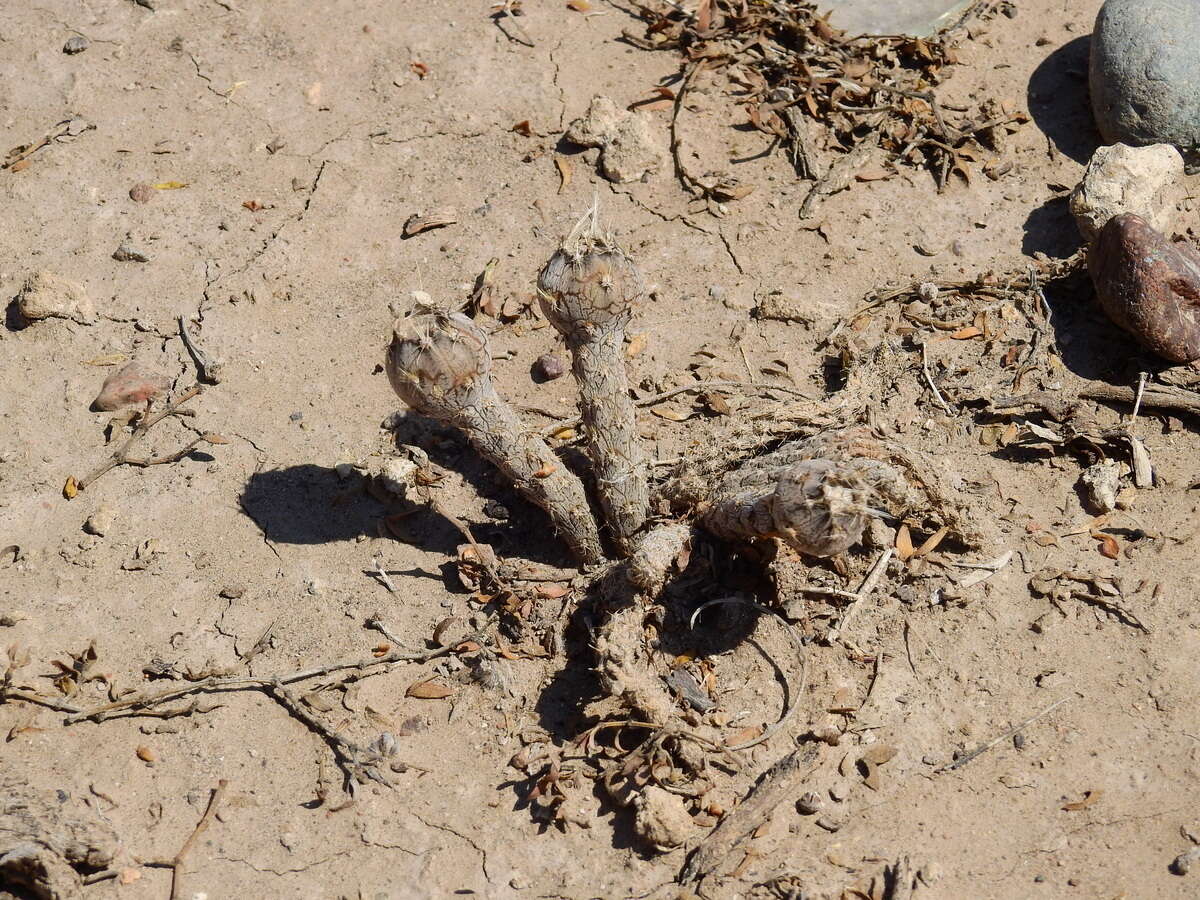
Pterocactus tuberosus
species of plant

Consolea moniliformis
species of plant
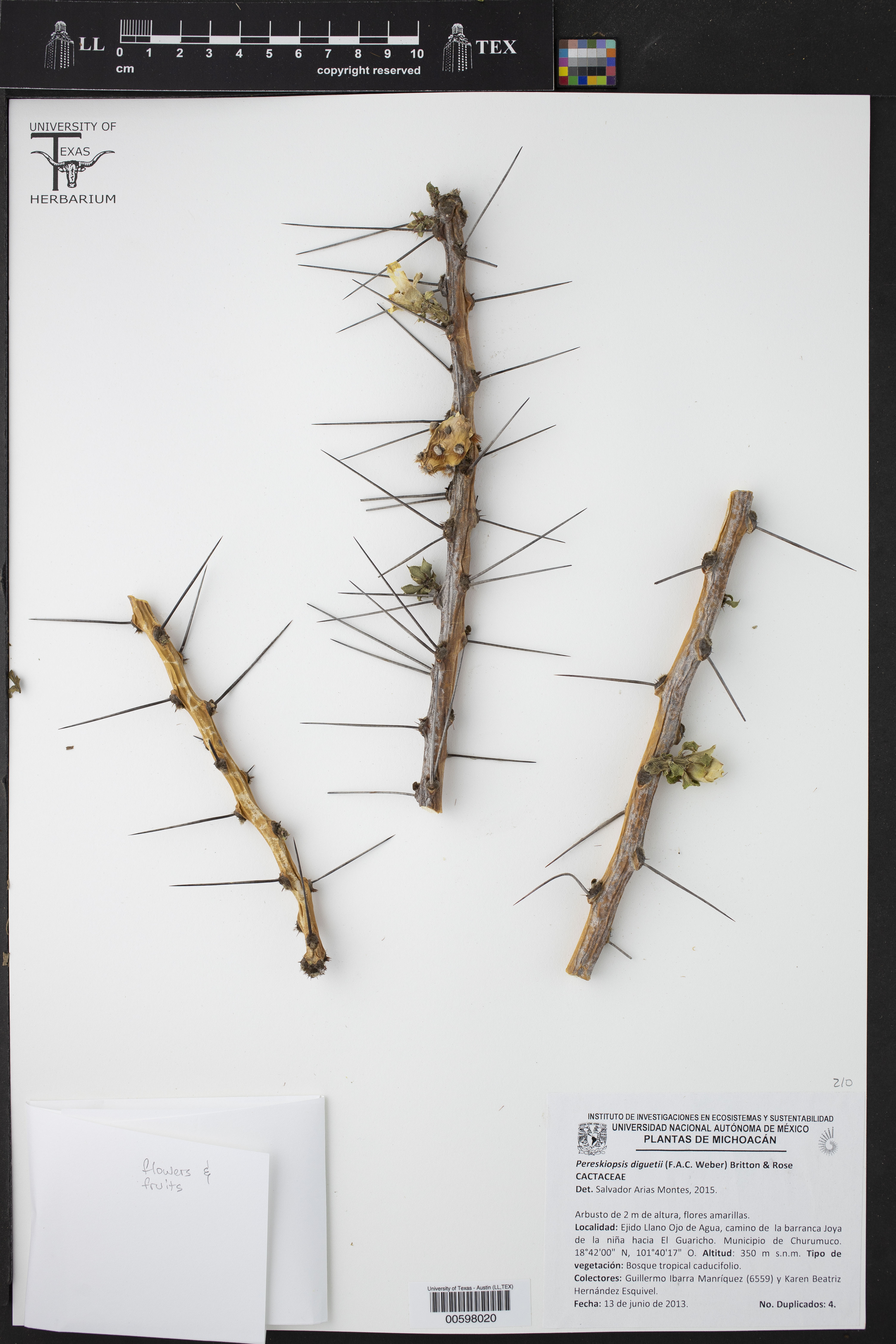
Pereskiopsis diguetii
species of plant
Micropuntia pulchella
Micropuntia is a monotypic genus of cactus. Its only species is Micropuntia pulchella, synonym Grusonia pulchella. The species is also known as sagebrush cholla. It is a tuberous species of opuntioid cactus from the Great Basin Desert of central Nevada, eastern California and western Utah in the United States.
Consolea millspaughii subsp. corallicola
species of cactus

Corynopuntia
REDIRECT Grusonia
Miqueliopuntia
Miqueliopuntia is a monotypic genus of cactus in the Cactaceae family, containing a single species, Miqueliopuntia miquelii , which is native to the Chilean coasts of South America.
Brasiliopuntia
Brasiliopuntia is a genus in the cactus family, Cactaceae. It contains only one species, Brasiliopuntia brasiliensis.