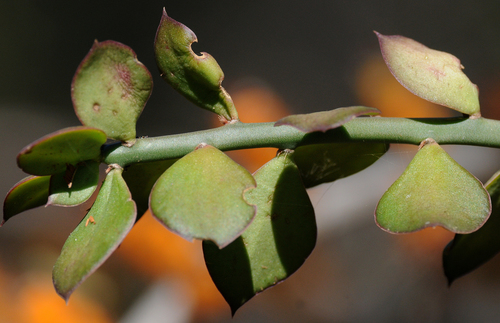
(c) Steven Mlodinow, some rights reserved (CC BY-NC), uploaded by Steven Mlodinow · cc-by-nc
Pereskiopsis
Sign in to savePereskiopsis is a genus of cactus (family Cactaceae) in the subfamily Opuntioideae. Unlike typical cacti, it has persistent fleshy leaves. The genus name refers to its resemblance to the genus Pereskia. Most species are found in Mexico south through Guatemala to Honduras, with one species in Bolivia. The incorrect spelling Peireskiopsis has also been used.
Species
GENUS
- KingdomPlantae
- PhylumTracheophyta
- ClassMagnoliopsida
- OrderCaryophyllales
- FamilyCactaceae
via GBIF · Kew POWO
Museum specimens
- Specimen records
- 28
- With media
- 8
- Family
- Cactaceae
- Collections
- INECOL, CIIDIR-IPN, CAS, IBUNAM, MICH, UCR
- Recorded in
- Mexico, Guatemala, Brasil, Mexique
Wikidata facts
- Instance of
- taxon
- Image
- Pereskiopsis chapistle - Britton.jpg
Show 7 more facts
- taxon name
- Pereskiopsis
- taxon rank
- genus
- Commons category
- Pereskiopsis
- taxonomic type
- Pereskiopsis porteri
- topic's main category
- Category:Pereskiopsis
- taxon common name
- 麒麟掌属
Sources (1)
via Wikidata · CC0
~4 min read
Encyclopedic overview
7 sectionsContents
- Description
- Taxonomy
- Phylogeny
- Species
- Distribution
- Cultivation
- References
Pereskiopsis is a genus of cactus (family Cactaceae) in the subfamily Opuntioideae. Unlike typical cacti, it has persistent fleshy leaves. The genus name refers to its resemblance to the genus Pereskia. Most species are found in Mexico south through Guatemala to Honduras, with one species in Bolivia. The incorrect spelling Peireskiopsis has also been used.
==Description== Species of Pereskiopsis do not have the typical appearance of most cacti, including those in the subfamily Opuntioideae to which it belongs, since they have persistent fleshy leaves. They mostly have a shrubby or treelike growth habit, although some scramble or climb. Their stems have a round cross section and are not divided into segments. Their leaves are flat, succulent and generally long-lasting, and of various shapes, including elliptical and almost round. The characteristic areoles of cacti are present, and usually have glochids marking them as members of the Opuntioideae as well as needle-like spines. Their flowers resemble those of the genus Opuntia, with petals that open widely during the day. The fruits, which have few seeds, are fleshy and often have glochids.
Excerpted from Wikipedia’s “Pereskiopsis” article, available under the CC BY-SA 4.0 licence.