Category
page 1Organizational behavior
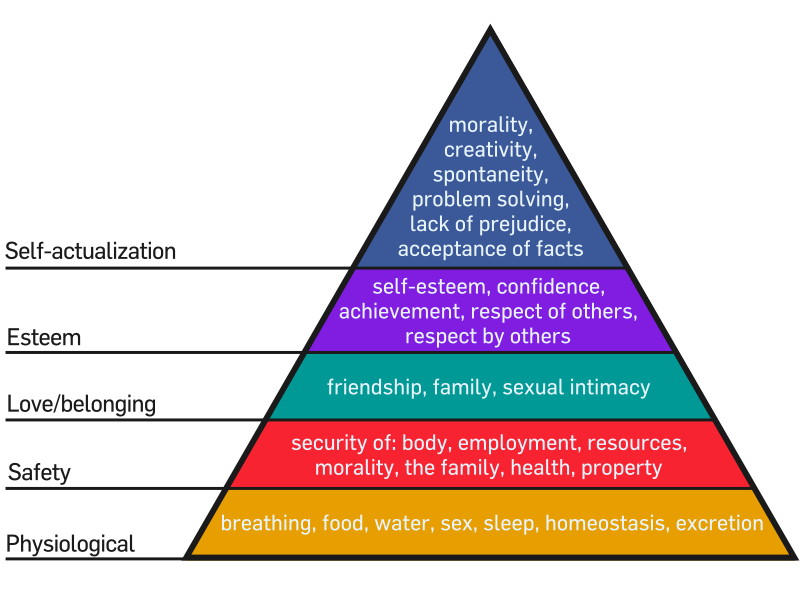
Maslow's hierarchy of needs
theory in developmental psychology proposed by Abraham Maslow, comprising a five-tier model of human needs: physiological, safety, love and belonging, esteem, and self-actualization

conformity
Conformity or conformism is the act of matching attitudes, beliefs, and behaviors to group norms, politics or being like-minded. Norms are implicit, specific rules, guidance shared by a group of individuals, that guide their interactions with others. People often choose to conform to society rather than pursue personal desires – because it is often easier to follow the path others have already made than to forge a new one. Thus, conformity is sometimes a product of group communication. This tendency to conform occurs in small groups and/or in society as a whole and may result from subtle uncon

occupational burnout
type of work-related stress, with symptoms characterized by feelings of energy depletion or exhaustion; increased mental distance from one’s job, or feelings of negativism or cynicism related to one's job; and reduced professional efficacy

collaboration
thumb|Catalan castellers collaborate, working together with a shared goal.
anti-pattern
An anti-pattern is a solution to a class of problem which may be commonly used but is likely to be ineffective or counterproductive. The term, coined in 1995 by Andrew Koenig, was inspired by the book Design Patterns which highlights software development design patterns that its authors consider to be reliable and effective.
A paper in 1996 presented by Michael Ackroyd at the Object World West Conference described anti-patterns. It was, however, the 1998 book AntiPatterns that both popularized the idea and extended its scope beyond the field of software design to include software architecture
Theory X and Theory Y
theories of human motivation
organizational behavior studies
study of human behavior in organizational settings
job satisfaction
attitude of a person towards work
Parkinson's law of triviality
focusing on what is irrelevant but easy to understand
workplace bullying
harmful mistreatment of others in workplace
ERG theory
theory
Garbage can model
theory of organizational decison-making
span of control
the ability of one person
managerial grid model
behavioral leadership model
Fiedler contingency model
business and management theory
appreciative inquiry
organizational model that seeks to engage stakeholders in self-determined change
cultural intelligence
ability to function in diverse settings
organization climate
employees' collective appraisal of the organizational work environment
workplace democracy
application of democratic principles to places of work

employee engagement
relationship between employees and their jobs
organizational commitment
concept in organizational behaviour and industrial psychology
satisficing
Satisficing is a decision-making strategy or cognitive heuristic that entails searching through the available alternatives until an acceptability threshold is met, without necessarily maximizing any specific objective. The term satisficing, a portmanteau of satisfy and suffice, was introduced by Herbert A. Simon in 1956, although the concept was first posited in his 1947 book Administrative Behavior. Simon used satisficing to explain the behavior of decision makers under circumstances in which an optimal solution cannot be determined. He maintained that many natural problems are characterized
workplace politics
interpersonal interactions within the office
Job characteristic theory
theory of work design
work design
core function of Human Resource Management
Team effectiveness
a team's ability to accomplish their goals or objectives
Jeffrey Pfeffer
American academic
The Tyranny of Structurelessness
1972 essay by Jo Freeman
informal organization
social structure that governs how people work together
Organizational citizenship behavior
a person's voluntary commitment within an organization or company
organizational studies
sub-discipline of sociology which deals with organizations
boreout
thumb|right|Office workers in a cubicle setting
organizational behavior management
subdiscipline of applied behavior analysis
Behavior-based safety
System used in industry to eliminate or minimize exposure to hazards
organizational justice
concept
Performance improvement
business improvement to increase organizational effectiveness and efficiency, and enhance the ability of the organization to deliver goods and or services
Maslach Burnout Inventory
Test to assess the burn-out experience of a person
industry self-regulation
process whereby members of an industry, trade or sector of the economy monitor and influence their own adherence to legal, ethical, or safety standards