Category
page 1Otology

eardrum
In the anatomy of humans and various other tetrapods, the eardrum, also called the tympanic membrane or myringa, is a thin, cone-shaped membrane that separates the external ear from the middle ear. Its function is to transmit changes in pressure of sound from the air to the ossicles inside the middle ear, and thence to the oval window in the fluid-filled cochlea. The ear thereby converts and amplifies vibration in the air to vibration in cochlear fluid. The malleus bone bridges the gap between the eardrum and the other ossicles.
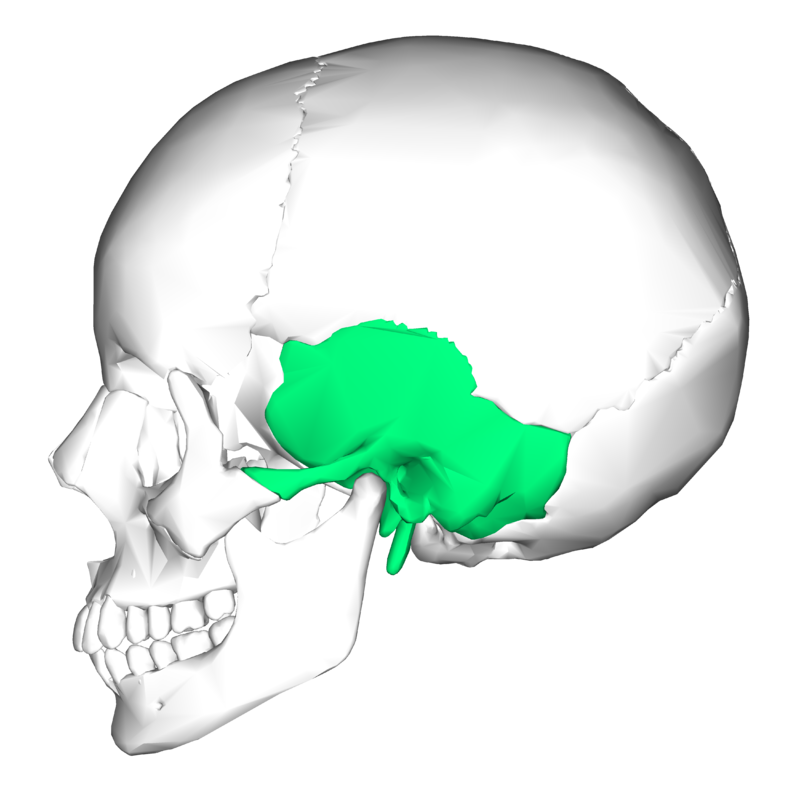
temporal bone
bones situated at the sides and base of the skull, and lateral to the temporal lobes of the cerebrum

malleus
The malleus, or hammer, is a hammer-shaped small bone or ossicle of the middle ear. It connects with the incus, and is attached to the inner surface of the eardrum. The word is Latin for 'hammer' or 'mallet'. It transmits the sound vibrations from the eardrum to the incus (anvil).

hearing aid
small sound amplifiers worn in the ear (ITE) to compensate for hearing loss
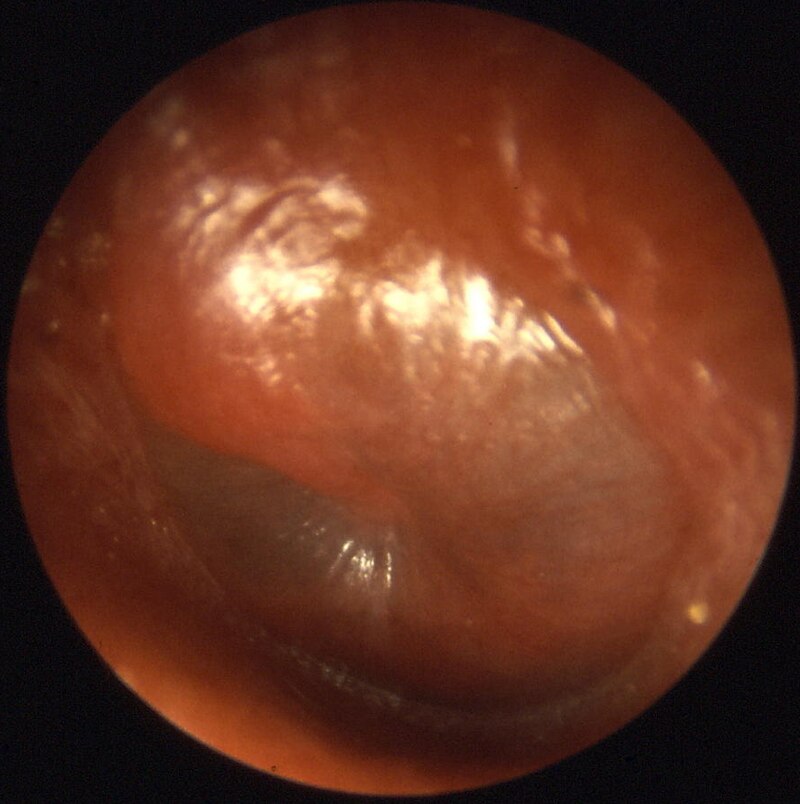
otitis media
otitis, processo that involves inflammation and accumulation of fluid of the middle ear
cochlea
thumb|3D model of cochlea and semicircular canals
The cochlea is the part of the inner ear involved in hearing. It is a spiral-shaped cavity in the bony labyrinth, in humans making 2.75 turns around its axis, the modiolus. A core component of the cochlea is the organ of Corti, the sensory organ of hearing, which is distributed along the partition separating the fluid chambers in the coiled tapered tube of the cochlea.

incus
The incus (: incudes) or anvil in the ear is one of three small bones (ossicles) in the middle ear. The incus receives vibrations from the malleus, to which it is connected laterally, and transmits these to the stapes medially. The incus is named for its resemblance to an anvil ().
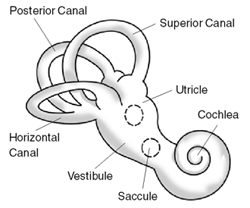
Meniere's disease
disorder of the inner ear, characterized by potentially severe and incapacitating episodes of vertigo, tinnitus, hearing loss, and a feeling of fullness in the ear

stapes
The stapes or stirrup is a bone in the middle ear of humans and other tetrapods which is involved in the conduction of sound vibrations to the inner ear. This bone is connected to the oval window by its annular ligament, which allows the footplate (or base) to transmit sound energy through the oval window into the inner ear. The stapes is the smallest and lightest bone in the human body, and is so-called because of its resemblance to a stirrup ().

middle ear
part of the ear that lies between the eardrum and the oval window

inner ear
innermost part of the vertebrate ear

Eustachian tube
tube found in the middle ear which equalises pressure and drains mucus, connecting the middle ear to the throat

cochlear implant
prosthesis used for severe and profound hearing loss

auditory ossicle
The ossicles (also called auditory ossicles) are three irregular bones in the middle ear of humans and other mammals, and are among the smallest bones in the human body. Although the term "ossicle" literally means "tiny bone" (from ) and may refer to any small bone throughout the body, it typically refers specifically to the malleus, incus and stapes ("hammer, anvil, and stirrup") of the middle ear.
auditory system
sensory system used for hearing

audiology
alt=Image showing an audiologist testing the hearing of a patient inside a hearing booth and using an audiometer|thumb|upright=1.3|Audiological exam

outer ear
the outer portion of the ear which includes the auricle and the ear canal and leads to the eardrum
organ of Corti
type of mechanoreceptor

mastoiditis
Mastoiditis is the result of an infection that extends to the air cells of the skull behind the ear. Specifically, it is an inflammation of the mucosal lining of the mastoid antrum and mastoid air cell system inside the mastoid process. The mastoid process is the portion of the temporal bone of the skull that is behind the ear. The mastoid process contains open, air-containing spaces. Mastoiditis is usually caused by untreated acute otitis media (middle ear infection) and used to be a leading cause of child mortality. With the development of antibiotics, however, mastoiditis has become quite r

otosclerosis
Otosclerosis is a condition of the middle and inner ear where portions of the dense enchondral layer of the bony labyrinth]] remodel into one or more lesions of irregularly-laid spongy bone. As the lesions reach the stapes the bone is resorbed, then hardened (sclerotized), which limits its movement and results in hearing loss, tinnitus, vertigo or a combination of these. The term otosclerosis is something of a misnomer: much of the clinical course is characterized by lucent rather than sclerotic bony changes, so the disease is also known as otospongiosis.
semicircular canal
tube located inside the ear

hyperacusis
Hyperacusis is an increased sensitivity to sound and a low tolerance for environmental noise. Definitions of hyperacusis can vary significantly; it often revolves around damage to or dysfunction of the stapes bone, stapedius muscle or tensor tympani. It is often categorized into four subtypes: loudness, pain (also called noxacusis), annoyance, and fear. It can be a highly debilitating hearing disorder.
external ear canal
tube running from the outer ear to the middle ear
tympanic cavity
small cavity surrounding the bones of the middle ear

cholesteatoma
Cholesteatoma is a destructive and expanding growth consisting of keratinizing squamous epithelium in the middle ear and/or mastoid process. Cholesteatomas are not cancerous as the name may suggest, but can cause significant problems because of their erosive and expansile properties. This can result in the destruction of the bones of the middle ear (ossicles), as well as growth through the base of the skull into the brain. They often become infected and can result in chronically draining ears. Treatment almost always consists of surgical removal.
otalgia
pain in the ear
bone conduction
conduction of sound to the inner ear through bones other than the ossicles of the middle ear

otology
thumb|Ear inspection
perforated eardrum
an injury leading to a hole in the eardrum
hearing range
range of frequencies that can be heard by humans or other animals

tympanometry
Tympanometry is an acoustic evaluation of the condition of the middle ear eardrum (tympanic membrane) and the conduction bones by creating variations of air pressure in the ear canal.
sensorineural hearing loss
type of hearing loss
cochlear nerve
nerve carrying auditory information from the inner ear to the brain
patulous eustachian tube
eustachian tube disorder
internal ear canal
canal within the temporal bone

Myringotomy
A myringotomy is a surgical procedure in which an incision is created in the eardrum (tympanic membrane) to relieve pressure caused by excessive buildup of fluid, or to drain pus from the middle ear. A tympanostomy tube may be inserted through the eardrum to keep the middle ear aerated for a prolonged time and to prevent reaccumulation of fluid. Without the insertion of a tube, the incision usually heals spontaneously within two to three weeks. Depending on the type, the tube is either naturally extruded in 6 to 12 months or removed during a minor procedure.
neurotology
Neurotology or neuro-otology is a subspecialty of otolaryngology—head and neck surgery, also known as ENT (ear, nose, and throat) medicine. Neuro-otology is closely related to otology, clinical neurology and neurosurgery.
mastoid cell
air-filled cavities in the temporal bone
spiral ganglion
anatomical structure
cochlear duct
anatomic element
auditory brainstem response
process
tympanic duct
one of the perilymph-filled cavities in the human inner ear
mastoid antrum
air space in the petrous portion of the temporal bone
mastoid part of the temporal bone
Posterior part of the temporal bone
cochlear nuclei
two cranial nerve nuclei of the human brainstem
conductive hearing loss
medical condition
mastoidectomy
A mastoidectomy is a procedure performed to remove the mastoid air cells near the middle ear. The procedure is part of the treatment for mastoiditis, chronic suppurative otitis media or cholesteatoma. Additionally, it is sometimes performed as part of other procedures, such as cochlear implants, or to access the middle ear.
evolution of mammalian auditory ossicles
evolutionary event in which bones in the jaw of reptiles were co-opted to form part of the hearing apparatus in mammals
Tullio phenomenon
sound-induced vertigo
Rudolf Goldschmidt
German engineer (1876-1950)
Unterberger test
test used in otolaryngology to help assess whether a patient has a vestibular pathology
computational audiology
branch of audiology that employs techniques from mathematics and computer science to improve clinical treatments and scientific understanding of the auditory system
neuronal encoding of sound
representation of auditory sensation and perception in the nervous system
auditory brainstem implant
hearing aid and medical implant
olivocochlear system
component of the auditory system