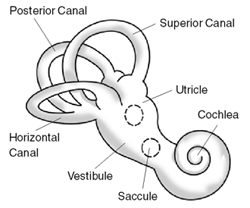
Meniere's disease
Also known as Meniere disease, Ménière's disease, Meniere's vertigo, Otogenic vertigo, Mnire's vertigo, Meniere's Syndrome, MD
disorder of the inner ear, characterized by potentially severe and incapacitating episodes of vertigo, tinnitus, hearing loss, and a feeling of fullness in the ear
Key facts
- Other names
- Ménière's syndrome, idiopathic endolymphatic hydrops
- Pronunciation
- / m eɪ n ˈ j ɛər z /
- Specialty
- Otolaryngology , Neurology
- Symptoms
- Vertigo , tinnitus , hearing loss , fullness in the ear
- Usual onset
- 40s–60s
- Duration
- 20 minutes to few hours per episode
- Causes
- Unknown
- Risk factors
- Family history
- Diagnostic method
- Based on symptoms, hearing test
- Differential diagnosis
- Vestibular migraine , transient ischemic attack
- Treatment
- Low-salt diet, diuretics , corticosteroids , counselling
- Prognosis
- After ~10 years hearing loss and chronic ringing
Article
Ménière's disease (MD) is a disease of the inner ear characterized by potentially severe and incapacitating episodes of vertigo, tinnitus, hearing loss, and a feeling of fullness in the ear. Typically, only one ear is affected initially, but over time, both ears may become involved. Episodes generally last from 20 minutes to a few hours, with varying time between episodes. The hearing loss and ringing in the ears can become constant over time. Ménière's disease was identified in the mid-1800s by Prosper Menière.
The cause of Ménière's disease is unclear, but likely involves both genetic and environmental factors. Several theories exist for why it occurs, including constrictions in blood vessels, viral infections, and autoimmune reactions. About 10% of cases run in families. Symptoms are believed to occur as the result of increased fluid buildup in the labyrinth of the inner ear. Diagnosis is based on the symptoms and a hearing test. Other conditions that may produce similar symptoms include vestibular migraine and transient ischemic attack.