Category
page 1Pagan anti-Gnosticism

Porphyry
3rd-century Greek Neoplatonist philosopher
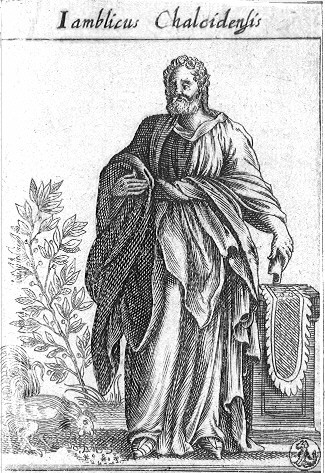
Iamblichus
Iamblichus ( ; ; ; ) was a Syrian Arab Neoplatonist philosopher who determined a direction later taken by Neoplatonism. Iamblichus was also the biographer of the Greek mystic, philosopher, and mathematician Pythagoras. In addition to his philosophical contributions, his is important for the study of the sophists because it preserved about ten pages of an otherwise unknown sophist known as the Anonymus Iamblichi.

Proclus
Proclus Lycius (; 8 February 412 – 17 April 485), called Proclus the Successor (, ), was a Greek Neoplatonist philosopher, one of the last major classical philosophers of late antiquity. He set forth one of the most elaborate and fully developed systems of Neoplatonism and, through later interpreters and translators, exerted an influence on Byzantine philosophy, early Islamic philosophy, scholastic philosophy, and German idealism, especially G. W. F. Hegel, who called Proclus's Platonic Theology "the true turning point or transition from ancient to modern times, from ancient philosophy to

Celsus
thumb|Origen, Contra Celsum ([[Cambridge, 1676 edition)]]

Enneads
The Enneads (; ), fully The Six Enneads, is the collection of writings of the philosopher Plotinus, edited and compiled by his student Porphyry (270). Plotinus was a student of Ammonius Saccas, and together they were founders of Neoplatonism. His work, through Augustine of Hippo, the Cappadocian Fathers, Pseudo-Dionysius the Areopagite and several subsequent Christian and Muslim thinkers, has greatly influenced Western and Near-Eastern thought.
Amelius
Amelius Gentilianus (; ), was a Neoplatonist philosopher and writer of the second half of the 3rd century.
Alexander of Lycopolis
ancient philosopher
The True Word
treatise by Celsus criticising Christianity

Elements of theology
work by Proclus