Category
page 1Pakistani cuisine

samosa
A samosa () () is a fried Indian pastry with a savoury filling that mostly consists of vegetables like spiced potatoes, onions, and peas, but can include cheese such as paneer, meat or even fish. Its name originates from the Middle Persian word sambosag () (meaning 'triangular pastry'). It is made in different shapes, including triangular, cone, or crescent, depending on the region. Samosas are often accompanied by chutney, and have origins in medieval times or earlier. Sweet versions containing traditional Indian flavours or even chocolate are also made. Samosas are popular snacks in South As

ghee
Ghee (Hindi: घी) is a type of clarified butter, originating from India. It is commonly used for cooking, as a traditional medicine, and for Hindu religious rituals.

semolina
Semolina is a coarse flour traditionally made from durum wheat. Its high protein and gluten content make it especially suitable for pasta.
Jalebi
thumb|Jalebi being prepared by a street vendor in Bangalore, India
Jalebi is a common sweet snack in the Indian subcontinent, West Asia and some parts of Africa. It goes by many names, including jilapi, zelepi, jilebi, jilipi, zulbia, zoolbia, jerry, mushabak, '''''z'labia, or zalabia.'''''

tandoor
upright=1.2|thumb|Modern ceramic wood-fired tandoors
.jpg)
dal
In Indian cuisine, dal (also spelled daal or dhal pronunciation: ) are dried, split pulses (e.g., lentils, peas, and beans) that do not require soaking before cooking. India is the largest producer of pulses in the world. The term is also used for various soups prepared from these pulses. These pulses are among the leading staple foods in South Asian countries, and form an important part of the cuisines of the Indian subcontinent.
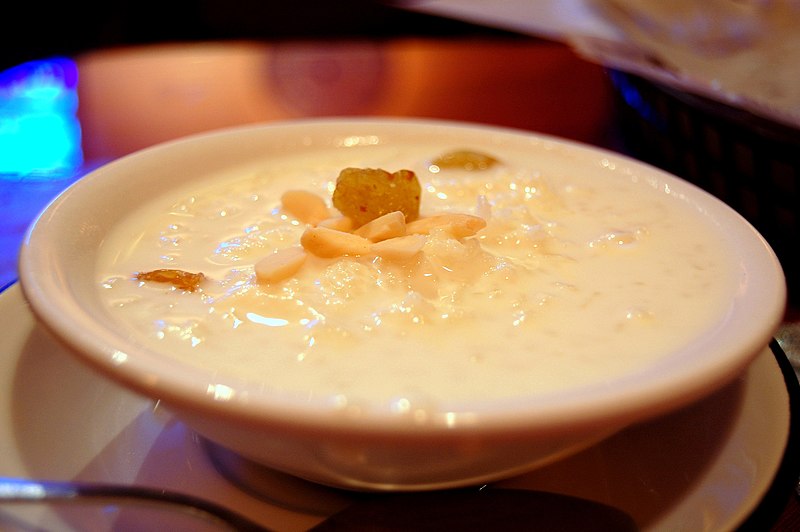
kheer
Kheer, khir, payesh, fenni or payasam is a pudding or porridge (specifically rice pudding) popular in the Indian subcontinent, usually made by boiling milk, sugar or jaggery, and rice. It can be additionally flavoured with dried fruits, nuts, cardamom and saffron. Instead of rice, it may contain cracked wheat, vermicelli (sevai), sago or tapioca (sabudana).

curry powder
spice mix
Pakistani cuisine
culinary traditions of Pakistan

thali
thumb|North Indian cuisine|North Indian style vegetarian thali served in a restaurant
laghman
Central Asian noodle dish

Dabbawala
A dabbawala (also spelled dabbawalla or dabbawallah, called tiffin wallah in older sources) is a worker who delivers hot lunches from homes and restaurants to people at work in India and Pakistan, especially in Mumbai and Karachi. The dabbawalas constitute a lunchbox delivery and return system for workers in Mumbai and Karachi. The lunchboxes are picked up in the late morning, delivered predominantly using bicycles and railway trains, and returned empty in the afternoon.
Aush
Aush ( ; ), properly romanized as '''''', is a variety of thick soup, usually served hot. It is part of Iranian cuisine and Afghan cuisine, and is also found in Azerbaijani, Turkish, and South Caucasian cuisines.
Dahi vada
Indian snack
Dastarkhān
A dastarkhān (Persian / Urdu: دسترخوان, , , , , , , , ) or dastarkhwān is the name used across Central Asia and South Asia to refer to the traditional dining space where food is eaten. The term is a word of Persian origin meaning the tablecloth which is spread on the ground, floor, or table as a sanitary surface for food.

khoa
Khoa, khoya, khowa or mawa is a soft cheese widely used in the cuisines of the Indian subcontinent, encompassing India, Nepal, and Pakistan. It is made of either dried whole milk or milk thickened by heating in an open iron pan. It is lower in moisture than typical fresh cheeses such as ricotta. It is made from whole milk instead of whey.

harees
Harees, haresa, hareesa, arizah, harise, jarish, jareesh, (), harisa (), or korkot () is a dish of boiled, cracked, or coarsely-ground cracked wheat or bulgur, mixed with meat and seasoned. Its consistency varies between a porridge and a gruel. Harees is known throughout Armenia where it is served on Easter, and the Arab world, where it is commonly eaten in Arab states of the Persian Gulf in the month of Ramadan, and in Iraq, Lebanon and Bahrain during Ashura by Shia Muslims.
Punjabi cuisine
food from the Punjab region of India and Pakistan
dahi
traditional yogurt or fermented milk product, originating from the Indian subcontinent
Rajma
Rājmā, is a vegetarian dish, originating from the Indian subcontinent, consisting of red kidney beans in a thick gravy with many Indian whole spices, and is usually served over rice, in a meal called Rajma Chawal. It is a part of the regular diet in Northern India, Nepal and Punjab province of Pakistan. The dish developed after the red kidney bean was brought to the Indian subcontinent from Mexico.
Chole bhature
dish notable in Indian and Pakistani cuisine, consisting of poori bread with chana masala. it is considered as heavy lunch or dinner meal option.
yak butter
butter made from the milk of the domesticated yak

rabri
Rabri, rabdi or rabidi (IAST: Rabaḍī) is a sweet, condensed-milk-based dish, originating from the Indian subcontinent, made by boiling milk on low heat for a long time until it becomes dense and changes its colour to off-white or pale yellow. Jaggery, spices, and nuts are added to it to give it flavor. It is chilled and served as dessert. Rabri is the main ingredient in several desserts, such as rasabali, chhena kheeri, and khira sagara.
Mughlai cuisine
"Mughal" style of cooking
Dum Aloo
potato dish
tikka
type of Indian or Pakistani food

Malai
Malai (Hindi: मलाई) is a type of clotted cream, originating from the Indian subcontinent. It is used in the cuisine of the Indian subcontinent, especially in sweets from the Indian subcontinent. It is made by heating non-homogenized whole milk to about 80 °C (180 °F) for about one hour and then cooling it. A thick yellowish layer of fat and coagulated proteins forms on the surface, which is skimmed off.
Chaunk
South Asian cooking technique
egg bhurji
South Asian dish of eggs, onions, chilies, and spices
Sindhi cuisine
cuisine of the Sindhi people from Sindh, Pakistan
rice and curry
popular dish in South Asia

Panjiri
Panjiri is a sweet dish from India which is specially prepared for Krishna Janmashtami festival. The sweet panjiri evolved from an Ayurvedic preparation called Panchajīraka.

Ramadan in Pakistan
religious observance in Pakistan
Dum pukht
Cooking technique
green mango chutney
Indian chutney made from unripe mangoes
Kachumber
Kachumber, or cachumber, is a salad dish in South Asian cuisine consisting of fresh chopped tomatoes, cucumbers, onions, unripe mangoes, coriander leaves, lemon juice, and sometimes, chili peppers.
Sindhi biryani
variety of biryani
bun kebab
sandwich originating in Pakistan
Magaj
Maghaz (, Urdu: , ), also known as Bheja (, ), is an offal dish, originating from the Indian subcontinent, popular in Pakistani, Bangladeshi, and Indian cuisine. It is the brain of a cow, goat or sheep served with gravy.
Kashmiri red chilli
variety of chilli pepper
chaiwala
thumb|A chaiwala prepares masala chai on a coal fire in a street of [[Kolkata.]]
A chaiwala (also transliterated as chaiwalah or chaiwallah; , ) is a tea-seller in the Indian subcontinent. They are an integral part of subcontinent culture. Chai is the Hindi and Urdu word for "tea", as in masala chai, and wala indicates the person performing the task, so chaiwala is a street vendor of tea.
Baloch cuisine
food and cuisine of the Baloch people
Sher Berinj
rice pudding
Hazara cuisine
food and cuisine of the Hazara people in central Afghanistan (in the region of Hazarajat) and western Pakistan (Balochistan province)
Kewra
thumb|Bottle of kewra
Pashtun cuisine
cuisine of the Pashtuns
food street
pedestrianised area designated for restaurants and cafes
Dundicut paprika
alt=Dundicut Pepper in Behbahan, Iran|thumb|Dundicut Pepper in Behbahan, [[Iran ]]
alt=Dundicut Pepper in Behbahan, Iran|thumb|Dundicut Pepper in Behbahan, Iran
Dundicut peppers are a variety of small, round (approx. 1/2" to 1" diameter), dark red chili peppers grown in Sindh, in Pakistan, Sikkim in India and Ilam in Nepal. They are a cultivar of either Capsicum frutescens or Capsicum annuum and are also known in Asia as gol lal mirch. Sold dried, Dundicuts are similar in size and flavor to Scotch bonnet peppers, but are not as hot, and are of a different species.
alt=Dundicut Peppe