Category
page 1Parity (mathematics)

parity
property of being an odd or even number
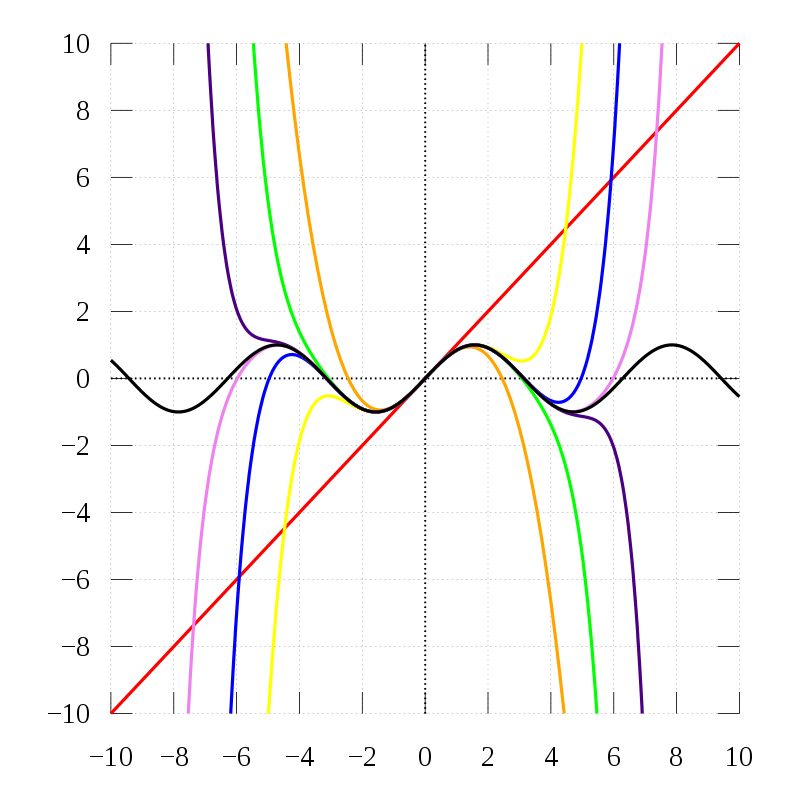
even and odd functions
types of mathematical functions
parity bit
bit added to a binary string to ensure that the sum of the bit values is even or odd; used as an error detecting code
parity of zero
quality of the number zero as either even or odd
bipartite graph
graph whose vertices can be divided into two disjoint and independent sets
Morra
game using hands (like drawing lots)
Grandi's series
the infinite sum of alternating 1 and -1 terms
even number
integer divisible by two
odd number
integer not divisible by two
half-integer
In mathematics, a half-integer is a number of the form
n + \tfrac{1}{2},
where n is an integer. For example,
4\tfrac12,\quad 7/2,\quad -\tfrac{13}{2},\quad 8.5
are all half-integers. The name "half-integer" is perhaps misleading, as each integer n is itself half of the integer 2n. A name such as "integer-plus-half" may be more accurate, but while not literally true, "half integer" is the conventional term. Half-integers occur frequently enough in mathematics and in quantum mechanics that a distinct term is convenient.
Thue–Morse sequence
an infinite binary sequence generated by repeated complementation and concatenation
parity of a permutation
group homomorphism from the symmetric group over a finite set to the two-element group {±1}
division by two
mathematical operation
Kolakoski sequence
infinite sequence of symbols {1,2} that is its own run-length encoding and the prototype for an infinite family of related sequences
singly and doubly even
how many times a number is divisible by 2
Nitrogen rule
principle in mass spectrometry