Category
page 1Particle physics

particle physics
branch of physics dealing with the interactions of subatomic particles
Standard Model
theory of particle physics based on Yang–Mills theory with gauge group SU(3)×SU(2)×U(1) and spontaneous symmetry breaking

electronvolt
In physics, an electronvolt (symbol eV), also written as electron-volt and electron volt, is a unit of measurement equivalent to the amount of kinetic energy gained by a single electron accelerating through an electric potential difference of one volt in a vacuum. When used as a unit of energy, the numerical value of 1 eV expressed in unit of joules (symbol J) is equal to the numerical value of the charge of an electron in coulombs (symbol C). Under the 2019 revision of the SI, this sets 1 eV equal to the exact value
Historically, the electronvolt was devised as a standard unit of measur

antiparticle
thumb|alt=Diagram illustrating the particles and antiparticles of electron, neutron and proton, as well as their "size" (not to scale). It is easier to identify them by looking at the total mass of both the antiparticle and particle. On the left, from top to bottom, is shown an electron (small red dot), a proton (big blue dot), and a neutron (big dot, black in the middle, gradually fading to white near the edges). On the right, from top to bottom, are shown the anti electron (small blue dot), anti proton (big red dot) and anti neutron (big dot, white in the middle, fading to black near the edg
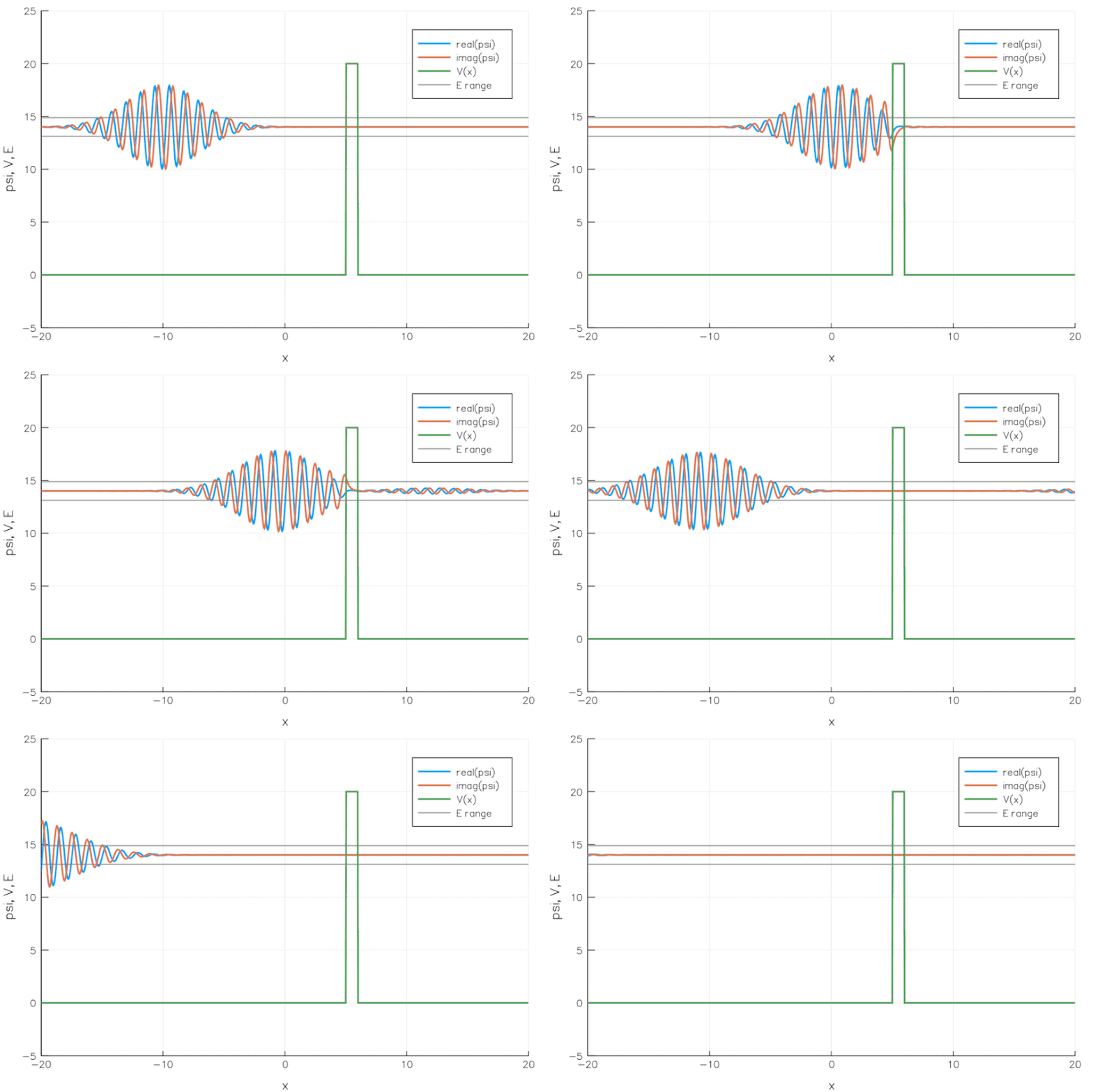
quantum tunneling
quantum mechanical phenomenon

Cherenkov radiation
electromagnetic phenomenon
gauge boson
force carrier, a bosonic particle that carries any of the fundamental interactions of nature, commonly called forces

synchrotron radiation
electromagnetic radiation emitted when charged particles are accelerated radially

pair production
interaction of photon with matter resulting into ejection of electron-positron pair

scattering
thumb|A wine glass in an [[LCD projector's light beam makes the beam scatter.]]
In physics, scattering is a wide range of physical processes where moving particles or radiation of some form, such as light or sound, are forced to deviate from a straight trajectory by localized non-uniformities (including particles and radiation) in the medium through which they pass. In conventional use, this also includes deviation of reflected radiation from the angle predicted by the law of reflection. Reflections of radiation that undergo scattering are often called diffuse reflections and unscattered refle
barn
unit for cross-sectional
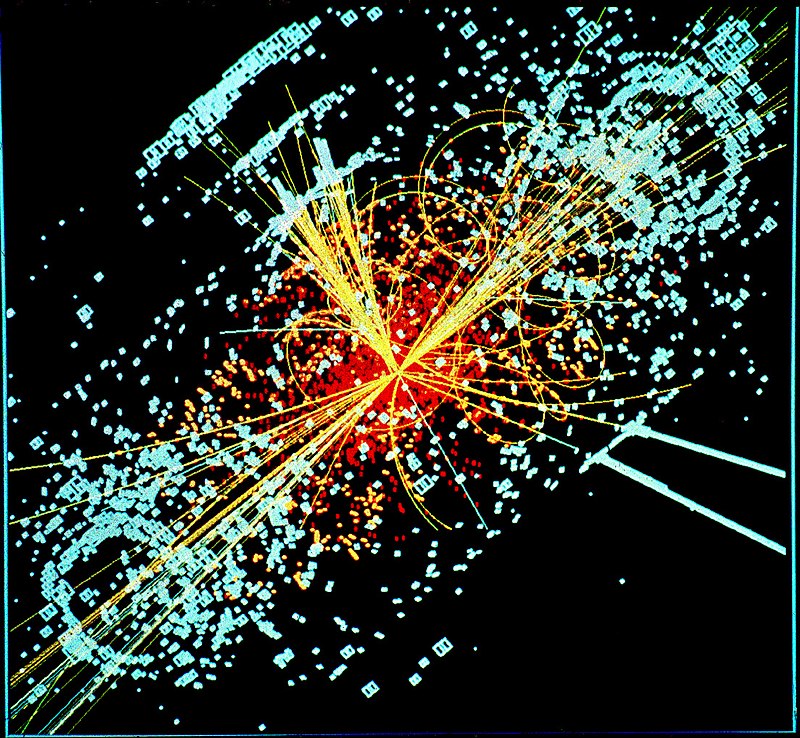
grand unified theory
quantum field theory in which the three gauge groups of the standard model combine into subgroups of a larger gauge group
cross section
measure of probability that a specific process will take place in a collision of two particles
unified field theory
type of physical field theory unifying fundamental forces
proton decay
hypothetical decay process of a nucleon (proton or neutron) into non-nucleons (anything else)
lepton number
conserved quantum number representing the number of leptons minus the number of antileptons in an elementary particle reaction
elastic collision
collision in which kinetic energy is conserved and not dissipated
charge carrier
particle free to move, carrying an electric charge, especially the particles that carry electric charges in electrical conductors
charged particle
particle with a nonzero electric charge
Kaluza–Klein theory
field theory on a spacetime with small, compact extra dimensions beyond the large observed dimensions
baryogenesis
In physical cosmology, baryogenesis (also known as baryosynthesis) is the physical process that is hypothesized to have taken place during the early universe to produce baryonic asymmetry, the observation that only matter (baryons) and not antimatter (antibaryons) is detected in the universe (other than in cosmic ray collisions).
Since it is assumed in cosmology that the particles we see were created using the same physics we measure today, and in particle physics experiments today matter and antimatter are always symmetric, the dominance of matter over antimatter is unexplained.

spallation
thumb|Spallation as a result of impact can occur with or without penetration of the impacting object.
superpartner
In particle physics, a superpartner (also sparticle) is a class of hypothetical elementary particles predicted by supersymmetry, which, among other applications, is one of the well-studied ways to extend the Standard Model of high-energy physics.
CP violation
violation of CP (charge-parity) symmetry in particle physics and cosmology
inelastic collision
collision where energy is lost to heat, so that kinetic energy is not conserved
solar neutrino problem
major discrepancy between measurements of the numbers of neutrinos flowing through the Earth and theoretical models of the solar interior
massless quantum particle
quantum particle having zero rest mass (zero invariant or intrinsic mass)

muonium
alt=Simplified drawing of the muonium atom|thumb|300x300px|A muonium atom
astroparticle physics
branch of particle physics
physics beyond the Standard Model
theories attempting to explain the deficiencies of the Standard Model, Quantum field theory and general relativity
resonance
peak located around a certain energy found in differential cross sections of scattering experiments
force carrier
particles (quanta of a field) that give rise to forces between other particles
Eightfold Way
classification scheme for hadrons
timeline of particle discoveries
Wikimedia timeline article
relativistic quantum mechanics
quantum mechanics taking into account particles near or at the speed of light
quark model
Classification scheme of hadrons
particle decay
spontaneous process of one unstable subatomic particle transforming into multiple other particles

onium
thumb|An illustration of the protonium atom.
An onium (plural: onia) is a bound state of a particle and its antiparticle. These states are usually named by adding the suffix -onium to the name of one of the constituent particles (replacing an -on suffix when present), with one exception for "muonium"; a muon–antimuon bound pair is called "true muonium" to avoid confusion with old nomenclature.
g-factor
Relation between observed magnetic moment of a particle and the related unit of magnetic moment
vector boson
boson with the spin equal to 1
Cherenkov detector
particle detector for Cherenkov radiation
branching fraction
proportion of a nuclear or particle decay going to a given decay mode
particle physics phenomenology
application of theoretical physics to experimental data by making quantitative predictions based upon known theories
ultra-high-energy cosmic ray
cosmic-ray particle with a kinetic energy greater than 1 EeV (10¹⁸ eV)
subcritical reactor
nuclear fission reactor concept
Particle Data Group
organization
elastic scattering
process in nuclear and particle physics
coupling
when two systems are interacting with each other, that is not being independent
Planck scale
scale

particle therapy
fighting cancer with high-energy particles

Particle-induced X-ray emission
Non-destructive elemental analysis technique
leptogenesis
__NOTOC__
neutral particle
particle with no electric charge
G-parity
In particle physics, G-parity is a multiplicative quantum number that results from the generalization of C-parity to multiplets of particles.
electron magnetic dipole moment
spin of an electron
synchrotron light source
particle accelerator designed to produce intense x-ray beams
Askaryan effect
optical phenomenon
inelastic scattering
particle scattering in which kinetic energy is not conserved
transition radiation
contrasts to the Cherenkov radiation
Harari-Schupe preon model
preonic model of sub-quark particle physics