Category
page 1People executed by the Roman Empire

Jesus

Paul the Apostle
Early Christian apostle and missionary (c. AD 5 – c. 64/65)

Seneca
Roman Stoic philosopher, statesman and dramatist (c. 4 BCE–65 CE)

Saint Peter
apostle of Jesus Christ

Vitellius
Aulus Vitellius ( ; 24 September 1520 December 69) was Roman emperor, ruling for eight months from 19 April to 20 December AD 69. Vitellius became emperor following the quick succession of the previous emperors Galba and Otho, in a year of civil war known as the Year of the Four Emperors. Vitellius added the honorific title Germanicus to his name instead of Caesar upon his accession. Like his predecessor, Otho, Vitellius attempted to rally public support to his cause by honoring and imitating Nero who remained popular in the empire.

Sixtus II
Bishop of Rome from 257 to 258

Didius Julianus
emperor of ancient Rome (193 CE)

Macrinus
Marcus Opellius Macrinus (; – June 218) was a Roman emperor who reigned from April 217 to June 218, jointly with his young son Diadumenianus. Born in Caesarea (now called Cherchell, in modern Algeria), in the Roman province of Mauretania Caesariensis to an equestrian family of Berber origins, he became the first emperor who did not hail from the senatorial class and also the first emperor who never visited Rome during his reign. Before becoming emperor, Macrinus served under Emperor Caracalla as a praetorian prefect and dealt with Rome's civil affairs. He later conspired against Caracalla and

Ignatius of Antioch
late 1st/early 2nd century Christian author and Patriarch of Antioch

Licinius
Valerius Licinianus Licinius (; Greek: Λικίνιος; c. 265 – 325) was Roman emperor from 308 to 324. For most of his reign, he was the colleague and rival of Constantine I, with whom he co-authored the Edict of Milan that granted official toleration to Christians in the Roman Empire. He was finally defeated at the Battle of Chrysopolis (AD 324), and was later executed on the orders of Constantine.

Justin Martyr
2nd century CE Christian apologist and martyr

Saint Sebastian
Christian saint and martyr (256–288)
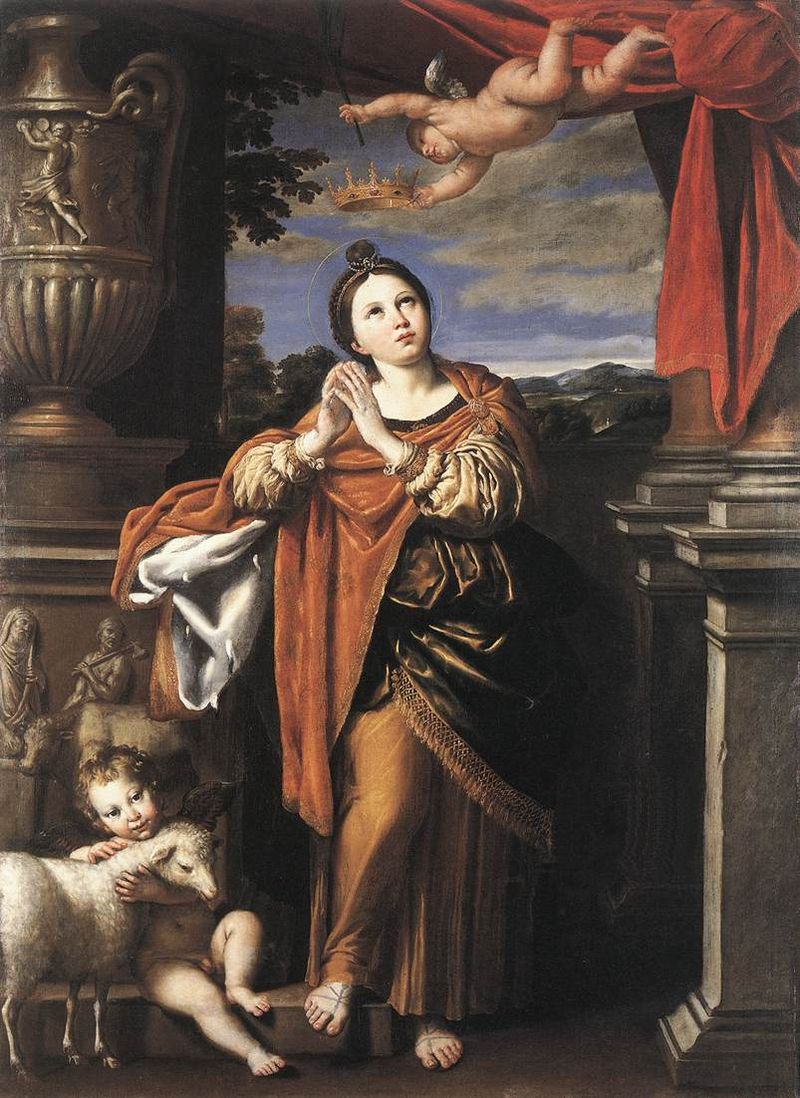
Agnes of Rome
Christian martyr

Polycarp
Polycarp (; , Polýkarpos; ; AD 69 155) was a Christian bishop of Smyrna. According to the Martyrdom of Polycarp, he died a martyr, bound and burned at the stake, then stabbed when the fire failed to consume his body. Polycarp is regarded as a saint and Church Father in the Eastern Orthodox Church, the Catholic Church, Oriental Orthodox Churches, Lutheranism, and Anglicanism.

Gratian
Gratian (; ; 18 April 359 – 25 August 383) was emperor of the Western Roman Empire from 367 to 383. The eldest son of Valentinian I, Gratian was raised to the rank of Augustus as a child and inherited the West after his father's death in 375. He nominally shared the government with his infant half-brother Valentinian II, who was also acclaimed emperor in Pannonia on Valentinian's death. The East was ruled by his uncle Valens, who was later succeeded by Theodosius I.

Diadumenian
Diadumenian ( ; ; 14September 208 – June 218) was the son of the Roman emperor Macrinus and served as his co-ruler for a brief time in 218. His mother, Macrinus' wife, is called Nonia Celsa in the unreliable , though this name may have been fictional. Diadumenian became in May 217, shortly after his father's accession to the imperial throne. Elagabalus, a relative of the recently deceased Caracalla, revolted in May of the following year, and Diadumenian was elevated to co-emperor. After Macrinus was defeated in the Battle of Antioch on 8 June 218, Diadumenian was sent to the court of Artabanus

Saint Cecilia
Roman Catholic saint, martyr and patron saint of music
%20MET%20DT5196.jpg)
Constans
Flavius Julius Constans ( 323 – 350), also called Constans I, was Roman emperor from 337 to 350. He held the imperial rank of caesar from 333, and was the youngest son of Constantine the Great.

Messalina
Valeria Messalina (; ) was the third wife of Roman emperor Claudius. She was a paternal cousin of Emperor Nero, a second cousin of Emperor Caligula, and a great-grandniece of Emperor Augustus. A powerful and influential woman with a reputation for promiscuity, she allegedly conspired against her husband and was executed on the discovery of the plot. Her notorious reputation may have resulted from political bias, but works of art and literature have perpetuated it into modern times.

Anthemius
Procopius Anthemius (; died 11 July 472) was the Western Roman emperor from 467 to 472. Born in the Eastern Roman Empire, Anthemius quickly worked his way up the ranks. He married into the Theodosian dynasty through Marcia Euphemia, daughter of Eastern emperor Marcian. He soon received a significant number of promotions to various posts, and was presumed to be Marcian's planned successor. However, Marcian's sudden death in 457, together with that of Western emperor Avitus, left the imperial succession in the hands of Aspar. He instead appointed Leo, a low-ranking officer, to the Eastern throne

Akiva ben Joseph
Jewish scholar and sage (c. 50 – c.135)

Stilicho
Stilicho (; – 22 August 408) was a military commander in the Roman army who, for a time, became the most powerful man in the Western Roman Empire. He was partly of Vandal origins and married to Serena, the niece of emperor Theodosius I. He became guardian for the underage Honorius. After years of struggle against barbarian and Roman enemies, political and military disasters finally allowed his enemies in the court of Honorius to remove him from power. His fall culminated in his arrest and execution in 408.

Magnus Maximus
late 4th-century Roman emperor of Britain and usurper of the West

Constantine III
Western Roman Emperor from 407 to 411

Apollodorus of Damascus
2nd century Syrian Roman architect and engineer
Novatian
Novatian (Greek: , , ) was a scholar, priest, and theologian. He is considered by the Catholic Church to have been an antipope between 251 and 258. Some Greek authors give his name as Novatus, who was an African presbyter.

Joannes
Joannes or Johannes (; died 425) was Western Roman emperor from 423 to 425.
Martinianus
early 4th-century Roman emperor
%2001.jpg)
Sejanus
Lucius Aelius Sejanus ( – 18 October AD 31), commonly known as Sejanus (), was a Roman soldier and confidant of the Roman Emperor Tiberius. Of the Equites class by birth, Sejanus rose to power as prefect of the Praetorian Guard, the imperial bodyguard, of which he was commander from AD 14 until his execution for treason in AD 31.

Claudia Octavia
daughter of Roman Emperor Claudius and wife of Emperor Nero
Eugenius
Eugenius (died 6 September 394) was a Western Roman emperor from 392 to 394, unrecognized by the Eastern Roman emperor Theodosius I. While Christian himself, Eugenius capitalized on the discontent in the West caused by Theodosius' religious policies targeting pagans. He renovated the pagan Temple of Venus and Roma and restored the Altar of Victory after continued petitions from the Roman Senate. Eugenius replaced Theodosius' administrators with men loyal to him. This included pagans, reviving the pagan cause. His army fought the army of Theodosius at the Battle of the Frigidus, where he was ca
Penitent Thief
Christian saint; thief pardoned by Jesus on the cross in Luke 23:39-43

Flavia Maxima Fausta
Roman empress and second wife of Constantine I
.png)
Crispus
Flavius Julius Crispus (; 300 – 326) was the eldest son of the Roman emperor Constantine I, as well as his junior colleague (caesar) from March 317 until his execution by his father in 326. The grandson of the augustus Constantius I, Crispus was the elder half-brother of the future augustus Constantine II and became co-caesar with him and with his cousin Licinius II at Serdica, part of the settlement ending the Cibalensean War between Constantine and his father's rival Licinius I. Crispus ruled from Augusta Treverorum (Trier) in Roman Gaul between 318 and 323 and defeated the navy of Licinius

Bruttia Crispina
Roman empress, consort of Commodus
Constantius Gallus
Junior Roman emperor from 351 to 354

Livilla
Claudia Livia (Classical Latin: CLAVDIA•LIVIA; – AD 31) was the only daughter of Nero Claudius Drusus and Antonia Minor and sister to Roman Emperor Claudius and general Germanicus, and thus paternal aunt of emperor Caligula and maternal great-aunt of emperor Nero, as well as the niece and daughter-in-law of Tiberius. She was named after her grandmother, Augustus' wife Livia Drusilla, and commonly known by her family nickname Livilla ("little Livia"). She was born after Germanicus and before Claudius.

Julia Avita Mamaea
mother of Roman emperor Alexander Severus (died 235)

Julia Soaemias
mother of Roman emperor Elagabalus (180-222)
Cassius Longinus
Syrian/Egyptian Neoplatonist philosopher (c.213–273)
Ptolemy of Mauretania
1st century king of Mauretania
Procopius
4th-century Roman usurper
Simeon of Jerusalem
human biblical figure in Acts 13:1, early bishop of Jerusalem
Cassius Chaerea
assassin of emperor Caligula
Tiberius Gemellus
Julio-Claudian prince, grandson of Emperor Tiberius (19 AD - 37/38 AD) (19-38)

Lucilla
thumb|A female bust, possibly depicting Lucilla, 160-180 AD
Annia Aurelia Galeria Lucilla or Lucilla (7 March 148 or 150 – 182) was the second daughter of Roman emperor Marcus Aurelius and Roman empress Faustina the Younger. She was the wife of her father's co-ruler and adoptive brother Lucius Verus and an elder sister to later emperor Commodus. Commodus ordered Lucilla's execution after a failed assassination and coup attempt when she was about 33 years old.
Flavius Victor
emperor of the Western Roman Empire
Domitius Alexander
usurper of the Roman Empire
Jovinus
Jovinus was a Gallo-Roman senator and claimed to be Roman Emperor (411–413 AD).
Nero Caesar
adopted grandson and heir of the Roman Emperor Tiberius (c. AD 6 - AD 31)
Priscillian
Priscillian (in Latin: Priscillianus; Gallaecia, – Augusta Treverorum, Gallia Belgica, ) was a wealthy nobleman of Roman Hispania who promoted a strict form of Christian asceticism. He became bishop of Ávila in 380. Certain practices of his followers (such as meeting at country villas instead of attending church) were denounced at the Council of Zaragoza in 380. Tensions between Priscillian and bishops opposed to his views continued, as well as political maneuvering by both sides. Around 385, Priscillian was charged with sorcery and executed by authority of the Emperor Maximus. The ascetic mov
Eutropios
chamberlain at the Eastern Roman imperial court and consul in 399 AD
Domitia Lepida Minor
mother of Roman empress Messalina
.jpg)
Locusta
thumbnail|''Locusta testing in Nero's presence the poison prepared for Britannicus'', painting by Joseph-Noël Sylvestre, 1876
Licinius II
Roman caesar from 317 to 324
Drusus Caesar
adopted grandson and heir of the Roman emperor Tiberius (c. 8 AD-33 AD) (7-33)
Fulvia Plautilla
wife of the Roman emperor Caracalla (died 211)

Lucius Antonius Saturninus
1st-century Roman governor, general and usurper
Lusius Quietus
2nd century Roman general and governor of Judaea
Prisca
Roman empress, wife of Emperor Diocletian