Category
page 1Permian paleogeography
.png)
Pangaea
thumb|270x270px|Map of Pangaea around 250 million years ago, at the beginning of the Triassic
Pangaea or Pangea ( ) was a supercontinent that existed during the late Paleozoic and early Mesozoic eras. It assembled from the earlier continental units of Gondwana, Euramerica and Siberia during the Carboniferous period approximately 335 million years ago, and began to break apart about 200 million years ago, at the end of the Triassic and beginning of the Jurassic. Pangaea was C-shaped, with the bulk of its mass stretching between Earth's northern and southern polar regions and surrounded by the s

Laurasia
Laurasia () was the more northern of two large landmasses that formed part of the Pangaea supercontinent from around (Mya), the other being Gondwana. It separated from Gondwana (beginning in the late Triassic period) during the breakup of Pangaea, drifting further north after the split and finally broke apart with the opening of the North Atlantic Ocean 56 Mya. The name is a portmanteau of Laurentia and Eurasia.
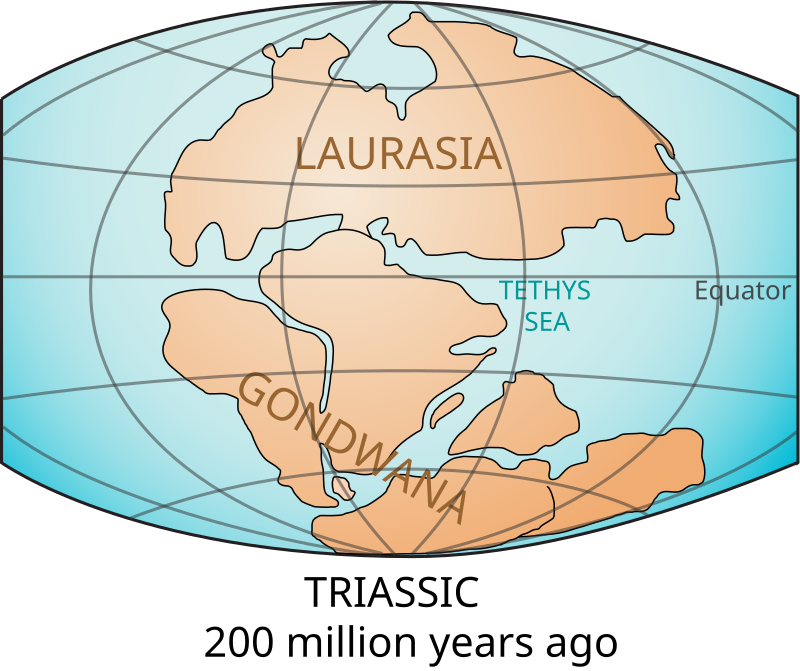
Tethys Ocean
prehistoric ocean
Cimmeria
ancient string of microcontinents that rifted from Gondwana
Cathaysia
thumb|330x330px|Map of the world at the Carboniferous-Permian boundary (~ 300 million years ago) showing Cathaysia (pink)
Cathaysia was a microcontinent or a group of terranes that rifted off Gondwana during the Late Paleozoic. They mostly correspond to the modern territory of China, historically referred to in Europe as Cathay, which was split into the North China and South China blocks.