Category
page 1Personal life

health
Health has a variety of definitions, which have been used for different purposes over time. In general, it refers to physical and emotional well-being, especially that associated with normal functioning of the human body, absent of disease, pain (including mental pain), or injury.

happiness
thumb|upright=1.2|A 93-year-old man from Pichilemu, Chile. His smile and facial expression indicates his happiness.

sadness
thumb|A detail of the 1672 sculpture Entombment of Christ, showing Mary Magdalene crying

jealousy
Jealousy generally refers to the thoughts or feelings of insecurity, fear, and concern over a relative lack of possessions or safety.

hobby
thumb|Le Philatéliste by François Barraud, showing a person collecting postage stamps as a hobby
.jpg)
lust
thumb|262px|Detail: Luxuria (Lust), in The Seven Deadly Sins and the Four Last Things, by [[Hieronymus Bosch]]
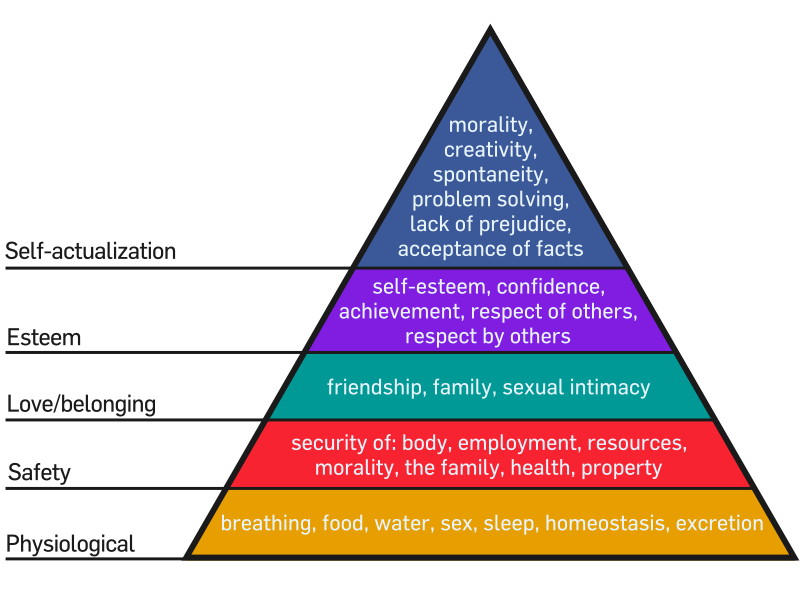
Maslow's hierarchy of needs
theory in developmental psychology proposed by Abraham Maslow, comprising a five-tier model of human needs: physiological, safety, love and belonging, esteem, and self-actualization

frustration
thumb|262px|A frustrated man sitting in a traffic jam

desire
thumb|Désir, sculpture by Aristide Maillol
Desires are states of mind that are expressed by terms like "wanting", "wishing", "longing" or "craving". A great variety of features is commonly associated with desires. They are seen as propositional attitudes towards conceivable states of affairs. They aim to change the world by representing how the world should be, unlike beliefs, which aim to represent how the world actually is. Desires are closely related to agency: they motivate the agent to realize them. For this to be possible, a desire has to be combined with a belief about which action woul
lifestyle
Lifestyle is the interests, opinions, behaviours, and behavioural orientations of an individual, group, or culture. The term "style of life" () was introduced by Austrian psychologist Alfred Adler in his 1929 book, The Case of Miss R., with the meaning of "a person's basic character as established early in childhood". The broader sense of lifestyle as a "way or style of living" has been documented since 1961. Lifestyle is a combination of determining intangible or tangible factors. Tangible factors relate specifically to demographic variables, i.e. an individual's demographic profile, whe

human nature
fundamental characteristics of human beings
affection
thumb|right|200px|Two children showing affection

loyalty
thumb|Schoolchildren reciting the Pledge of Allegiance to the United States flag
annoyance
Annoyance is an unpleasant mental state that is characterized by irritation and distraction from one's conscious thinking. It can lead to emotions such as frustration and anger. The property of being easily annoyed is called irritability.
personal data
any piece of information about a person that is not publicly known, or that allows identification of that person
everyday life
routine processes in people's daily and weekly cycle
social environment
setting in which people live or something happens, from a social perspective
Pomodoro Technique
time management method
existential crisis
moment when individuals question whether their lives have meaning, purpose, or value, and are negatively impacted by the contemplation

consummation
thumb|240px|Illustration from Tacuinum Sanitatis, a medieval handbook by [[Ibn Butlan on health and wellness]]
The consummation of a marriage, or simply consummation, is the first officially credited act of sexual intercourse following marriage. In many traditions and statutes of civil or religious law, the definition usually refers to penile–vaginal penetration (i.e., heterosexual), and some religious doctrines hold an additional requirement prohibiting contraception. In this sense, "a marriage is consummated only if the conjugal act performed deposits semen in the vagina."
life hack
trick to make life easier
coping
Coping refers to the application of coping mechanisms, conscious and unconscious cognitions that people use to manage unpleasant emotions, stress and anxiety. Coping mechanisms can be adaptive, meaning that they successfully improve the well-being of the person applying them, or maladaptive, meaning they may manage a specific unpleasant emotion, but at the expense of other aspects of one's mental and/or physical health.
== Theories of coping ==
Hundreds of coping strategies have been proposed to explain how people manage stress. However, no universal classification system has been agreed upon.
personal life
course or state of an individual's life

Lebensphilosophie
thumb|Clockwise from top left: Henri Bergson|Bergson, Dilthey, Schopenhauer and Nietzsche.
' (; meaning "philosophy of life'") was a dominant philosophical movement of German-speaking countries in the late 19th and early 20th centuries, which had developed out of German Romanticism. emphasised the meaning, value and purpose of life as the foremost focus of philosophy.
locus of control
degree to which people believe that they, as opposed to external forces, have control over their lives

limerence
right|240px|thumb|''Psyche Revived by Cupid's Kiss'', by [[Antonio Canova, first version 1787–1793]]
self-love
Self-love, defined as "love of self" or "regard for one's own happiness or advantage", has been conceptualized both as a basic human necessity and as a moral flaw, akin to vanity and selfishness, synonymous with amour-propre, conceitedness, egotism, narcissism, et al. However, throughout the 20th and 21st centuries self-love has adopted a more positive connotation through pride parades, Self-Respect Movement, self-love protests, the hippie era, the modern feminist movement (3rd & 4th wave), as well as the increase in mental health awareness that promotes self-love as intrinsic to self-help and
human condition
characteristics and key events that compose the essentials of human existence
morbid jealousy
Psychological disorder
ERG theory
theory
life stance
person's relation with what they accept as being of ultimate importance
comfort object
item used to provide psychological comfort
subjective well-being
self-reported measure of well-being
accusation
An accusation is a statement by one person asserting that another person or entity has done something improper. The person who makes the accusation is an accuser, while the subject against whom it is made is the accused. Whether a statement is interpreted as an accusation may rely on the social environment in which it is made:
sex life
sector of a person's day-to-day life which involves any form of sexual activity.
personal website
web page created by an individual to contain content of a personal nature
hypnopompia
Hypnopompia (also known as hypnopompic state) is the state of consciousness leading out of sleep, a term coined by the psychical researcher Frederic Myers. Its mirror is the hypnagogic state at sleep onset; though often conflated, the two states are not identical and have a different phenomenological character. Hypnopompic and hypnagogic hallucinations are frequently accompanied by sleep paralysis, which is a state wherein one is consciously aware of one's surroundings but unable to move or speak.
quality time
time spent with loved ones which is in some way special
Rowan Robinson
English actress