Category
page 1Philosophical logic

Aristotle
Aristotle (; 384–322 BC) was an ancient Greek philosopher and polymath. His writings cover a broad range of subjects spanning the natural sciences, philosophy, linguistics, economics, politics, psychology, and the arts. As the founder of the Peripatetic school of philosophy in the Lyceum in Athens, he began the wider Aristotelian tradition that followed, which set the groundwork for the development of modern science.

name
thumb|Names of the 2002 Bali bombings victims in [[Indonesia]]
A name is a term used for identification by an external observer. A name can identify a class or category of things, or a single thing, either uniquely, or within a given context. The entity identified by a name is called its referent. A personal name identifies, not necessarily uniquely, a specific individual human. The name of a specific entity is sometimes called a proper name (although that term has a philosophical meaning as well) and is, when consisting of only one word, a proper noun. Other nouns are sometimes called "common

reason
Reason is the capacity to consciously apply logic by drawing valid conclusions from new or existing information, with the aim of seeking truth. It is associated with activities considered characteristic of humans, including philosophy, religion, science, language, and mathematics, and is generally considered a distinguishing ability possessed by humans. The term "reason" is sometimes used to refer to rationality, although the latter is more about its application.
.jpg)
rhetoric
thumb|right|upright=1.25|Painting depicting a lecture in a knight academy, painted by [[Pieter Isaacsz or Reinhold Timm for Rosenborg Castle as part of a series of seven paintings depicting the seven independent arts. This painting illustrates rhetoric.]]
thumb|upright|Jesus was a preacher in 1st-century Judea.

paradox
A paradox is a logically self-contradictory statement or a statement that runs contrary to one's expectation. It is a statement that, despite apparently valid reasoning from true or apparently true premises, leads to a seemingly self-contradictory or a logically unacceptable conclusion. A paradox usually involves contradictory-yet-interrelated elements that exist simultaneously and persist over time. They result in "persistent contradiction between interdependent elements" leading to a lasting "unity of opposites".

definition
thumb|A definition states the meaning of a word using other words. This is sometimes challenging. Common dictionaries contain lexical descriptive definitions, but there are various types of definition – all with different purposes and focuses.

natural language
language naturally spoken by humans, as opposed to "constructed" and "formal" languages

fallacy
A fallacy is the use of invalid or otherwise faulty reasoning in the construction of an argument that may appear to be well-reasoned if unnoticed. The term was introduced in the Western intellectual tradition by the Aristotelian De Sophisticis Elenchis.
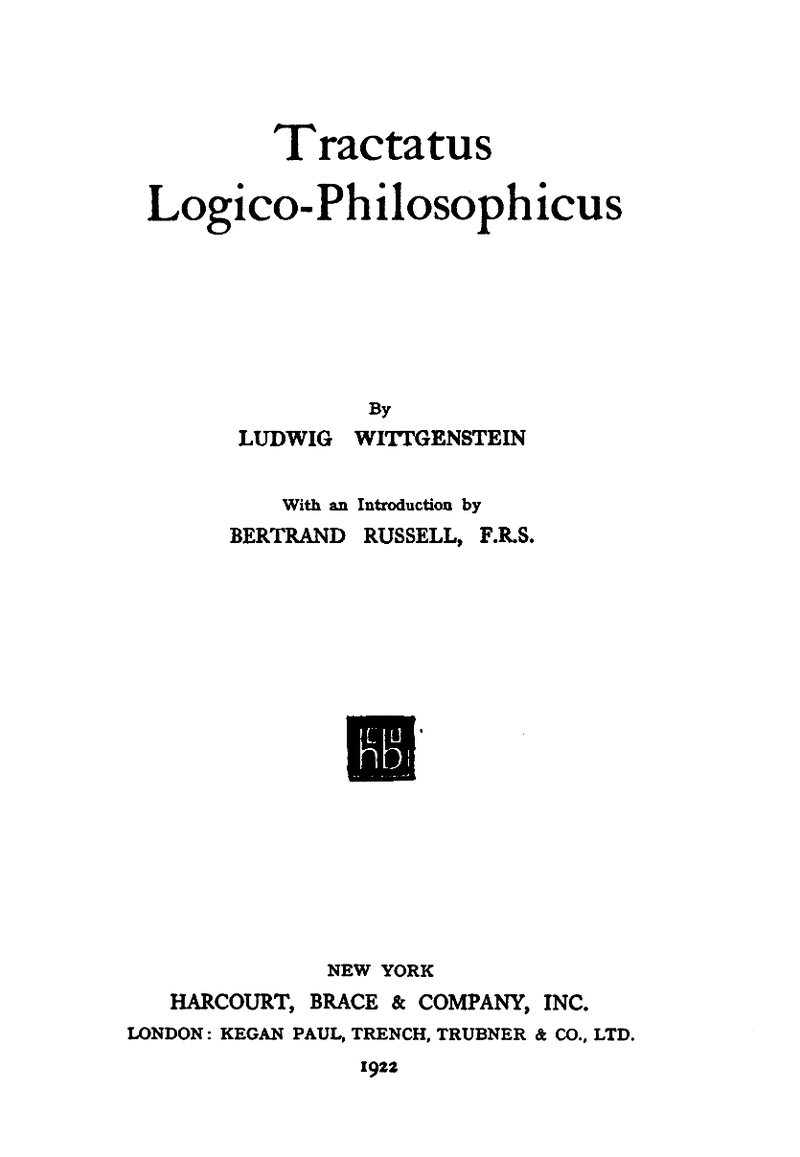
Tractatus Logico-Philosophicus
philosophical work by Wittgenstein

quantifier
logical operator specifying how many entities in the domain of discourse that satisfy an open formula
modal logic
formal logic able to express concepts such as necessity, possibility, provability, obligation, knowledge etc.
circular reasoning
logical fallacy in which the reasoner begins the premise with what they are trying to conclude with

reference
In logic, a reference is a relationship between objects in which one object designates, or acts as a means by which to connect to or link to, another object. The first object in this relation is said to refer to the second object. It is called a name for the second object. The next object, the one to which the first object refers, is called the referent of the first object. A name is usually a phrase or expression, or some other symbolic representation. Its referent may be anything – a material object, a person, an event, an activity, or an abstract concept.
philosophical logic
application of logical methods to philosophical problems
logical consequence
fundamental concept in logic
problem of induction
epistemological question of whether inductive reasoning leads to definitive knowledge understood in the classic philosophical sense
logical truth
statement which is true regardless of the truth or falsity of its constituent parts
infinite regress
philosophical problem
circular definition
self-referential description of meaning
analytic–synthetic distinction
semantic distinction, used primarily in philosophy to distinguish propositions (in particular, statements that are affirmative subject–predicate judgments) into two types: analytic propositions and synthetic propositions
identity of indiscernibles
impossibility for separate objects to have all their properties in common
deontic logic
The field of philosphical logic and a class of formal systems that are concerned with obligation, permission, and related concepts
paraconsistent logic
type of formal logic without explosion principle
dialectical logic
system of laws of thought
logical constant
term in logic
informal fallacy
form of incorrect argument in natural language
type–token distinction
distinction that separates a concept from the objects which are particular instances of the concept
formal fallacy
deductive argument that is invalid due to faulty reasoning, regardless of the truthiness of the conclusion
circular reporting
problem where a piece of information appears to come from multiple independent sources, but in reality comes from only one source
term logic
type of logic whose elements are concepts
inquiry
An inquiry (also spelled as enquiry in British English) is any process that has the aim of augmenting knowledge, resolving doubt, or solving a problem. A theory of inquiry is an account of the various types of inquiry and a treatment of the ways that each type of inquiry achieves its aim.
word sense
one of the meanings of a word
description
Description is any type of communication that aims to make vivid a place, object, person, group, or other physical entity. It is one of four rhetorical modes (also known as modes of discourse), along with exposition, argumentation, and narration.
Sense and reference
mathematical paper by Gottlob Frege

rigour
Rigour (British English) or rigor (American English; see spelling differences) describes a condition of stiffness or strictness. These constraints may be environmentally imposed, such as "the rigours of famine"; logically imposed, such as mathematical proofs which must maintain consistent answers; or socially imposed, such as the process of defining ethics and law.

Kripke semantics
semantics for modal logics
circular reference
chain of logical connections that form a loop
Compossibility
Compossibility is a philosophical concept from Gottfried Wilhelm Leibniz. According to Leibniz, a complete individual thing (for example a person) is characterized by all its properties, and these determine its relations with other individuals. The existence of one individual may negate the possibility of the existence of another. A possible world is made up of individuals that are compossible—that is, individuals that can exist together.
analytic reasoning
ability to look at information and discern patterns

state of affairs
philosophical concept
existential graph
diagrammatic notation for logical expressions proposed by Peirce
Contra principia negantem non est disputandum
Latin phrase
T-schema
The T-schema ("truth schema", not to be confused with "Convention T") is used to check if an inductive definition of truth is valid, which lies at the heart of any realisation of Alfred Tarski's semantic theory of truth. Some authors refer to it as the "Equivalence Schema", a synonym introduced by Michael Dummett.
Association for Symbolic Logic
international organization focused on logic
modal fallacy
type of fallacy in modal logic