Category
page 1Physical optics

refraction
thumb|A ray of light being refracted in a plastic block
In physics, refraction is the redirection of a wave as it passes from one medium to another. The redirection can be caused by the wave's change in speed or by a change in the medium. Refraction of light is the most commonly observed phenomenon, but other waves such as sound waves and water waves also experience refraction. How much a wave is refracted is determined by the change in wave speed and the initial direction of wave propagation relative to the direction of change in speed.

reflection
change in direction of a wavefront at an interface between two different media so that the wavefront returns into the medium from which it originated
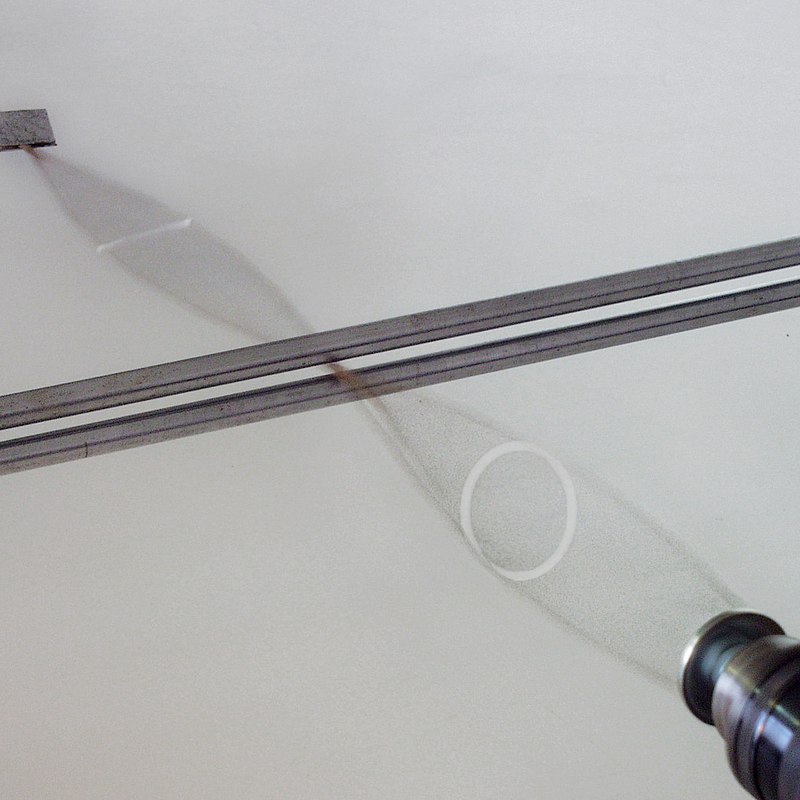
polarization
property of waves that can oscillate with more than one orientation

Total internal reflection
physical phenomenon
Fermat's principle
principle of least time

aperture
thumb|Different apertures of a lens
thumb|In biology, the pupil (appearing as a black hole) of the eye is its aperture and the iris is its diaphragm. In humans, the pupil can constrict to as small as 2 mm (8.3) and dilate to larger than 8 mm (2.1) in some individuals.
thumb|A camera aperture
thumb|Definitions of Aperture in the 1707 Glossographia Anglicana Nova
thumb|Aperture icon
physical optics
branch of optics that studies interference, diffraction, polarization
Brewster's angle
angle of incidence for which all reflected light will be polarized
Fresnel integral
special function defined by an integral
Fresnel equations
equations of light transmission and reflection
Fraunhofer diffraction
far-field diffraction
Gaussian beam
field of radiation (e.g. electromagnetic wave) whose amplitude is described by the Gaussian function
optical path length
term
Airy disk
diffraction pattern in optics
reflection coefficient
measure of wave reflectivity
phase shift
difference between phase angles
Fourier optics
study of classical optics using Fourier transforms

Optical path
path taken by light in traversing a system
transmission coefficient
coefficient describing the amplitude, intensity, or total power of a transmitted wave relative to an incident wave

radius of curvature
concept in optical lens design
coherence length
distance over which a propagating wave maintains a certain degree of coherence
optical vortex
optical phenomenon
coherence time
the time over which a propagating wave (especially a laser or maser beam) may be considered coherent
index ellipsoid
aspect of crystal optics
Fresnel rhomb
Optical prism
Kirchhoff's diffraction formula
Physics formula
Lloyd's mirror
optical setup to obtain interference pattern by reflection
Signal reflection
in signal transmission
frequency selective surface
any thin, repetitive surface designed to reflect, transmit or absorb electromagnetic fields based on the frequency of the field
Transfer-matrix method
Process used in optics and acoustics
Kirchhoff integral theorem
Method to solve scalar wave equation