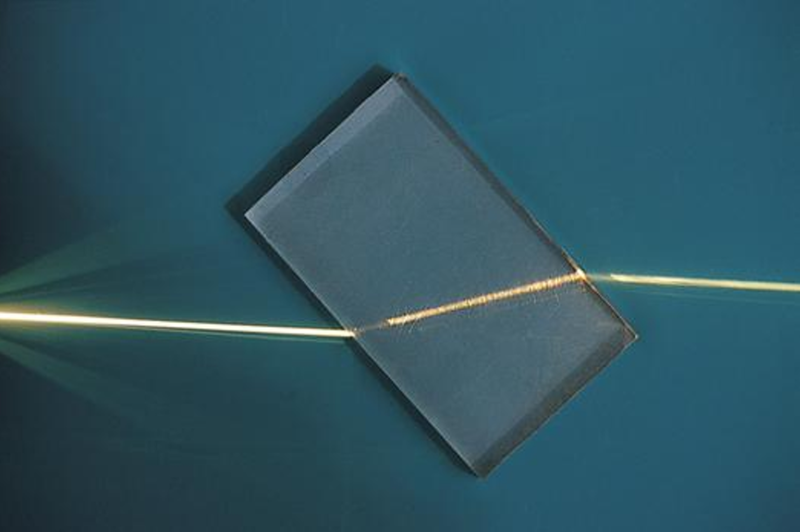
File:Refraction_photo.png · Wikimedia Commons · See Wikimedia Commons
refraction
Sign in to saveAlso known as optical refraction
thumb|A ray of light being refracted in a plastic block In physics, refraction is the redirection of a wave as it passes from one medium to another. The redirection can be caused by the wave's change in speed or by a change in the medium. Refraction of light is the most commonly observed phenomenon, but other waves such as sound waves and water waves also experience refraction. How much a wave is refracted is determined by the change in wave speed and the initial direction of wave propagation relative to the direction of change in speed.
Refraction is the bending of waves, like light or sound, when they move from one material to another—a change caused by the wave slowing down or speeding up in the new medium. It matters because it's a fundamental phenomenon that affects how we see objects through water or glass, how sound travels through different environments, and helps explain many everyday optical and acoustic effects.
AI-generated from the Wikipedia summary — may contain errors.
Wikidata facts
- Subclass of
- occurrence
- Image
- Refraction animation.gif
Show 7 more facts
- described by source
- Encyclopædia Britannica 11th edition
- has effect
- reflection
- Commons gallery
- Refraction
- different from
- refractory period
- Commons category
- Refraction
- topic's main category
- Category:Refraction
- on focus list of Wikimedia project
- Wikipedia:Vital articles/Level/4
via Wikidata · CC0
~14 min read
Encyclopedic overview
15 sectionsContents
- Law
- General explanation
- Slowing of light
- Bending of light
- Dispersion of light
- On water
- Atmospheric
- In eye care
- Mechanical waves
- Water
- Sound
- Gallery
- See also
- References
- External links
thumb|A ray of light being refracted in a plastic block In physics, refraction is the redirection of a wave as it passes from one medium to another. The redirection can be caused by the wave's change in speed or by a change in the medium. Refraction of light is the most commonly observed phenomenon, but other waves such as sound waves and water waves also experience refraction. How much a wave is refracted is determined by the change in wave speed and the initial direction of wave propagation relative to the direction of change in speed.
Optical prisms and lenses use refraction to redirect light, as does the human eye. The refractive index of materials varies with the wavelength of light, and thus the angle of the refraction also varies correspondingly. This is called dispersion and allows prisms and raindrops in rainbows to divide white light into its constituent spectral colors. ==Law== thumb|Refraction of light at the interface between two media of different refractive indices, with . Since the phase velocity is lower in the second medium (), the angle of refraction is less than the angle of incidence ; that is, the ray in the higher-index medium is closer to the normal.
Excerpted from Wikipedia’s “refraction” article, available under the CC BY-SA 4.0 licence.
Gallery (38)
Available in 90 languages
- Español
- Français
- Deutsch
- 中文
- 日本語
- Русский
- Português
- Italiano
- العربية
- हिन्दी
- Afrikaans
- Albanian
- Amharic
- Armenian
- Asturian
- Azerbaijani
- Bahasa Indonesia
- Bangla
Show 71 more
- Basque
- Belarusian
- Betawi
- Bulgarian
- Catalan
- Central Kurdish
- Chuvash
- Croatian
- Czech
- Danish
- Esperanto
- Estonian
- Finnish
- Galician
- Greek
- Haitian Creole
- Hebrew
- Hungarian
- Icelandic
- Irish
- Javanese
- Kannada
- Kazakh
- Kyrgyz
- Latin
- Latvian
- Lithuanian
- Lombard
- Luxembourgish
- Macedonian
- Malay
- Malayalam
- Marathi
- Nederlands
- Nigerian Pidgin
- Norwegian
- Norwegian Nynorsk
- Occitan
- Oromo
- Piedmontese
- Polski
- Punjabi
- Romanian
- Rusyn
- Sanskrit
- Scots
- Serbian
- Serbian (Latin)
- Shona
- Sicilian
- simple
- Sindhi
- Sinhala
- Slovenian
- Svenska
- Tamil
- Telugu
- Tiếng Việt
- Türkçe
- Ukrainian
- Urdu
- Uzbek
- Welsh
- Wu Chinese
- Yiddish
- zh_classical
- zh_min_nan
- zh_yue
- فارسی
- ไทย
- 한국어
via Wikidata sitelinks · CC0