Category
page 1Physics beyond the Standard Model

dark matter
mysterious non-luminous matter (and/or radiation) comprising most of the matter in our observable universe

Large Hadron Collider
particle collider
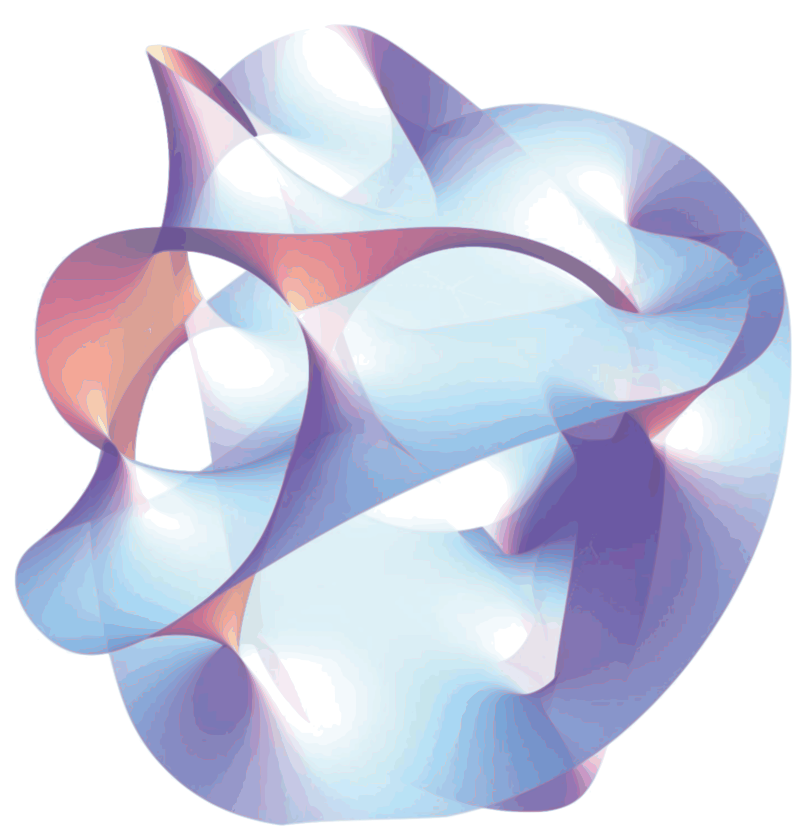
string theory
physical theory of quantized one-dimensional objects with conformal symmetry, which can describe gravitation, gauge theory and other phenomena

quantum gravity
field of theoretical physics

supersymmetry
Supersymmetry is a theoretical framework in physics that suggests the existence of a symmetry between particles with integer spin (bosons) and particles with half-integer spin (fermions). It proposes that for every known particle, there exists a partner particle with different spin properties. There have been multiple experiments on supersymmetry that have failed to provide evidence that it exists in nature. If evidence is found, supersymmetry could help explain certain phenomena, such as the nature of dark matter and the hierarchy problem in particle physics.
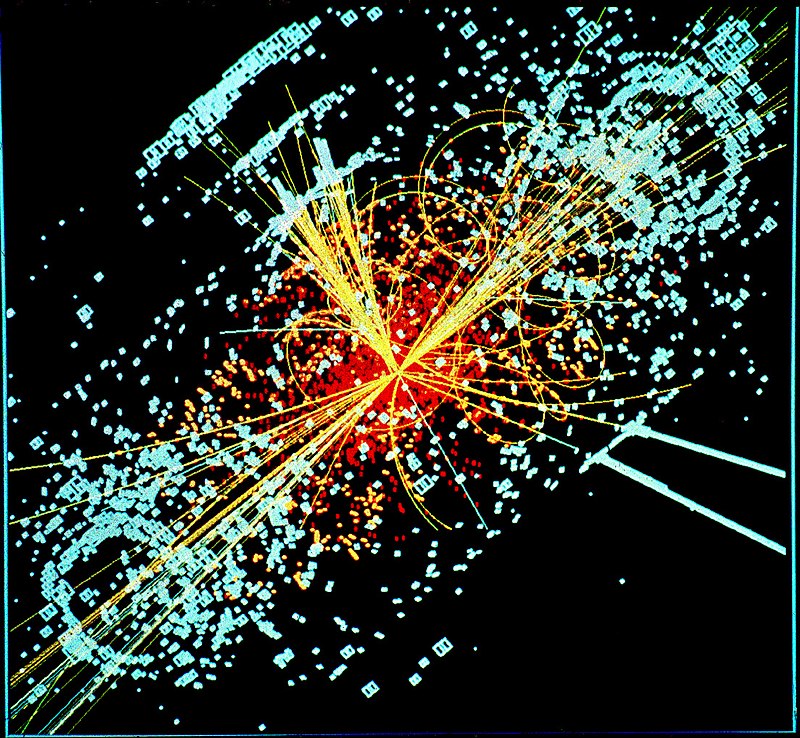
theory of everything
hypothetical single, all-encompassing, coherent theoretical framework of physics
superstring theory
theory of strings with supersymmetry
grand unified theory
quantum field theory in which the three gauge groups of the standard model combine into subgroups of a larger gauge group
supergravity
In theoretical physics, supergravity (supergravity theory; SUGRA for short) is a modern field theory that combines the principles of supersymmetry and general relativity; this is in contrast to non-gravitational supersymmetric theories such as the Minimal Supersymmetric Standard Model. Supergravity is the gauge theory of local supersymmetry. Since the supersymmetry (SUSY) generators form together with the Poincaré algebra and superalgebra, called the super-Poincaré algebra, supersymmetry as a gauge theory makes gravity arise in a natural way.
Tevatron
The Tevatron was a circular particle accelerator (active until 2011) in the United States, at the Fermi National Accelerator Laboratory (called Fermilab), east of Batavia, Illinois, and was the highest energy particle collider until the Large Hadron Collider (LHC) of the European Organization for Nuclear Research (CERN) was built near Geneva, Switzerland. The Tevatron was a synchrotron that accelerated protons and antiprotons in a circumference ring to energies of up to 1 TeV, hence its name. The Tevatron was completed in 1983 at a cost of $120 million and significant upgrade investments were
loop quantum gravity
theory that attempts to canonically quantize gravity via Ashtekar variables
proton decay
hypothetical decay process of a nucleon (proton or neutron) into non-nucleons (anything else)
unified field theory
type of physical field theory unifying fundamental forces
axion
An axion () is a hypothetical elementary particle originally theorized in 1978 independently by Frank Wilczek and Steven Weinberg as the Goldstone boson of Peccei–Quinn theory, which had been proposed in 1977 to solve the strong CP problem in quantum chromodynamics (QCD). If axions exist and have low mass within a specific range, they are of interest as a possible component of cold dark matter.
neutrino oscillation
phenomenon in which a neutrino changes lepton flavor as it travels
Kaluza–Klein theory
field theory on a spacetime with small, compact extra dimensions beyond the large observed dimensions
Modified Newtonian dynamics
alternative explanation of the non-Newtonian rotation of galaxies
galaxy rotation curve
plot of the orbital speeds of visible stars or gas in that galaxy versus their radial distance from that galaxy’s center
CP violation
violation of CP (charge-parity) symmetry in particle physics and cosmology

Super-Kamiokande
is a neutrino observatory located under Mount Ikeno near the city of Hida, Gifu Prefecture, Japan. It is operated by the Institute for Cosmic Ray Research, University of Tokyo with the help of an international team. It is located 1,000 m (3,300 ft) underground in the Mozumi Mine in Hida's Kamioka area. The observatory was designed to detect high-energy neutrinos, to search for proton decay, study solar and atmospheric neutrinos, and keep watch for supernovae in the Milky Way galaxy.
weakly interacting massive particle
dark matter candidate
hierarchy problem
why is gravity weaker, compared to other fundamental forces
physics beyond the Standard Model
theories attempting to explain the deficiencies of the Standard Model, Quantum field theory and general relativity
Sudbury Neutrino Observatory
underground laboratory in Ontario, Canada
Laboratori Nazionali del Gran Sasso
physics laboratory in Assergi, Italy
dark photon
theoretical elementary particle
technicolor
physical model in which electroweak symmetry is broken by a gauge-theoretic mechanism (instead of a Higgs boson)
seesaw mechanism
generic model for masses of neutrinos relative to the quarks and charged leptons

mirror matter
hypothetical counterpart to ordinary matter
cosmological constant problem
major unsolved problem in physics
canonical quantum gravity
formulation of general relativity
Standard-Model Extension
extension to the Standard Model
causal dynamical triangulation
theory that tries to give a quantum field description of gravity
Minimal Supersymmetric Standard Model
supersymmetric extension to the Standard Model
dyon
In physics, a dyon is a hypothetical particle in 4-dimensional theories with both electric and magnetic charges. A dyon with a zero electric charge is usually referred to as a magnetic monopole. Many Grand Unified Theories predict the existence of both magnetic monopoles and dyons.
Peccei–Quinn theory
proposed resolution to the strong CP problem
Extra Dimensions
proposed higher dimensions of space and time
Harari-Schupe preon model
preonic model of sub-quark particle physics
neutrinoless double beta decay
nuclear physics process that has not been observed yet
grand unification energy
energy scale (10¹⁶ GeV) at which the electroweak interaction and the strong interaction may unify
India-based Neutrino Observatory
Indian physics research project
flavor-changing neutral current
interactions between elementary particles that change a particle’s flavor without changing its electric charge
faster-than-light neutrino anomaly
2011 experiment which mistakenly seemed to show faster-than-light travel
superfluid vacuum theory
theory of fundamental physics
light dark matter
dark matter weakly interacting massive particles candidates with masses less than 1 GeV