Category
page 1Pinales families

Pinaceae
The Pinaceae, or pine family, are conifer trees or shrubs, including many of the well-known conifers of commercial importance such as cedars, firs, hemlocks, larches, pines, and spruces. The family is included in the order Pinales, formerly known as Coniferales. Pinaceae have distinctive cones with woody scales bearing typically two ovules, and are supported as monophyletic by both morphological trait and genetic analysis. They are the largest extant conifer family in species diversity, with between 220 and 250 species (depending on taxonomic opinion) in 11 genera, and the second-largest (afte

Cupressaceae
Cupressaceae or the cypress family is a family of conifers. The family includes 27–30 genera (17 monotypic), which include the junipers and redwoods, with about 130–140 species in total. They are monoecious, subdioecious or (rarely) dioecious trees and shrubs up to tall. The bark of mature trees is commonly orange- to red-brown and of stringy texture, often flaking or peeling in vertical strips, but smooth, scaly or hard and square-cracked in some species. The family reached its peak of diversity during the Mesozoic era.

Araucariaceae
Araucariaceae is a family of conifers with three living genera, Araucaria, Agathis, and Wollemia. While the family's native distribution is now largely confined to the Southern Hemisphere, except for a few species of Agathis in Malesia, it was formerly widespread in the Northern Hemisphere during the Jurassic and Cretaceous periods.

Taxaceae
Taxaceae (), commonly called the yew family, is a coniferous family which includes six extant and two extinct genera, and about 30 species of plants, or in older interpretations three genera and 7 to 12 species.

Podocarpaceae
Podocarpaceae is a large family of mainly southern hemisphere conifers, known in English as podocarps, comprising about 201 species of evergreen trees and shrubs. It contains 20 genera if Phyllocladus is included and Manoao and Sundacarpus are accepted. The family achieved its maximum diversity in the Cenozoic, making the Podocarpaceae family one of the most diverse in the southern hemisphere.
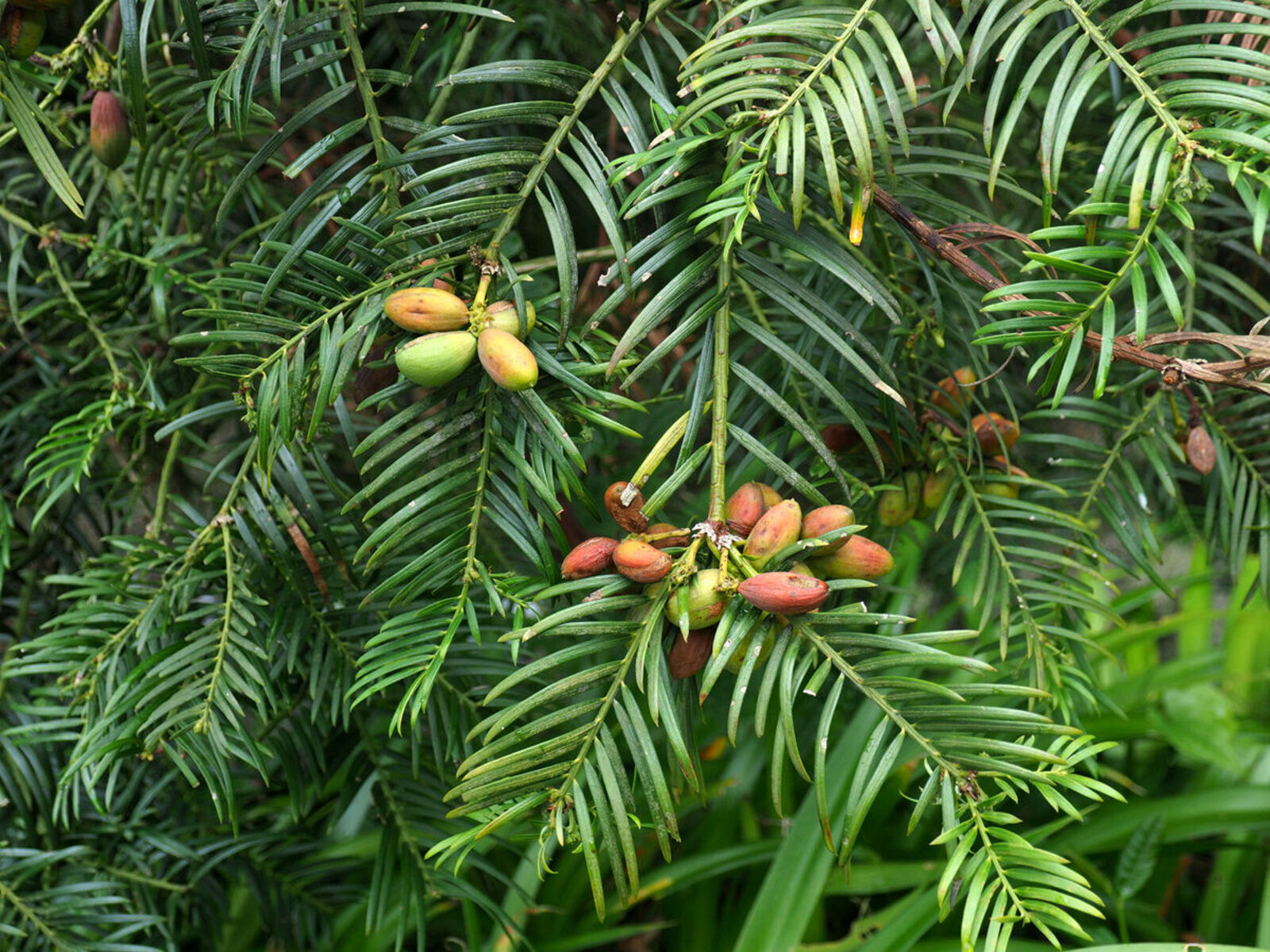
Cephalotaxaceae
Cephalotaxaceae is a small family of conifers. It is often treated as a monophyletic family including only the single genus Cephalotaxus, while others have also included Torreya and Amentotaxus in the family. Cephalotaxaceae is closely allied to the yew family Taxaceae, and is often included in a wide interpretation of Taxaceae, based on phylogenetic evidence and close morphological similarities between them. Included species were restricted to east Asia, except for two species of Torreya found in the southwest and southeast of the United States; fossil evidence shows a much wider prehistorica

Taxodiaceae
Taxodiaceae is a formerly recognized conifer family. It is today recognised as a paraphyletic grade of basal lineages within the Cupressaceae, with the exception of Sciadopitys verticillata, which has been reclassified into its own family, the Sciadopityaceae.

Sciadopityaceae
Sciadopityaceae, commonly called umbrella pines, are a family of conifers now endemic to Japan but in prehistoric times they could also be found in Europe and China. The sole living member of the family is Sciadopitys verticillata (the kōyamaki tree), while several extinct genera are known from the fossil record. Wood suggested to belong to the family has been reported from the Jurassic of China, though the relationship of pre-Cretaceous fossils to Sciadopitys is ambiguous. Sciadopitys species are known from the Late Cretaceous of Japan before becoming widespread across Laurasia during most of

Cheirolepidiaceae
Cheirolepidiaceae (also spelled Cheirolepidaceae and known as Hirmeriellaceae) is an extinct family of conifers. They first appeared in the Triassic, and were a diverse and common group of conifers during most of the Mesozoic era, primarily at low latitudes, where they often formed a dominant element of the vegetation. They are united by the possession of a distinctive pollen type assigned to the form genus Classopollis (the distinctive characters of which include "distal cryptopore, proximal scar often with filaments, striate equatorial girdle, subequatorial rimula, tegillum (outer tectum of