Category
page 2Plant morphology
peduncle
the stalk of a plant bearing an inflorescence or solitary flower
pappus
a modified calyx found in Asteraceae plants that sometimes functions in seed dispersal

tepal
thumb|upright=1.4|Diagram showing the parts of a mature flower. In this example the perianth is separated into a calyx (sepals) and corolla (petals)
corymb
Corymb is a botanical term for an inflorescence with the flowers growing in such a fashion that the outermost are borne on longer pedicels than the inner, bringing all flowers up to a common level. A corymb has a flattish top with a superficial resemblance towards an umbel, and may have a branching structure similar to a panicle. Flowers in a corymb structure can either be parallel, or alternate, and form in either a convex, or flat form.
whorl
arrangement of leaves, sepals, stamens etc. that radiate from a point and surround the stem or stalk

cauliflory
thumb|Flowers of Syzygium monospermum
thumb|Jackfruits
Cauliflory is a botanical term referring to plants that flower and fruit from their main stems or woody trunks, rather than from new growth and shoots. It is rare in temperate regions but common in tropical forests.
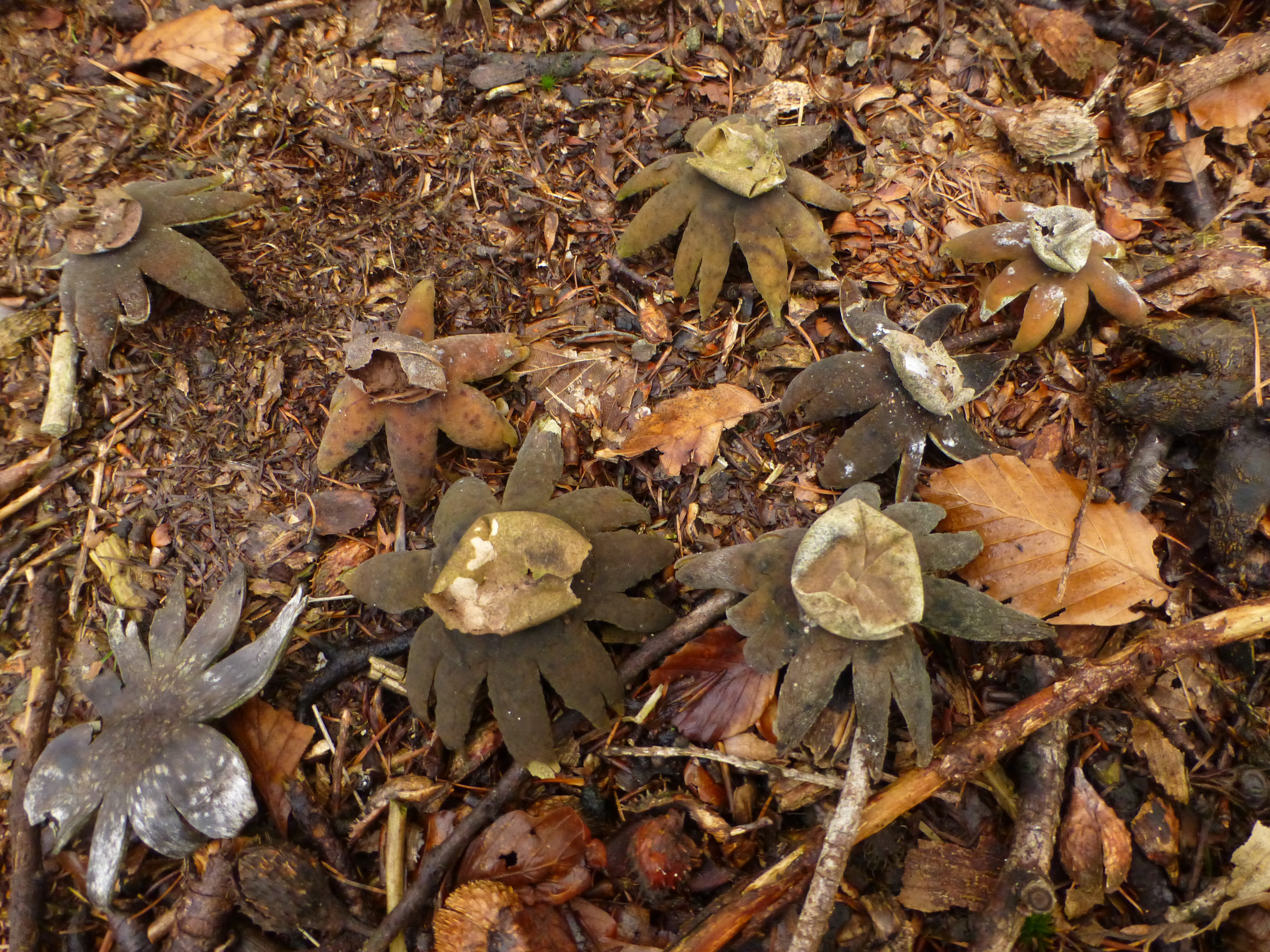
Astraeus hygrometricus
species of fungus

ligule
A ligule (from "strap", variant of lingula, from lingua "tongue") is a thin outgrowth at the junction of leaf and leafstalk of many grasses (family Poaceae) and sedges (family Cyperaceae). A ligule is also a strap-shaped extension of the corolla, such as that of a ray floret in plants in the daisy family Asteraceae.
awn
in botany, either a hair- or bristle-like appendage on a larger structure, or in the case of the Asteraceae, a stiff needle-like element of the pappus; in grasses, they typically extend from the lemmas of the florets

pith
250px|right|thumb|Sambucus|Elder shoot cut longitudinally to show the broad, solid pith (rough textured, white) inside the wood (smooth, yellow tinged). Scale in millimeters.
250px|right|thumb|Walnut shoot cut longitudinally to show the chambered pith found in this genus. Scale in millimeters.
Pith, or medulla, is a tissue in the stems of vascular plants. Pith is composed of soft, spongy parenchyma cells, which in some cases can store starch. In eudicotyledons, pith is located in the center of the stem. In monocotyledons, it extends only into roots. The pith is encircled by a ring of xylem; th
ear
grain-bearing tip part of the stem of a cereal plant

phylloclade
thumb|Flower clusters along the edge of the phylloclades/cladodes of Phyllanthus angustifolius
Phylloclades and cladodes are flattened, photosynthetic shoots, which are usually considered to be modified branches. The two terms are used either differently or interchangeably by different authors. Phyllocladus, a genus of conifer, is named after these structures. Phylloclades/cladodes have been identified in fossils dating from as early as the Permian.

haustorium
[[File:Hyaloperonospora-parasitica-hyphae-haustoria.jpg|thumb|right|Hyaloperonospora parasitica: hyphae and haustoria]]
thumb|right|Haustoria of Muellerina eucalyptoides|creeping mistletoe in a scribbly gum
thumb|A coconut sprout, the edible haustorium of germinating [[coconut seeds]]
In botany and mycology, a haustorium (plural haustoria) is a rootlike structure that grows into or around another structure to absorb water or nutrients. For example, in mistletoe or members of the broomrape family, the structure penetrates the host's tissue and draws nutrients from it. In mycology, it refers to

lenticel
thumb|right|The dark horizontal lines on silver birch bark are the lenticels.
A lenticel is a porous tissue consisting of cells with large intercellular spaces in the periderm of the secondarily thickened organs and the bark of woody stems and roots of gymnosperms and dicotyledonous flowering plants. It functions as a pore, providing a pathway for the direct exchange of gases between the internal tissues and atmosphere through the bark, which is otherwise impermeable to gases. The name lenticel, pronounced with an , derives from its lenticular (lens-like) shape. The shape of lenticels is one o
stele
botanical term for vascular cylinder
pedicel
structure connecting flowers or fruit to the main stem of a plant

hypocotyl
thumb|Diagram of Scouler's willow (Salix scouleriana) seed, indicating position of hypocotyl.
The hypocotyl (short for "hypocotyledonous stem", meaning "below seed leaf") is the stem of a germinating seedling, found below the cotyledons (seed leaves) and above the radicle (root).
floral diagram
schematic diagram of a flower

hypanthium
In angiosperms, a hypanthium or floral cup is a structure where basal portions of the calyx, the corolla, and the stamens form a cup-shaped tube. It is sometimes called a floral tube, a term that is also used for corolla tube and calyx tube.
It often contains the nectaries of the plant. It is present in many plant families, although varies in structural dimensions and appearance. This differentiation between the hypanthium in particular species is useful for identification. Some geometric forms are obconic shapes, as in toyon (Heteromeles), whereas some are saucer-shaped, as in Mitella caulesc
twig
thumb|Twigs covered in powdered snow
labellum
either of the 2 parts of a bilabiate corolla or calyx of an orchid or Canna that serves to attract insects

sporophyll
thumb|right|The sporophyll of a fern. It is a fertile leaf bearing reproductive structures.
tree hollow
a semi-enclosed cavity which has naturally formed in the trunk or branch of a tree
basal shoot
shoot that grows from an adventitious bud on the base of a tree or shrub, or from an adventitious bud on a root

endodermis
thumb|Ranunculus Root Cross Section
The endodermis is the innermost layer of cortex in vascular plants. It is a cylinder of compact living cells, the radial walls of which are impregnated with hydrophobic substances (Casparian strip) to restrict apoplastic flow of water to the inside. The endodermis is the boundary between the cortex and the stele.
plant reproductive morphology
parts of plant enabling sexual reproduction
clonal colony
group of genetically identical plants, fungi, or bacteria, originating vegetatively from a single ancestor, growing at a single site
crown shyness
phenomenon in which the crowns of fully stocked trees do not touch each other
style
Plant part. An elongated part of a carpel or a group of fused carpels between the ovary and the stigma.

fasciation
thumb|275px|Wyethia helianthoides or mule's ear wildflower (on right) showing fasciation
thumb|200px|A "crested" saguaro cactus (Carnegiea gigantea), resulting from fasciation, located at Saguaro National Park (West), Arizona, U.S.
Fasciation (pronounced , from the Latin root meaning "band" or "stripe"), also known as cresting, is a relatively rare condition of abnormal growth in vascular plants in which the apical meristem (growing tip), which normally is concentrated around a single point and produces approximately cylindrical tissue, instead becomes elongated perpendicularly to the directio

spikelet
Parts of a single grass spikelet, consisting of two glumes, four fertile florets, with one additional central floret that may or may not be sterile|thumb|400px|right
A spikelet, in botany, describes the typical arrangement of the inflorescences of grasses, sedges and some other monocots.

phytolith
Phytoliths (from Greek, "plant stone") are rigid, microscopic mineral deposits found in some plant tissues, often persisting after the decay of the plant. Although some use "phytolith" to refer to all mineral secretions by plants, it more commonly refers to siliceous plant remains. Phytoliths come in varying shapes and sizes. The plants which exhibit them take up dissolved silica from the groundwater, whereupon it is deposited within different intracellular and extracellular structures of the plant.
mesophyte
Mesophytes are terrestrial plants which are adapted to neither particularly dry nor particularly wet environments. An example of a mesophytic habitat would be a rural temperate meadow, which might contain goldenrod, clover, oxeye daisy, and Rosa multiflora. Mesophytes prefer soil and air of moderate humidity and avoid soil with standing water or containing a great abundance of salts. They make up the largest ecological group of terrestrial plants, and usually grow under moderate to hot and humid climatic regions.

areole
thumb|Aeroles and spines of the tree-like Rhodocactus grandifolius
In botany, areoles are small light- to dark-colored bumps on cacti out of which grow clusters of spines. Areoles are important diagnostic features of cacti, and identify them as a family distinct from other succulent plants. The spines are not easily detachable, but on certain cacti, members of the subfamily Opuntioideae, smaller, detachable bristles, glochids, also grow out of the areoles and afford additional protection.
culm
above-ground stem of a grass or sedge

glume
thumb|250px|right|Upper and lower glumes of Urochloa mosambicensis, a grass
In botany, a glume is a bract (leaf-like structure) below a spikelet in the inflorescence (flower cluster) of grasses (Poaceae) or the flowers of sedges (Cyperaceae). There are two other types of bracts in the spikelets of grasses: the lemma and palea.
floral symmetry
shape of flowers
diaspore
element allowing the dissemination of a plant species
glossary of botanical terms
Wikimedia glossary list article

double-flowered
thumb|250px|A double-flowered cultivar of Impatiens walleriana.
"Double-flowered" describes varieties of flowers with extra petals, often containing flowers within flowers. The double-flowered trait is often noted alongside the scientific name with the abbreviation fl. pl. (flore pleno, a Latin ablative form meaning "with full flower"). The first abnormality to be documented in flowers, double flowers are popular varieties of many commercial flower types, including roses, camellias and carnations. In some double-flowered varieties all of the reproductive organs are converted to petals. As a re

pseudanthium
A pseudanthium (; : pseudanthia) is an inflorescence that resembles a flower. The word is sometimes used for other structures that are neither a true flower nor a true inflorescence. Examples of pseudanthia include flower heads, composite flowers, or capitula, which are special types of inflorescences in which anything from a small cluster to hundreds or sometimes thousands of flowers are grouped together to form a single flower-like structure. Pseudanthia take various forms. The real flowers (the florets) are generally small and often greatly reduced, but the pseudanthium itself can sometimes

chalaza
The chalaza (; ; : chalazas or chalazae ) is a structure inside bird eggs and plant ovules. It attaches or suspends the yolk or nucellus within the larger structure.

cyathium
thumb|right|400px|Euphorbia tridentata, cross-section of a cyathium, red stalked female flower extending toward the camera
thumb|In Euphorbia milii—close up
A cyathium (: cyathia) is one of the specialised pseudanthia ("false flowers") forming the inflorescence of plants in the genus Euphorbia (Euphorbiaceae). A cyathium consists of:

groundcover
thumb|upright=1.1|Groundcover of Vinca major

sterigma
thumb|The sterigmata are the slender extensions that connect the spores (green) to the basidia (red).
thumb|The sterigmata remain as small projections on twigs of Picea and [[Tsuga after the leaves have fallen.]]
In biology, a sterigma (: sterigmata) is a small supporting structure.
dehiscence
splitting at maturity along a built-in line of weakness in a plant structure in order to release its contents, and is common among fruits, anthers and sporangia
cushion plant
plant life-form
strobilus
A strobilus (: strobili) is a structure present on many land plant species consisting of sporangia-bearing structures densely aggregated along a stem. Strobili are often called cones, but some botanists restrict the use of the term cone to the woody seed strobili of conifers. Strobili are characterized by a central axis (anatomically a stem) surrounded by spirally arranged or decussate structures that may be modified leaves or modified stems.

protonema
thumb|Protonematal cells of the moss [[Physcomitrella patens]]
A protonema (plural: protonemata) is a thread-like chain of cells that forms the earliest stage of development of the gametophyte (the haploid phase) in the life cycle of mosses. When a moss first grows from a spore, it starts as a germ tube, which lengthens and branches into a filamentous complex known as a protonema, from which a leafy gametophore, the adult form of a gametophyte in bryophytes, grows. Protonemata are filamentous in mosses, thalloid or globose in liverworts, and globose in hornworts.

heterostyly
Heterostyly is a unique form of polymorphism and herkogamy in flowers. In a heterostylous species, two or three morphological types of flowers, termed "morphs", exist in the population. On each individual plant, all flowers share the same morph. The flower morphs differ in the lengths of the pistil and stamens, and these traits are not continuous. The morph phenotype is genetically linked to genes responsible for a unique system of self-incompatibility, termed heteromorphic self-incompatibility, that is, the pollen from a flower on one morph cannot fertilize another flower of the same morph.
leaf scar
mark left after a leaf falls off a twig
sport
part of a plant genetically different from the rest
radicle
thumb|right|250px|Seed of Scouler's willow (Salix scouleriana)
In botany, the radicle is the first part of a seedling to emerge from the seed, during the process of germination. Germination understood as a biomechanical process describes the radicle with the hypocotyl combined as the embryonic axis in the seed. The radicle emerges from a seed through the micropyle.

rachis
thumb|upright=1.1|The dark rachis of a wild turkey feather

hydrophily
398x398px|thumb| Vallisneria spiralis is an example of hydrophily. Female flowers reach the water's surface temporarily to ensure pollination.
Hydrophily is a fairly uncommon form of pollination whereby pollen is distributed by the flow of waters, particularly in rivers and streams. Hydrophilous species fall into two categories:
(i) Those that distribute their pollen to the surface of water. e.g. Vallisneria's male flower or pollen grain are released on the surface of water, which are passively carried away by water currents; some of them eventually reach the female flower
(ii) Those that dis
prostrate shrub
plant with a trailing habit
tiller
stem produced by grass plants
pericycle
The pericycle is a cylinder of parenchyma or sclerenchyma cells that lies just inside the endodermis and is the outer most part of the stele of plants.
sessility
flowers or leaves that grow directly from the stem or peduncle of a plant

rhizodermis
thumb|Anatomy of a root tip. 3 is the rhizodermis
Rhizodermis is the root epidermis (also referred to as epiblem), the outermost primary cell layer of the root.