Category
page 1Plant physiology
.png)
leaf
thumb|The diversity of leaves, including Bismarckia, [[Araucaria, Euphorbia, Nymphaea, Colocasia, Hildegardia, Picea, Melocactus, Cycas, Acer, Yucca, Ferocactus, and Ocimum.|401x401px]]
thumb|Leaf of Tilia tomentosa (silver linden tree)
thumb|Diagram of a simple leaf.
thumb|Top and right: staghorn sumac, Rhus typhina (compound leaf) Bottom: skunk cabbage, [[Symplocarpus foetidus (simple leaf) ]]

photosynthesis
thumb|upright=1.5|Schematic of photosynthesis in plants. The carbohydrates produced are stored in or used by the plant.
upright=1.5|thumb|right|Composite image showing the global distribution of photosynthesis, including both oceanic phytoplankton and terrestrial [[vegetation. Dark red and blue-green indicate regions of high photosynthetic activity in the ocean and on land, respectively.]]

bark
plant tissue outside the vascular cambium or the xylem; in older trees may be divided into dead outer bark and living inner bark, which consists of secondary phloem. external parenchymal tissue, located just below the epidermis of the stem

nectar
thumb|Nectar of camellia
thumb|Orange-yellow nectaries and greenish nectar in buckwheat flowers
thumb|An Australian painted lady feeding on a flower's nectar
thumb|Gymnadenia conopsea flowers with nectar-filled spur
Nectar is a viscous, sugar-rich liquid produced by plants in glands called nectaries, either within the flowers with which it attracts pollinating animals, or by extrafloral nectaries, which provide a nutrient source to animal mutualists, which in turn provide herbivore protection. Common nectar-consuming pollinators include mosquitoes, hoverflies, wasps, bees, butterflies and moth
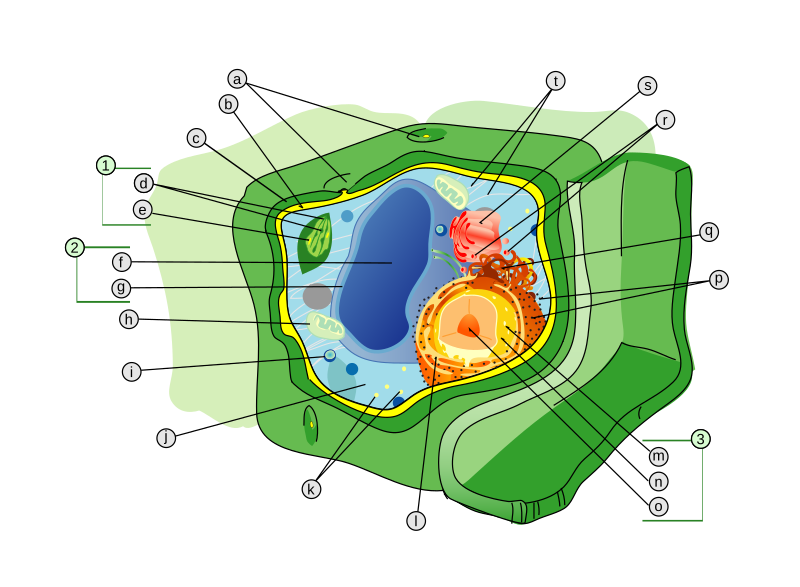
cell wall
rigid or semi-rigid envelope lying outside the cell membrane of plant, fungal, most prokaryotic cells and some protozoan parasites, maintaining their shape and protecting them from osmotic lysi

rhizome
thumb|An antique spurge plant, Euphorbia antiquorum, sending out white rhizomes

transpiration
thumb|Overview of transpiration:
thumb|Transpiration of water in xylem
thumb|Stoma in a [[tomato leaf shown via colorized scanning electron microscope]]
thumb|The clouds in this image of the [[Amazon rainforest are a result of evapotranspiration.]]

xylem
thumb|323x323px|Xylem (blue) transports water and minerals from the roots upwards.|alt=

plastid
thumb|Plant cells with visible chloroplasts

cellular respiration
enzymatic release of energy from inorganic and organic compounds

bud
thumb|upright=1.35|European beech (Fagus sylvatica) bud
In botany, a bud is an undeveloped or embryonic shoot and normally occurs in the axil of a leaf or at the tip of a stem. Once formed, a bud may remain for some time in a dormant condition, or it may form a shoot immediately. Buds may be specialized to develop flowers or short shoots or may have the potential for general shoot development. The term bud is also used in zoology, where it refers to an outgrowth from the body which can develop into a new individual.
phloem
thumb|upright=1.2|Phloem (orange) transports products of photosynthesis to various parts of the plant.|alt=
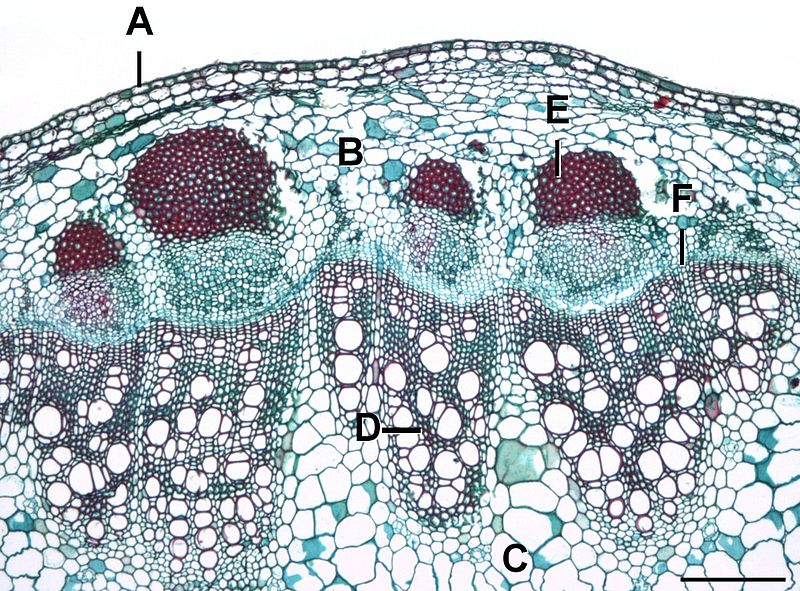
thumb|Cross-section of a flax plant stem:

stomata
thumb|Stoma in a tomato leaf shown via colorized [[scanning electron microscope image]]
thumb|A stoma in horizontal cross section
thumb|The underside of a leaf. In this species (Tradescantia zebrina), the guard cells of the stomata are green because they contain chlorophyll while the epidermal cells are chlorophyll-free and contain red pigments.

meristem
thumb|Tunica-corpus model of the apical meristem (growing tip). The epidermal (L1) and subepidermal (L2) layers form the outer layers called the Tunica (biology)|tunica. The corpus (L3) will form the vascular and stem tissues. Cells in the outer layers divide in a sideways fashion relative to each other, which keeps these layers distinct, whereas the lower layer divides in a more random fashion in all directions.|right

germination
thumb|250px|Sunflower seedlings, three days after germination

plant physiology
subdiscipline of botany

auxin
Auxins (plural of auxin ) are a class of plant hormones (or plant-growth regulators) with some morphogen-like characteristics. Auxins play a cardinal role in coordination of many growth and behavioral processes in plant life cycles and are essential for plant body development. The Dutch biologist Frits Warmolt Went first described auxins and their role in plant growth in the 1920s.
Kenneth V. Thimann became the first to isolate one of these phytohormones and to determine its chemical structure as indole-3-acetic acid (IAA). Went and Thimann co-authored a book on plant hormones, Phytohormones,

nitrogen fixation
process which converts nitrogen from the air into compounds such as ammonia
hygroscopy
Hygroscopy is the phenomenon of attracting and holding water molecules via either absorption or adsorption from the surrounding environment, which is usually at normal or room temperature. If water molecules become suspended among the substance's molecules, adsorbing substances can become physically changed, e.g. changing in volume, boiling point, viscosity or some other physical characteristic or property of the substance. For example, a finely dispersed hygroscopic powder, such as a salt, may become clumpy over time due to collection of moisture from the surrounding environment.
vascular cambium
part of a plant

plant sap
thumb|upright|Sap droplets of Dracaena trifasciata

photoperiodism
Photoperiod is the change of day length over the seasons. Earth's rotation around its axis produces 24-hour changes in light (daytime) and dark (night) cycles on Earth. The length of the light and dark in each phase varies across the seasons due to the axial tilt of Earth. The photoperiod defines the length of the light. For example, in summer the length of light could be 16 hours while the dark is 8 hours, whereas in winter the length of day could be 8 hours, while the dark is 16 hours. Importantly, the axial tilt of the Earth causes the opposing seasons in the Northern and Southern Hemispher

endosperm
200px|thumb|Wheat seed
The endosperm is a tissue produced inside the seeds of most of the flowering plants following double fertilization. It is triploid (meaning three chromosome sets per nucleus) in most species, which may be auxin-driven. It surrounds the embryo and provides nutrition in the form of starch, though it can also contain oils and protein. This can make endosperm a source of nutrition in animal diet. For example, wheat endosperm is ground into flour for bread (the rest of the grain is included as well in whole wheat flour), while barley endosperm is the main source of sugars fo

guttation
thumb|Guttation on Equisetum sp.
vascular tissue
complex conducting tissue in plants

protoplast
thumb|right|Protoplasts of cells from a petunia's leaf
thumb|Protoplasts of the moss Physcomitrella patens
Protoplast (), is a biological term coined by Hanstein in 1880 to refer to the entire cell, excluding the cell wall. Protoplasts can be generated by stripping the cell wall from plant, bacterial, or fungal cells by mechanical, chemical or enzymatic means.

leucoplast
thumb|250px|Leucoplasts, specifically, amyloplasts
Leucoplasts ("formed, molded") are a category of plastid and as such are organelles found in plant cells. They are non-pigmented, in contrast to other plastids such as the chloroplast.
parasitic plant
type of plant that derives some or all of its nutritional requirements from another living plant

plasmolysis
Plasmolysis is the process in which cells lose water in a hypertonic solution. The reverse process, deplasmolysis or cytolysis, can occur if the cell is in a hypotonic solution resulting in a lower external osmotic pressure and a net flow of water into the cell. Through observation of plasmolysis and deplasmolysis, it is possible to determine the tonicity of the cell's environment as well as the rate solute molecules cross the cellular membrane.

abscission
thumb|300px|Leaf litter on the forest floor. Annual autumn leaf drop in [[temperate zones is caused by the abscission of the mature leaves from the growth season in response to the approach of cold winter weather.]]
amyloplast
right|thumb|Amyloplasts in a potato cellAmyloplasts are a type of plastid, double-enveloped organelles in plant cells that are involved in various biological pathways. Amyloplasts are specifically a type of leucoplast, a subcategory for colorless, non-pigment-containing plastids. Amyloplasts are found in roots and storage tissues, and they store and synthesize starch for the plant through the polymerization of glucose. Starch synthesis relies on the transportation of carbon from the cytosol, the mechanism by which is currently under debate.
plant cuticle
protecting film covering the epidermis of leaves, young shoots and other aerial plant organs

photorespiration
class=skin-invert-image|thumb|upright=1.5|
class=skin-invert-image|thumb|upright=1.5|
vascular bundle
a longitudinal strand of vascular tissue in the stems and leaves of higher plants

vernalization
thumb|Many species of henbane require vernalization before flowering.

tracheid
thumb|220px|In radial section, two tracheids of a coniferous wood species are shown. A series of bordered Pit (botany)|pits are also appearing in each tracheid.
thumb|150px|A tracheid of oak shows pits along the walls. It has no perforation plates. Angiosperms have both tracheids and vessel elements.

dormancy
thumb|250px|During winter dormancy, plant [[metabolism comes to a virtual standstill, due in part to low temperatures that slow chemical activity.]]
%20(20065769024).jpg)
suberin
thumb
indoleacetic acid
chemical compound
phytochrome
thumb|Oat phytochrome absorption spectrum (Devlin, 1969)
Phytochromes are a class of photoreceptor proteins found in plants, bacteria and fungi. They respond to light in the red and far-red regions of the visible spectrum and can be classed as either Type I, which are activated by far-red light, or Type II that are activated by red light. Recent advances have suggested that phytochromes also act as temperature sensors, as warmer temperatures enhance their de-activation. All of these factors contribute to the plant's ability to germinate.
apical dominance
plant growth pattern

aerenchyma
thumb|alt=Aerenchyma of Schoenoplectus tabernaemontani|Aerenchyma in stem cross section of a typical wetland plant
Aerenchyma or aeriferous parenchyma or lacunae is a modification of the parenchyma to form a spongy tissue that creates spaces or air channels in the leaves, stems, and roots of some plants, which allows the exchange of gases between the shoot and the root. The channels of air-filled cavities (see image to right) provide a low-resistance internal pathway for the exchange of gases such as oxygen, carbon dioxide, and ethylene between the plant above the water and the submerged tissu

Cutin
thumb|Scheme of biosynthesis of cutin and lignin

anthesis
thumb|right|The sequential anthesis of the individual flowers in this Banksia menziesii inflorescence has begun.
Anthesis is the period during which a flower is fully open and functional. It may also refer to the onset of that period.

pith
250px|right|thumb|Sambucus|Elder shoot cut longitudinally to show the broad, solid pith (rough textured, white) inside the wood (smooth, yellow tinged). Scale in millimeters.
250px|right|thumb|Walnut shoot cut longitudinally to show the chambered pith found in this genus. Scale in millimeters.
Pith, or medulla, is a tissue in the stems of vascular plants. Pith is composed of soft, spongy parenchyma cells, which in some cases can store starch. In eudicotyledons, pith is located in the center of the stem. In monocotyledons, it extends only into roots. The pith is encircled by a ring of xylem; th

etiolation
thumb|300px|Spanish bluebells Hyacinthoides hispanica, showing both leaves and flowers in both etiolated and non-etiolated states. The longest etiolated leaves are about 50 cm long.
pollen tube
tubular cell projection that is part of a pollen tube cell and extends from a pollen grain
small molecule
molecule that weighs less than 800 dalton
water potential
potential energy of water per unit volume relative to pure water in reference conditions; the tendency of water to move from one area to another due to osmosis, gravity, mechanical pressure and matrix effects
autumn leaf color
deciduous trees' and shrubs' autumnal change of leaf color from green to other colors

thigmotropism
right|thumb|Redvine (Brunnichia ovata) tendrils coil upon contact.

variegated leaf
thumb|right|Cryptocarya williwilliana showing leaf venation and variegated leaves

phytolith
Phytoliths (from Greek, "plant stone") are rigid, microscopic mineral deposits found in some plant tissues, often persisting after the decay of the plant. Although some use "phytolith" to refer to all mineral secretions by plants, it more commonly refers to siliceous plant remains. Phytoliths come in varying shapes and sizes. The plants which exhibit them take up dissolved silica from the groundwater, whereupon it is deposited within different intracellular and extracellular structures of the plant.

etioplast
thumb|Different types of plastid
Etioplasts are an intermediate type of plastid that develop from proplastids that have not been exposed to light, and convert into chloroplasts upon exposure to light. They are usually found in stem and leaf tissue of flowering plants (Angiosperms) grown either in complete darkness, or in extremely low-light conditions.
casparian strip
thin tissue surrounding a stele
secondary growth
Lateral growth of a plant axis (shoot axis or root) that is an increase in thickness resulting from formation of secondary vascular tissues by the vascular cambium.

lysimeter
thumb|Lysimeter station in Kittendorf, Germany

apoplast
thumb|300px|The apoplastic and symplastic pathways
The apoplast is the network of cell walls, intercellular spaces, and xylem vessels in plants that allows the movement of water, ions, and small molecules outside the plasma membrane. It forms a continuous extracellular pathway, distinct from the symplast, which involves cytoplasmic transport through plasmodesmata. Water and solutes moving via the apoplast bypass the selective control of the plasma membrane, allowing rapid bulk flow across tissues.
root pressure
transverse osmotic pressure within the cells of a root system

glucosinolate
thumb|right|250px|Glucosinolate structure; side group R varies.
Glucosinolates are natural components of many pungent plants such as mustard, cabbage, and horseradish. The pungency of those plants is due to mustard oils produced from glucosinolates when the plant material is chewed, cut, or otherwise damaged. These natural chemicals most likely contribute to plant defence against pests and diseases, and impart a characteristic bitter flavor property to cruciferous vegetables.