File:Méristème_couches.png · Wikimedia Commons · See Wikimedia Commons
meristem
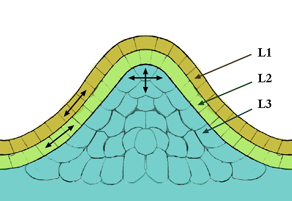
Sign in to savethumb|Tunica-corpus model of the apical meristem (growing tip). The epidermal (L1) and subepidermal (L2) layers form the outer layers called the Tunica (biology)|tunica. The corpus (L3) will form the vascular and stem tissues. Cells in the outer layers divide in a sideways fashion relative to each other, which keeps these layers distinct, whereas the lower layer divides in a more random fashion in all directions.|right
A meristem is a region of plant tissue, like the growing tip shown here, where cells actively divide to create new growth. These specialized areas are important because they contain distinct layers of cells that divide in different ways—outer layers dividing sideways to stay organized, and inner layers dividing randomly—which allows plants to develop their various tissues like skin and vascular systems.
AI-generated from the Wikipedia summary — may contain errors.
Research
12,753 papers- Fine-tuning shoot meristem size to feed the world.ReviewTrends in plant science · 2022Li S, Meng S, Weng J et al.DOI: 10.1016/j.tplants.2021.10.004
- Redox regulation of meristem quiescence: outside/in.ReviewJournal of experimental botany · 2024Considine MJ, Foyer CHDOI: 10.1093/jxb/erae161
- Axillary meristem initiation-a way to branch out.ReviewCurrent opinion in plant biology · 2018Wang Y, Jiao YDOI: 10.1016/j.pbi.2017.09.001
- Meristem maturation and inflorescence architecture--lessons from the Solanaceae.ReviewCurrent opinion in plant biology · 2014Park SJ, Eshed Y, Lippman ZBDOI: 10.1016/j.pbi.2013.11.006
- Regulation of meristem maintenance and organ identity during rice reproductive development.ReviewJournal of experimental botany · 2019Chongloi GL, Prakash S, Vijayraghavan UDOI: 10.1093/jxb/erz046
- The cellular basis of meristem development in fern gametophytes.ReviewBiochemical Society transactions · 2025Xie C, Zhang C, Liu X et al.DOI: 10.1042/BST20240728
- The meristem-to-organ boundary: more than an extremity of anything.ReviewCurrent opinion in genetics & development · 2008Rast MI, Simon RDOI: 10.1016/j.gde.2008.05.005
- Regulation of Shoot Apical Meristem and Axillary Meristem Development in Plants.ReviewInternational journal of molecular sciences · 2020Xue Z, Liu L, Zhang CDOI: 10.3390/ijms21082917
via PubMed
Wikidata facts
- Subclass of
- plant tissue
Show 3 more facts
- Commons gallery
- Méristème
- Commons category
- Meristem
- on focus list of Wikimedia project
- Wikipedia:Vital articles/Level/4
Sources (2)
via Wikidata · CC0
~23 min read
Encyclopedic overview
18 sectionsContents
- Primary meristems
- Secondary meristems
- Basal meristems
- Shoot Apical Meristems
- Root apical meristem
- Intercalary meristem{{anchor|intercalary}}
- Floral meristem
- Apical dominance
- Diversity in meristem architectures
- Role of the KNOX-family genes
- Indeterminate growth of meristems
- Cloning
- Induced meristems
- Lateral meristems
- See also
- References
- Sources
- External links
thumb|Tunica-corpus model of the apical meristem (growing tip). The epidermal (L1) and subepidermal (L2) layers form the outer layers called the Tunica (biology)|tunica. The corpus (L3) will form the vascular and stem tissues. Cells in the outer layers divide in a sideways fashion relative to each other, which keeps these layers distinct, whereas the lower layer divides in a more random fashion in all directions.|right
In cell biology, the meristem is a structure composed of specialized tissue found in plants, consisting of stem cells, known as meristematic cells, which are undifferentiated cells capable of continuous cellular division. These meristematic cells play a fundamental role in plant growth, regeneration, and acclimatization, as they serve as the source of all differentiated plant tissues and organs. They contribute to the formation of structures such as fruits, leaves, and seeds, as well as supportive tissues like stems and roots.
Excerpted from Wikipedia’s “meristem” article, available under the CC BY-SA 4.0 licence.