Category
page 1Plant reproduction

seed
thumb|350px| Micrograph|Photomicrograph of various seeds
.jpg)
tuber
thumb|upright=1.2|Ulluku (Ullucus tuberosus) tubers

rhizome
thumb|An antique spurge plant, Euphorbia antiquorum, sending out white rhizomes

spore
thumb|300px|Spores produced in a sporic life cycle
thumb|300px|Fresh snow partially covers rough-stalked feather-moss (Bryopsida|Brachythecium rutabulum), growing on a thinned hybrid black poplar (Populus x canadensis). The last stage of the moss lifecycle is shown, where the [[sporophytes are visible before dispersion of their spores: the calyptra (1) is still attached to the capsule (3). The tops of the gametophytes (2) can be discerned as well. Inset shows the surrounding, black poplars growing on sandy loam on the bank of a kolk, with the detail area marked.]]

grafting
thumb|right|upright|Cherry tree, consolidated "V" graft
thumb|right|upright|Tape has been used to bind the rootstock and scion at the graft, and tar to protect the scion from desiccation.
thumb|right|upright|A grafted tree showing two differently coloured blossoms

bulb
thumb|right|250px|Shallot bulbs
thumb|right|250px|Hippeastrum (amaryllis) bulb

cotyledon
thumb|Cotyledon from a Judas-tree (Cercis siliquastrum, a dicot) seedling
thumb|Comparison of a monocot and dicot sprouting. The visible part of the monocot plant (left) is actually the first true leaf produced from the meristem; the cotyledon itself remains within the seed.

gametophyte
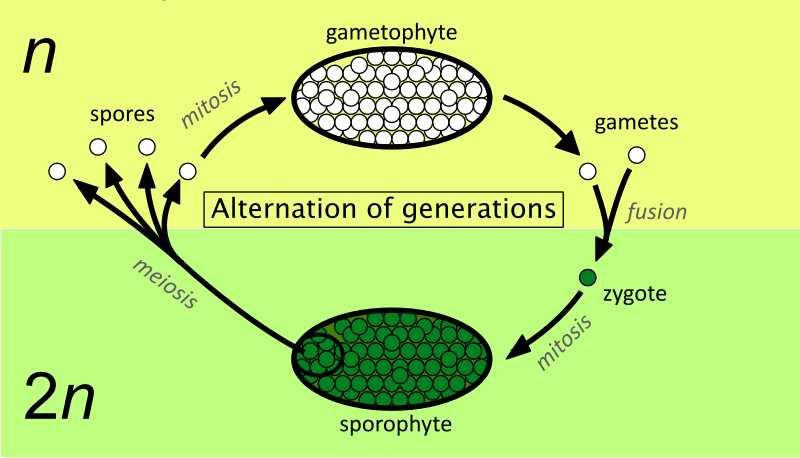
thumb|360px|Diagram showing the alternation of generations between a diploid sporophyte (bottom) and a haploid gametophyte (top)

sowing
thumb|Simon Bening, Labors of the Months: September, from a Flemish [[Book of hours (Bruges)]]
thumb|Men sowing seed by hand in the 1940s
thumb|Manual sowing machine
Sowing is the process of planting seeds. An area that has had seeds planted in it will be described as a sowed or sown area.
sporophyte
thumb|360px|Diagram showing the alternation of generations between a diploid sporophyte (bottom) and a haploid gametophyte (top)
A sporophyte () is one of the two alternating multicellular phases in the life cycles of plants and algae. It is a diploid multicellular organism which produces asexual spores. This stage alternates with a multicellular haploid gametophyte phase.

seedling
thumb|Monocot (left) and dicot (right)
thumb|right|Seedling of a Scots pine
thumb|Grass seedlings (150-minute time lapse)
alternation of generations
reproductive strategy

vegetative reproduction
asexual method of reproduction in plants
plant breeding
the art and science of changing the traits of plants in order to produce desired characteristics

budding
thumb|Saccharomyces cerevisiae reproducing by budding

stolon
right |thumb |Ficinia spiralis (pīngao) spreads by forming stolons in the sand.
right |thumb |Argentina anserina (common silverweed) showing red stolons
In biology, a stolon ( from Latin stolō, genitive – "branch"), also known as a runner, is a horizontal connection between parts of an organism. It may be part of the organism, or of its skeleton. Typically, animal stolons are exoskeletons (external skeletons).
cutting
piece of a plant that is used in horticulture for vegetative (asexual) propagation

protoplast
thumb|right|Protoplasts of cells from a petunia's leaf
thumb|Protoplasts of the moss Physcomitrella patens
Protoplast (), is a biological term coined by Hanstein in 1880 to refer to the entire cell, excluding the cell wall. Protoplasts can be generated by stripping the cell wall from plant, bacterial, or fungal cells by mechanical, chemical or enzymatic means.

corm
right|thumb|Taro corms for sale in a [[Réunion market]]

archegonium
right|thumb|240px|Diagram of archegonium anatomy
An archegonium (: archegonia), from the Ancient Greek ἀρχή ("beginning") and γόνος ("offspring"), is a multicellular structure or organ of the gametophyte phase of certain plants, producing and containing the ovum or female gamete. The corresponding male organ is called the antheridium. The archegonium has a long neck canal or venter and a swollen base. Archegonia are typically located on the surface of the plant thallus, although in the hornworts they are embedded.
__TOC__
monoicous
tumbleweed
thumb|Lechenaultia divaricata

apomixis
thumb|right|Vegetative apomixis in Poa bulbosa; [[bulbils form instead of flowers]]
In botany, apomixis is asexual development of seed or embryo without fertilization.
plant reproduction
production of new individuals or offspring in plants
layering
Plant propagation technique

parthenocarpy
right|thumb|Seedless watermelon due to Stenospermocarpy
In botany and horticulture, parthenocarpy is the natural or artificially induced production of fruit without fertilisation of ovules, which makes the fruit seedless. The phenomenon has been observed since ancient times but was first scientifically described by German botanist Fritz Noll in 1902.

antheridium
alt=Here is a diagram of antheridium structure in a liverwort, which is representative of most antheridia structures throughout species. It is a thin cellular layer that encapsulates many sperm cells.|thumb|General structure of antheridia. Antheridia consist of a thin cellular layer that holds many sperm inside. Here, the diagram of a liverwort antheridium is shown.

hypocotyl
thumb|Diagram of Scouler's willow (Salix scouleriana) seed, indicating position of hypocotyl.
The hypocotyl (short for "hypocotyledonous stem", meaning "below seed leaf") is the stem of a germinating seedling, found below the cotyledons (seed leaves) and above the radicle (root).
propagule
In biology, a propagule is any material that functions in propagating an organism to the next stage in its life cycle, such as by dispersal. The propagule is usually distinct in form from the parent organism. Propagules are produced by organisms such as plants (in the form of seeds or spores), fungi (in the form of spores), and bacteria (for example endospores or microbial cysts).

sporophyll
thumb|right|The sporophyll of a fern. It is a fertile leaf bearing reproductive structures.
hapaxanth
Monocarpy refers to a reproductive strategy in plants in which the plant will flower and set seeds only once in its lifetime, and then die. The term is derived from Greek ('', "single" + , "fruit" or "grain"), and was first used by Alphonse de Candolle. Other terms with the same meaning are hapaxanth and semelparous. The antonym is polycarpic, a plant that flowers and sets seeds many times during its lifetime; the antonym of semelparous is iteroparous. Plants which flower en masse (gregariously) before dying are known as plietesials. The term hapaxanth is most often in conjunction with describ
clonal colony
group of genetically identical plants, fungi, or bacteria, originating vegetatively from a single ancestor, growing at a single site

rootstock
thumb|right|275px|Grafting, 1870, by Winslow Homeran example of [[grafting]]
A rootstock is part of a plant, often an underground part, from which new above-ground growth can be produced. It could also be described as a stem with a well developed root system, to which a bud from another plant is grafted. It can refer to a rhizome or underground stem. In grafting, it refers to a plant, sometimes just a stump, which already has an established, healthy root system, onto which a cutting or a bud from another plant is grafted. In some cases, such as vines of grapes and other berries, cuttings may b

backcrossing
Backcrossing is a crossing of a hybrid with one of its parents or an individual genetically similar to its parent, to achieve offspring with a genetic identity closer to that of the parent. It is used in horticulture, animal breeding, and production of gene knockout organisms.

cleistogamy
300px|thumb|Chasmogamous (a) and cleistogamous (b) flowers of Viola pubescens. Arrows point to structure.
seed bank
backup seed storage
style
Plant part. An elongated part of a carpel or a group of fused carpels between the ovary and the stigma.

Polyembryony
Polyembryony is the phenomenon of two or more embryos developing from a single fertilized egg. Due to the embryos resulting from the same egg, the embryos are identical to one another, but are genetically diverse from the parents. The genetic difference between the offspring and the parents, but the similarity among siblings, are significant distinctions between polyembryony and the process of budding and typical sexual reproduction. Polyembryony can occur in humans, resulting in identical twins, though the process is random and at a low frequency. Polyembryony occurs regularly in many species
self-incompatibility in plants
Self-incompatibility (SI) is a general name for any genetic mechanism that prevents self-fertilization in fertile hermaphroditic organisms, and thus encourages outcrossing and allogamy. It is contrasted with separation of sexes among individuals (dioecy), and their various modes of spatial (herkogamy) and temporal (dichogamy) separation.

microspore
thumb|Microscopic photo of spores (in red) of Selaginella. The large three spores at the top are [[megaspores whereas the numerous smaller red spores at the bottom are microspores.]]
F1 hybrid
first-generation hybrid (or crossbreed) animal or plant
stratification
process of treating stored or collected seed by cold

heterospory
thumb|A female pinecone (Pinophyta) produces the megaspores of this heterosporic plant.
thumb|A male pinecone (Pinophyta) produces the microspores of this heterosporic plant.
Heterospory is the production of spores of two distinct sizes and sexes by the sporophytes of vascular plants (in bryophytes, spore dimorphism is referred to as anisospory). The smaller of these, the microspore, is male and the larger megaspore is female. Heterospory evolved during the Devonian period from isospory independently in several plant groups: the clubmosses, the ferns including the arborescent horsetails, and p

Micropropagation
thumb|right|A rose plant that began as cells grown in a tissue culture
plant propagation
process in growing new plants from a variety of sources
Plant breeders' rights
rights granted to the breeder of a new variety of plant that give the breeder exclusive control
soil seed bank
viable seed present in the soil
.JPG)
bulbil
Bulbils on Cardamine bulbifera|thumb
A bulbil (also referred to as a bulbel, bulblet, and/or pup) is a small, young plant that is reproduced vegetatively from axillary buds on the parent plant's stem or in place of a flower on an inflorescence. These young plants are clones of the parent plant that produced them—they have identical genetic material. The formation of bulbils is a form of asexual reproduction, as they can eventually go on to form new stand-alone plants.
thumb|Lilium lancifolium
thumb|Ficaria verna
thumb|Allium vineale
thumb|Nitellopsis obtusa forming "pseudobulbils"
Although som

microsporangium
thumb|Encephalartos villosus [[microsporophylls with microsporangia]]
A microsporangium () is a sporangium that produces microspores that give rise to male gametophytes when they germinate. Microsporangia occur in all vascular plants that have heterosporic life cycles, such as seed plants, spike mosses and the aquatic fern genus Azolla. In gymnosperms and angiosperm anthers, the microsporangia produce microsporocytes, the microspore mother cells, which then produce four microspores through the process of meiosis. Microsporocytes are produced in the microsporangia of gymnosperm cones and the an
shield budding
technique of grafting to change varieties of fruit trees; typically used in fruit tree propagation, it can also be used for many other kinds of nursery stock.
placenta development
Placentation is the formation, type and structure, or modes of arrangement of the placenta. The function of placentation is to transfer nutrients, respiratory gases, and water from maternal tissue to a growing embryo, and in some instances to remove waste from the embryo. Placentation is best known in live-bearing mammals (Theria), but also occurs in some fish, reptiles, amphibians, a diversity of invertebrates, and flowering plants. In vertebrates, placentas have evolved more than 100 times independently, with the majority of these instances occurring in squamate reptiles.

seed predation
type of plant-animal interaction in which granivores feed on the seeds of plants as a main or exclusive food source
gemma
single cell, mass of cells, or modified bud of tissue that detaches from the parent and develops into a new individual
Somaclonal variation
Genetic changes during culture medium in a part of a single plant, which nextly be placed in different medium to grow up its own genetical properties.
seed dormancy
adaptive mechanism in plants
Millennium Seed Bank Partnership
plant conservation programme and organization
Recalcitrant seed
Plant seeds intolerant of drying or cold
Chasmogamy
300px|thumb|Chasmogamous (a) and cleistogamous (b) flowers of Viola pubescens. Arrows point to structure.
Siphonogamy
thumb|right|Pollen tubes, sperm, and ovule of Cycadophyta
hypogeal germination