Category
page 1Plant taxonomy

species
A species () is the basic unit of classification and a taxonomic rank of an organism, as well as a unit of biodiversity. It can be defined as the largest group of organisms in which any two individuals of the appropriate sexes or mating types can produce fertile offspring, typically by sexual reproduction. Other ways of defining species include their karyotype, DNA sequence, morphology, behaviour, or ecological niche. In addition, palaeontologists use the concept of the chronospecies since fossil reproduction cannot be examined. The most recent rigorous estimate for the total number of species

genus
Genus (; : genera ) is a taxonomic rank above species and below family as used in the biological classification of living and fossil organisms as well as viruses. In binomial nomenclature, the genus name forms the first part of the binomial species name for each species within the genus.

class
taxonomic rank in biology
order
taxonomic rank

subspecies
In biological classification, subspecies (: subspecies) is a rank below species, used for populations that live in different areas and vary in size, shape, or other physical characteristics (morphology), but that can successfully interbreed. Not all species have subspecies, but for those that do there must be at least two. Subspecies is abbreviated as subsp. or ssp. and the singular and plural forms are the same ("the subspecies is" or "the subspecies are").
tribe
taxonomic rank between family and genus
.jpg)
cultivar
right|thumb|upright=1.25|
.jpg)
herbarium
thumb|Herbarium book which dates from 1633. Made by the Flemish Bernardus Wynhouts.
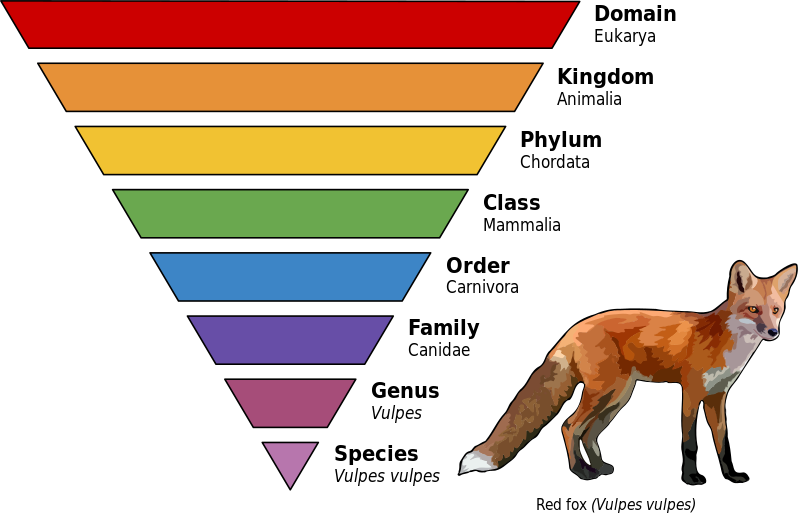
taxonomic rank
in biology, level in a taxonomic hierarchy
variety
taxonomic rank
subfamily
In biological classification, a subfamily (Latin: ', plural ') is an auxiliary (intermediate) taxonomic rank, positioned below family and above genera. It is used to classify groups of related genera within a family, helping organize the diversity of life more precisely.

International Code of Nomenclature for algae, fungi, and plants
Code of Nomenclature

subgenus
thumb|A hoverfly of the subgenus [[Eristalis (Eoseristalis)]]
In biology, a subgenus ( subgenera) is a taxonomic rank directly below genus.
The Plant List
database of scientific plant names
Angiosperm Phylogeny Group
group of systematists (botany), of varying composition
World Flora Online
online flora for plants
plant taxonomy
the study of relation between plant species and genera
Plants of the World Online
online database of the world's plants
ground tissue
ground tissue is one of three main tissue systems: protective, ground, and vascular, each tissue system has a different role and functionality inside plant tissues
section
taxonomic rank in botany
botanical name
scientific name for a plant, alga or fungus
World Checklist of Selected Plant Families
project in Kew Gardens
International Code of Nomenclature for Cultivated Plants
nomenclature code
identification key
device that aids the identification of biological entities
cultivated plant taxonomy
study of the theory and practice of the science that identifies, describes, classifies, and names cultigens—those plants whose origin or selection is primarily due to intentional human activity;one part of the study of horticultural botany
International Association for Plant Taxonomy
organization
infraspecific name
name of a taxon, at a rank lower than species
section
taxonomic rank
series
taxonomic rank in botany
Angiosperm Phylogeny Website
website
subtribe
In a social context, a subtribe is a secondary division of a broader ethnic grouping or tribe, functioning as a distinct unit defined by specific kinship ties, geographic territory, or linguistic dialects. For example, the Kipsigis are a major sub-tribe that falls under the broader Kalenjin ethnic group of East Africa.

Ecocrop
Ecocrop was a database used to determine the suitability of a crop for a specified environment. Developed by the Food and Agriculture Organization of the United Nations (FAO) it provided information predicting crop viability in different locations and climatic conditions. It also served as a catalog of plants and plant growth characteristics.
history of plant systematics
aspect of history
Hort.
thumb|220x220px|The Citrus reshni|cleopatra mandarin is classified as Citrus reshni Hort. ex Tanaka.
Hort., in the taxonomy of plants, is an abbreviation used to indicate a name that saw significant use in the horticultural literature (often of the 19th century and earlier), but was never properly published. This system was developed by Tyozaburo Tanaka to deal with the problem of citrus taxonomy.
Pteridophyte Phylogeny Group
Plant classification organization
form classification
classification of organisms based on their morphology
National Botanical Research Institute
Uttar Pradesh Government Research Institute

American Society of Plant Taxonomists
botanical organization