taxonomic rank
Also known as taxonomic category
in biology, level in a taxonomic hierarchy
AI overview
Taxonomic rank is a level in the biological classification system that organizes living things into groups, such as species, genus, family, or kingdom, with each rank representing a different scale of similarity. It matters because it provides a standardized way to organize and understand the relationships between all organisms on Earth.
AI-generated from the Wikipedia summary — may contain errors.
Wikidata facts
- Image
- Taxonomic Rank Graph.svg
Sources (2)
via Wikidata · CC0
Article
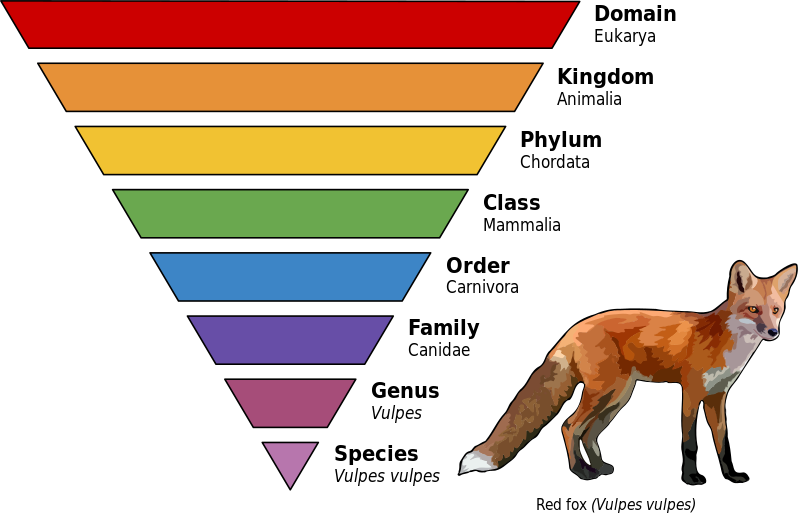
The major ranks: domain, kingdom, phylum, class, order, family, genus, and species, applied to the red fox, Vulpes vulpes. Many classifications based on genetic analysis require more than these eight ranks, not all of which have distinct names.
In biological taxonomy, a taxonomic rank denotes the level that a group of organisms—either taxon or clade—occupies in a hierarchical system of classification, which is based on evolutionary relationships. Some authors prefer to use the term nomenclatural rank, contending that, according to some definitions, the ranking of organisms is more accurately described under nomenclature rather than that of taxonomy. Thus, the most inclusive taxa (or clades), such as the Eukarya and Animalia, are assigned the highest ranks of classification, whereas the least inclusive ones, such as Homo sapiens, Bufo bufo, Tyrannosaurus rex, and Vulpes vulpes, are given the lowest ranks.