Category
page 1Pleistocene carnivorans
.png)
Canis lupus
The wolf (Canis lupus; : wolves), also known as the grey wolf or gray wolf, is a canine native to Eurasia and North America. More than thirty subspecies of Canis lupus have been recognized, including the dog and dingo, though grey wolves, as popularly understood, include only naturally occurring wild subspecies. The wolf is the largest wild extant member of the family Canidae, and is further distinguished from other Canis species by its less pointed ears and muzzle, as well as a shorter torso and a longer tail. The wolf is nonetheless related closely enough to smaller Canis species, such as th

cougar
The cougar (Puma concolor) (, KOO-gər), also called puma, mountain lion, catamount, and panther, is a large small cat native to the Americas. It inhabits North, Central and South America, making it the most widely distributed wild, terrestrial mammal in the Western Hemisphere, and one of the most widespread in the world. Its range spans Yukon, British Columbia and Alberta in Canada, the Rocky Mountains and areas in the western United States. Further south, its range extends through Mexico to the Amazon rainforest and the southern Andes Mountains in Patagonia. It is an adaptable generalist spec

coyote
The coyote (Canis latrans) is a species of canine also known as the American jackal, prairie wolf, and brush wolf. It is native to North America, and it is smaller than its close relative, the gray wolf, and slightly smaller than the closely related eastern wolf and red wolf. It fills much of the same ecological niche as the golden jackal does in Eurasia but the coyote is generally larger.

bobcat
The bobcat (Lynx rufus), also known as the wildcat, bay lynx, or red lynx, is one of the four extant species within the medium-sized wild cat genus Lynx. Native to North America, it ranges from southern Canada through most of the contiguous United States to Oaxaca in Mexico. It is listed as Least Concern on the IUCN Red List since 2002, due to its wide distribution and large population. Although it has been hunted extensively both for sport and fur, populations have proven stable, though declining in some areas.

sea otter
species of marine mammal

Smilodon
Smilodon is a genus of extinct felids. It is one of the best-known saber-toothed predators and prehistoric mammals. Although commonly known as the saber-toothed tiger, it was not closely related to the tiger or other modern cats, belonging to the extinct subfamily Machairodontinae, with an estimated date of divergence from the ancestor of living cats around 20 million years ago. Smilodon was one of the last surviving machairodonts alongside Homotherium. Smilodon lived in the Americas during the Pleistocene to early Holocene epoch (2.5 mya – at latest 8,200 years ago). The genus was named in 18

maned wolf
a large canid native to South America
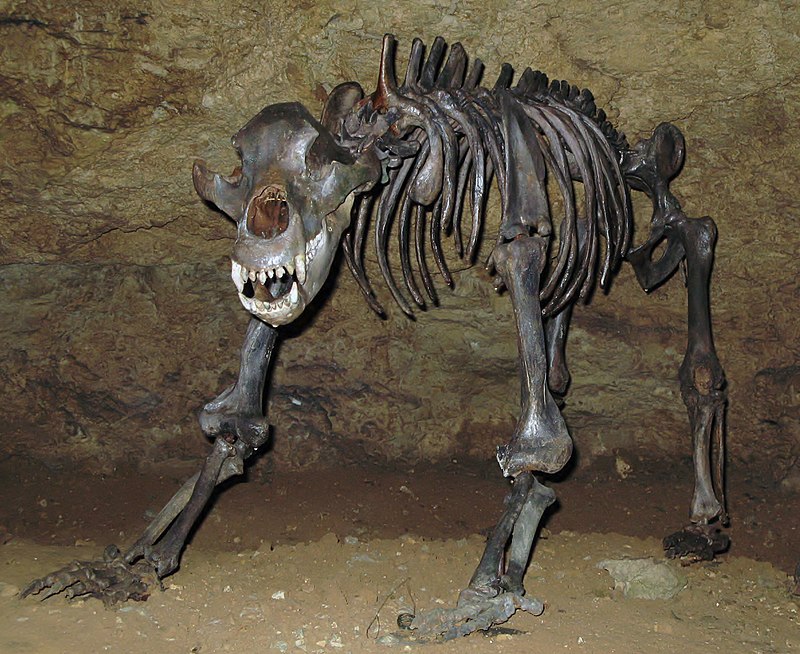
Ursus spelaeus
species of mammal (fossil)

dire wolf
extinct species of canids (Canidae)
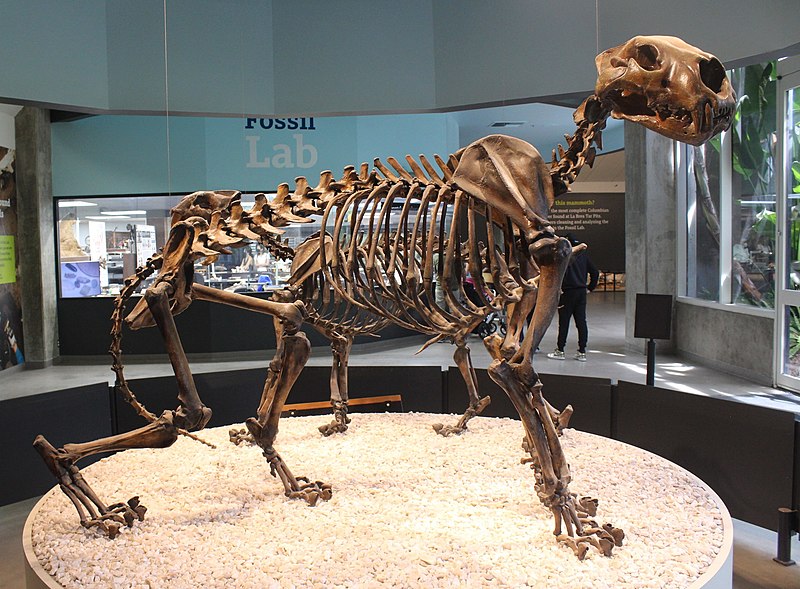
American lion
extinct species of big cats (Pantherinae)

African golden wolf
Canis lupaster
European jaguar
species of mammal

Homotherium
Homotherium is an extinct genus of scimitar-toothed cat belonging to the extinct subfamily Machairodontinae that inhabited North America, Eurasia, and Africa, as well as possibly South America during the Pliocene and Pleistocene epochs from around 4 million to 12,000 years ago. A probable descendant of Amphimachairodus, it was one of the last surviving members of Machairodontinae alongside the more famous sabertooth Smilodon, to which it was not particularly closely related. It was a large cat, comparable in size to a lion with a body mass of up to , functioning as an apex predator in the ecos
Panthera spelaea
species of extinct mammal (fossil)
Cave hyena
extinct subspecies of carnivore

Arctodus
Arctodus is an extinct genus of short-faced bears that inhabited North America during the Pleistocene (about 2.6 Mya until 12,800 years ago). The two recognized species are the lesser short-faced bear (Arctodus pristinus) and the giant short-faced bear (Arctodus simus). Of these species, A. simus was larger, is known from more complete remains, and is considered one of the best-known members of North America's extinct Ice Age megafauna. A. pristinus was largely restricted to the Early Pleistocene of the eastern United States, whereas A. simus had a broader range, with most finds being from the
%20fig.%2011.png)
Dinofelis
Dinofelis is an extinct genus of machairodontine (sabre-toothed cat), usually classified in the tribe Metailurini. It was widespread in Europe, Asia, Africa and North America from 5 million to about 1.2 million years ago (early Pliocene to early Pleistocene). Fossils very similar to Dinofelis from Lothagam range back to around 8 million years ago, in the Late Miocene.
Trinil tiger
subspecies of mammal
Panthera fossilis
fossil species of big cats (Pantherinae)
.png)
Miracinonyx
Miracinonyx, colloquially known as the American cheetah or the New World cheetah, is an extinct genus of felids belonging to the subfamily Felinae that was endemic to North America from the Pleistocene epoch (about 2.5 million to 16,000 years ago) and morphologically similar to the modern cheetah (Acinonyx jubatus), although its apparent similar ecological niches have been considered questionable due to anatomical morphologies of the former that would have limited its ability to act as a specialized pursuit predator. The genus was originally known from fragments of skeletons, but nearly comple

Arctoidea
Arctoidea is an infraorder of mostly carnivorous mammals which include the extinct Hemicyonidae (dog-bears), and the extant Musteloidea (weasels, raccoons, skunks, red pandas), Pinnipedia (seals, sea lions), and Ursidae (bears), found in all continents from the Eocene, , to the present. The oldest group of the clade is the bears, as their CMAH gene is still intact. The gene became non-functional in the common ancestor of the Mustelida (the musteloids and pinnipeds). Arctoids are caniforms, along with dogs (canids) and extinct bear dogs (Amphicyonidae). The earliest caniforms were superficially

Megantereon
Megantereon is an extinct genus of prehistoric machairodontine saber-toothed cat that lived in Eurasia, Africa and possibly North America from the late Pliocene to the Middle Pleistocene, first described by George Cuvier in 1824. It is a member of the tribe Smilodontini, and closely related to and possibly the ancestor of the more widely-known American sabertooth Smilodon, with which it shared greatly elongated saber canine teeth. In comparison to Smilodon, Megantereon was somewhat smaller, around the size of a jaguar, although it is thought to have had a similar hunting strategy as an ambush
%20(18017143788).jpg)
Pachycrocuta
Pachycrocuta is an extinct genus of hyena. The largest and most well-researched species is Pachycrocuta brevirostris, colloquially known as the giant short-faced hyena as it stood about at the shoulder and it is estimated to have averaged in weight, approaching the size of a lioness, making it the largest known undisputed hyena, only exceeded in size by the possible hyena Dinocrocuta. It is often hypothesised to have been a specialised kleptoparasitic scavenger, using its imposing size to force other predators off of carcasses, though some authors have suggested they may have been effective pa
Panthera leo sinhaleyus
subspecies of mammal
Lynx issiodorensis
species of mammal (fossil)
Ursus maritimus tyrannus
fossil subspecies of mammal
.jpg)
Arctotherium
Arctotherium ("bear beast") is an extinct genus of short-faced bears endemic to Central and South America from the Late Pliocene to the end of the Late Pleistocene. Arctotherium migrated from North America to South America during the Great American Interchange, following the formation of the Isthmus of Panama during the late Pliocene.
Panthera palaeosinensis
species of mammal (fossil)
Sardinian dhole
species of carnivoran
Puma pardoides
species of mammal
Ursus etruscus
species of bear

Chasmaporthetes
Chasmaporthetes, also known as hunting or running hyena, is an extinct genus of hyenas distributed in Eurasia, North America, and Africa during the Pliocene-Pleistocene epochs, living from 4.9 million to 780,000 years ago, existing for about . The genus probably arose from Eurasian Miocene hyenas such as Thalassictis or Lycyaena, with C. borissiaki being the oldest known representative. The species C. ossifragus was the only hyena to cross the Bering land bridge into the Americas, and ranged over what is now Arizona and Mexico during Blancan and early Irvingtonian Land Mammal ages, between 5.0
Felis lunensis
species of mammal

Agriotherium
Agriotherium is an extinct genus of bears whose fossils are found in Miocene through Pleistocene-aged strata of Eurasia and Africa. The earliest species, A. inexpetans, evolved during the Late Miocene, around 7.6 Mya. The latest record for the genus was around 1.8 Mya, during the Early Pleistocene.
Panthera zdanskyi
species of mammal (fossil)
Ursus deningeri
species of mammal
Panthera tigris soloensis
subspecies of mammal
Canis lepophagus
species of mammal
Lycaon sekowei
species of mammal
Speothos pacivorus
species of mammal
%20Fig.%201.png)
Xenocyon
Xenocyon ("strange dog") is an extinct group of canids, either considered a distinct genus or a subgenus of Canis. The group includes Canis (Xenocyon) africanus, Canis (Xenocyon) antonii and Canis (Xenocyon) falconeri that gave rise to Canis (Xenocyon) lycanoides. The hypercarnivorous Xenocyon is thought to be closely related and possibly ancestral to modern dhole and the African wild dog, as well as the insular Sardinian dhole.
Protocyon
Protocyon (from Greek for "first dog") is an extinct genus of large canid endemic to South and Central America from the Late Pliocene to the Late Pleistocene.
Panthera tigris acutidens
subspecies of mammal (fossil)
Canis etruscus
species of mammal
Canis edwardii
species of mammal (fossil)
Panthera onca augusta
subspecies of big cat native to the Americas
Ailuropoda baconi
prehistoric animal, ancestor to the giant panda
European Ice Age leopard
subspecies of mammal
Beringian wolf
extinct type of wolf
Armbruster's wolf
species of mammal (fossil)
Ursus rossicus
species of mammal
evolution of the wolf
overview about the evolution of the wolf
Homotherini
Homotherini (Machairodontini) is a tribe (or subtribe) of saber-toothed cats of the family Felidae (true cats). The tribe is commonly known as scimitar-toothed cats. These saber-toothed cats were endemic to North America, Europe, Asia, Africa, and South America from the Miocene to Pleistocene living from c. 12.5 Ma until c. 12,000 years ago. The evolutionary relationship between the tribes Homotherini and Machairodontini cause paleontologists to classify Homotherini either as a subtribe of Machairodontini, or the same tribe often using either name interchangeably.
Cyrnaonyx
Cyrnaonyx is an extinct genus of Lutrinae, otters from the Pleistocene. It was originally described by Helbing based on materials from France and he also attributed material from Corsica to it. The latter appeared to belong to another species and genus, Algarolutra majori. The only species of Cyrnaonyx is C. antiqua. It is known from the Pleistocene (Holsteinian to Eemian/Weichselian) of Europe: France, Germany, Netherlands, Southern England and probably Italy.
Cerdocyon avius
Ferrucyon is an extinct genus of omnivorous mammal of the family Canidae, which inhabited North America during the Pliocene, Blancan in the NALMA classification, from about 4.9 to approximately 2.6 Ma. The type species, F. avius, was originally interpreted as a relative of the modern crab-eating fox, and described as a species belonging to the genus Cerdocyon. Ruiz-Ramoni et al. (2020) reinterpreted it as a vulpine canid related to North American species Metalopex macconnelli, and to the Eurasian genus Nyctereutes. This reinterpretation necessitated removal of "Cerdocyon" avius from the genus
Megalenhydris barbaricina
Megalenhydris barbaricina is an extinct species of giant otter from the Late Pleistocene of Sardinia. It is known from a single partial skeleton, discovered in the Grotta di Ispinigoli near Dorgali, and was described in 1987. It was larger than any living otter, exceeding the size of South American giant otters (Pteronura), which can reach two meters in length. The species is one of four extinct otter species from Sardinia and Corsica. The others are Algarolutra majori, Lutra castiglionis and Sardolutra ichnusae. It is suggested to have ultimately originated from the much smaller European main
European dhole
subspecies of mammal
Megafaunal wolf
extinct species of carnivore
Ursus arctos priscus
extinct subspecies of Eurasian brown bear
Sardolutra
Sardolutra ichnusae is an extinct species of otter from the Late Pleistocene of Sardinia. It was originally described as Nesolutra ichnusae. It was a rather small species of otter, probably living in the sea. Among its characteristics is a relatively very large baculum, larger than in any living otter.
The species probably evolved from a species of Lutra, maybe L. castiglionis.