Category
page 1Political repression
.svg)
authoritarianism
Authoritarianism is a political system characterized by the rejection of political plurality, the use of strong central power to preserve the political status quo, and reductions in democracy, separation of powers, civil liberties, and the rule of law. Authoritarian regimes may be either autocratic or oligarchic and may be based upon the rule of a party, the military, or the concentration of power in a single person. States that have a blurred boundary between democracy and authoritarianism have sometimes been characterized as "hybrid democracies", "hybrid regimes" or "competitive authoritaria
.jpg)
curfew
thumb|Atlanta Police Department enforce a curfew in Atlanta, Georgia, during the 2020 [[George Floyd protests.|300x300px]]

political prisoner
someone imprisoned because they have opposed or criticized the government responsible for their imprisonment
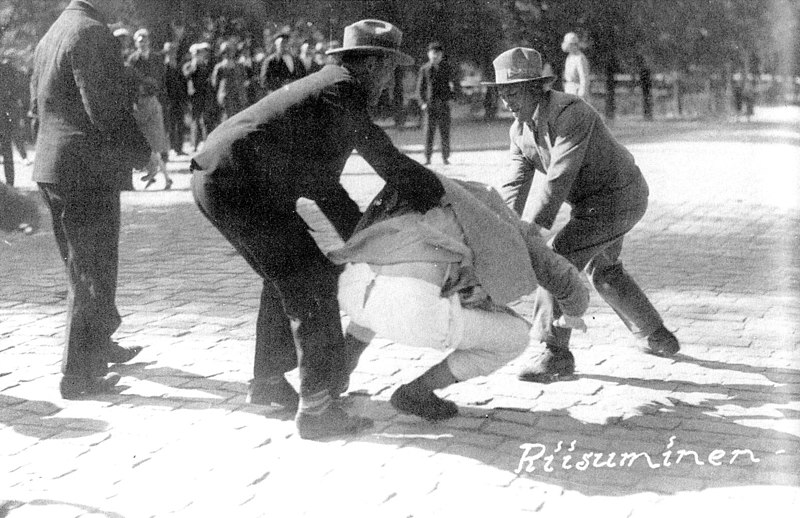
political repression
persecution of an individual or group within society for political reasons, for the purpose of restricting or preventing their ability to take part in the political life of a society

police brutality
use of excessive force by a police officer

secret police
intelligence agency and or police agency, law enforcement office which operates in secrecy

state terrorism
acts of terrorism against individuals conducted by organs of a state
enemy of the people
designation for political or class opponents of a state; term used in Antique Rome, Revolutionary France, Nazi Germany, Stalin-era Soviet Union, Communist China and The United States
death squad
armed group that conducts extrajudicial killings
enforced disappearance
unlawful secret disappearance
terror
policy of political repression and violence against opponents
Emergency
21-month period in the history of India

purge
thumb|Russian Count Nikolay Yevdokimov, who organized the extermination campaigns of "[[Tsitsekun", designated Russian military operations targeting Circassian natives by the term ochishchenie ("cleansing").]]
In history, religion and political science, a purge is a position removal or execution of people who are considered undesirable by those in power from a government, another, their team leaders, or society as a whole. A group undertaking such an effort is labeled as purging itself.
8888 Uprising
series of nationwide protests, marches and civil unrest in Burma (Myanmar) that peaked in August 1988
Victims of Communism Memorial
artwork
odious debt
legal theory that says that the national debt incurred by a despotic regime should not be enforceable
mass killings under communist regimes
organized communist killing of large numbers of non-combatants
Boluan Fanzheng
transition period in modern Chinese history in the aftermath of the Cultural Revolution, aiming at correcting the wrongs incurred during the previous political turmoils
political abuse of psychiatry
the misuse of psychiatry, including diagnosis, detention, and treatment, for the purposes of obstructing the human rights of individuals and/or groups in a society
suppression of the Society of Jesus
persecution of Jesuits from 1759 to 1814
salami tactics
divide and conquer process of threats and alliances used to overcome opposition
enemy of the state
person accused of certain crimes against the state
%20Bocca%20di%20Leone%20in%20the%20Doge's%20Palace.jpg)
denunciation
thumb|A "Lion's Mouth" postbox for anonymous denunciations at the Doge's Palace in [[Venice. Text translation: "Secret denunciations against anyone who will conceal favors and services or will collude to hide the true revenue from them".]]
exclusion zone
geographic area in which a sanctioning authority prohibits specified activities
Burning of Jaffna library
1981 event during the Sri Lankan civil war
Bedoun
The Bedoon or Bidoon or Bidoun (), fully Bidoon jinsiya, are stateless people in several Middle Eastern countries, but particularly in Kuwait, where there is a large population of stateless people who lack access to many of the country's basic services. It is widely believed that the Bedoon issue in Kuwait is sectarian in nature.

deplatforming
thumb|A bust of MIT president Francis Amasa Walker separated from its pedestal at the [[MIT Museum]]
Deplatforming, also known as no-platforming, is a boycott on an individual or group by removing the platforms used to share their information or ideas. The term is commonly associated with social media.

sexual repression
state in which a person is prevented from expressing their own sexuality or sexual orientation
political rehabilitation
process of a politician fallen from grace returning to public life

anti-communist mass killings
list of politically-motivated killings and atrocities committed against communists, alleged communists and related groups and their supporters

Human rights violations during the Syrian civil war
Wikimedia list article
ideological repression
forceful activities against competing ideologies and philosophies
Korean literati purges
series of political purges in the late 15th and 16th centuries
Years of Lead (Marocco)
period of Moroccan history between the 1960s and 1980s

transnational repression
effort by a state to prevent political dissent outside its borders
Portuguese Legion
Portuguese paramilitary organization under the Second Portuguese Republic
Belene labour camp
former forced labour camp
Johnny Abbes García
politician (1924-1967)
Memorial to Victims of Stalinist Repressions
monument in Chișinău, Moldova
Battalion 3-16
Eliminationism
Eliminationism is a political ideology that views a group within a larger social group as harmful and therefore believes it must be eliminated—by separation, censorship, or extermination—for the benefit of the larger group and in order to preserve its "purity."
Operation Murambatsvina
nationwide campaign of forcible slum clearances by the Zimbabwean government
Temara interrogation centre
interrogation centre in Morocco
Causeway Bay Books disappearances
missing staff from a Hong Kong bookseller
party prohibition
prohibition of a political party
Monument to the Victims of the Soviet Occupation
Proposed monument in Chișinău, Moldova
Mongoose Gang
Paramilitary group which operated from 1967 to 1979 under the control of Sir Eric Gairy
Death squads in El Salvador
1960s–1990s right-wing paramilitary groups
Treason Case of 1589
Joseon rebellion (1589)