Category
page 1Pre-Pottery Neolithic B

Baalbek
Baalbek (; ; ) is a city located east of the Litani River in Lebanon's Beqaa Valley, about northeast of Beirut. It is the capital of Baalbek-Hermel Governorate. In 1998, the city had a population of 82,608. Most of the population consists of Shia Muslims, followed by Sunni Muslims and Christians; in 2017, there was also a large presence of Syrian refugees.

Byblos
Byblos ( ; ), also known as Jbail, Jebeil, Jbeil or Jubayl (, locally ), is an ancient city in the Keserwan-Jbeil Governorate of Lebanon. The area is believed to have been first settled between 8800 and 7000BC and continuously inhabited since 5000BC. During its history, Byblos was part of numerous cultures including Egyptian, Phoenician, Assyrian, Persian, Hellenistic, Roman, Genoese, Mamluk and Ottoman. Urbanisation is thought to have begun during the third millennium BC when it developed into a city, making it one of the oldest cities in the world, if not the oldest. It is a UNESCO World Her
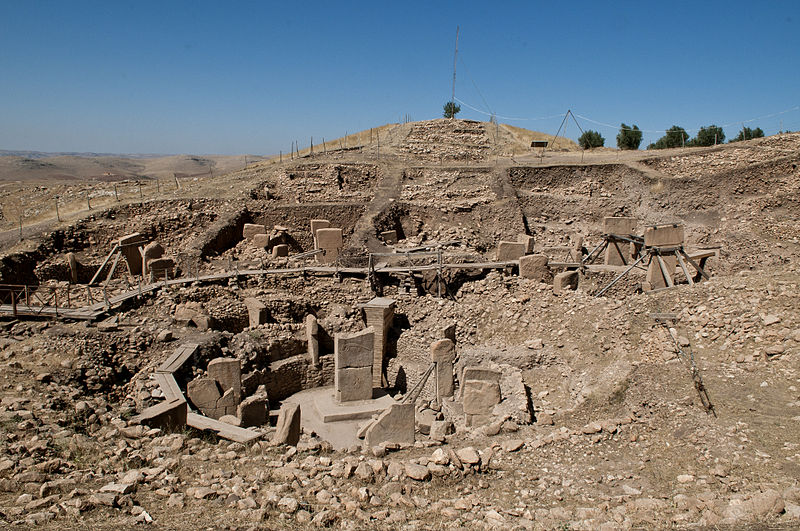
Göbekli Tepe
neolithic archaeological site in Turkey

Çayönü
Çayönü Tepesi is a Pre-Pottery Neolithic B settlement in southeastern Turkey which prospered from circa 8,630 to 6,800 BC. It is located in Diyarbakır Province forty kilometres north-west of Diyarbakır, one hundred and forty kilometres north-east of Şanlıurfa, at the foot of the Taurus mountains. It lies near the Boğazçay, a tributary of the upper Tigris River and the Bestakot, an intermittent stream. It is an early example of agriculture.
Ayn Ghazal
archaeological site in Jordan
Nevalı Çori
Early Neolithic settlement and archaeological site
Tell es-Sultan
archaeological site in the West Bank
Franchthi Cave
cave in Peloponnese, Greece
Pre-Pottery Neolithic B
archaeological culture

Mureybet
Mureybet () is a tell, or ancient settlement mound, located on the west bank of the Euphrates in Raqqa Governorate, northern Syria. The site was excavated between 1964 and 1974 and has since disappeared under the rising waters of Euphrates Lake. Mureybet was occupied between 10,200 and 8000 BC and is the eponymous type site for the Mureybetian culture, a subdivision of the Pre-Pottery Neolithic A (PPNA). In its early stages, Mureybet was a small village occupied by hunter-gatherers. Hunting was important and crops were first gathered and later cultivated, but they remained wild. During its fin
Mishmar HaEmek
kibbutz in Israel
Beidha
archaeological site in Jordan
Tell Aswad
Archaeological site in Syria
Bir al-Maksur
village in Israel
Haplogroup K
mtDNA
Basta
Prehistoric archaeological site in Jordan

Atlit Yam
submerged neolithic settlement in Israel

Shimron
Tel Shimron (Hebrew: תל שמרון) is an archaeological site and nature reserve in the Jezreel Valley. Since 2016 the site is being excavated in cooperation with the Jezreel Valley Regional Project.

Jabal es Saaïdé
human settlement in Lebanon

Ba'ja
thumb|Areas B, E, and TU 2
thumb|Walls in Area TU 2
'''Ba'ja''' () is a Neolithic village north of Petra, Jordan. Like the nearby site of Basta, the settlement was built in c. , during the PPNB (Pre-Pottery Neolithic B) period. Ba'ja lies at an altitude of approximately , and is only accessible with a climbing route through a narrow, steep canyon.
It is one of the largest neolithic villages in the Jordan area.
Cafer Höyük
archeological site in Turkey

Plastered human skulls
prehistoric burial practice
Nahal Oren
archaeological site in Israel
Boncuklu Tarla
Neolithic archaeological site in Turkey

Baysamun
Baysamun or Beisamoun (, Beisamûn) was a small Palestinian Arab village, located in the marshy Hula Valley northeast of Safad. In 1945, it had a population of 20. It was depopulated during the 1948 War on May 25, 1948, by the Palmach's First Battalion in Operation Yiftach.
lime plaster
type of plaster composed of sand, water, and lime
Tahunian
thumb|upright=1.7|Object said to be "the oldest sickle", flint and resin, Tahunian culture, c. 7000 BC, [[Nahal Hemar Cave. Israel Museum.]]
Shillourokambos
Shillourokambos () is a Pre-Pottery Neolithic B (PPNB) site near Parekklisia, east of Limassol in southern Cyprus. It is located on a low plateau. Excavations began in 1992. The settlement has four phases and was occupied from the end of the 9th millennium to the second half of the 8th millennium.
Gürcütepe
Gürcütepe is a Neolithic site on the southeastern outskirts of Şanlıurfa in Turkey, consisting of four very shallow tells along Sirrin Stream that flows from Şanlıurfa. All four hills are now covered by modern buildings, so they are no longer recognizable. In the late 1990s a German archaeological team under the direction of Klaus Schmidt carried out soundings on all four hills and made extensive excavations on the second hill seen from the east.