Category
page 1Psychological concepts
.jpg)
thought
thumb|The Thinker by [[Auguste Rodin (1840–1917) in the garden of the Musée Rodin, Paris]]
In their most common sense, thought and thinking refer to cognitive processes that occur independently of direct sensory stimulation. Core forms include judging, reasoning, concept formation, problem solving, and deliberation. Other processes, such as entertaining an idea, memory, or imagination, are also frequently considered types of thought. Unlike perception, these activities can occur without immediate input from the sensory organs. In a broader sense, any mental event—including perception and uncon

mind
thumb|alt=Diagram of a head with symbols for different mental capacities inside it|The mind is responsible for phenomena like perception, [[thought, feeling, and action.]]
.jpg)
emotion
thumb|Sixteen faces expressing the human passions – colored engraving by J. Pass, 1821, after [[Charles Le Brun|371x371px]]

behavior
Behavior (American English) or behaviour (British English) is the range of actions of organisms, individuals, systems or artificial entities in some environment. These systems can include other systems or organisms as well as the inanimate physical environment. It is the computed response of the system or organism to various stimuli or inputs, whether internal or external, conscious or subconscious, overt or covert, and voluntary or involuntary. While some behavior is produced in response to an organism's environment (extrinsic motivation), behavior can also be the product of intrinsic motivat

belief
A belief is a subjective attitude that something is true or a state of affairs is the case. A subjective attitude is a mental state of having some stance, take, or opinion about something. In epistemology, philosophers use the term belief to refer to attitudes about the world which can be either true or false. To believe something is to take it to be true; for instance, to believe that snow is white is comparable to accepting the truth of the proposition "snow is white". However, holding a belief does not require active introspection. For example, few individuals carefully consider whether or

feeling
According to the APA Dictionary of Psychology, a feeling is "a self-contained phenomenal experience"; feelings are "subjective, evaluative, and independent of the sensations, thoughts, or images evoking them". The term feeling is closely related to, but not the same as, emotion. Feeling may, for instance, refer to the conscious subjective experience of emotions. The study of subjective experiences is called phenomenology. Psychotherapy generally involves a therapist helping a client understand, articulate, and learn to effectively regulate the client's own feelings, and ultimately to take resp

motivation
Motivation is an internal state that propels individuals to engage in goal-directed behavior. It is often understood as a force that explains why people or other animals initiate, continue, or terminate a certain behavior at a particular time. It is a complex phenomenon and its precise definition is disputed. It contrasts with amotivation, which is a state of apathy or listlessness. Motivation is studied in fields such as psychology, motivation science, neuroscience, and philosophy.

will
faculty of the mind which intentionally selects the strongest desire from among the various desires present

narcissism
thumb|250px|Narcissus (Caravaggio)|Narcissus (1597–99) by [[Caravaggio; the man in love with his own reflection]]
intuition
Intuition is the ability to acquire knowledge without recourse to conscious reasoning or needing an explanation. Different fields use the word "intuition" in very different ways, including but not limited to: direct access to unconscious knowledge; unconscious cognition; gut feelings; inner sensing; inner insight to unconscious pattern-recognition; and the ability to understand something instinctively, without any need for conscious reasoning. Intuitive knowledge tends to be approximate or heuristic.

déjà vu
the phenomenon of feeling as though one has lived through the present situation before
.jpg)
world view
A worldview (also world-view or world view) or '''''' is the fundamental cognitive orientation of an individual or society encompassing the whole of the individual's or society's knowledge, culture, and point of view. When two parties view the same real world phenomenon, if their world views differ, one may include elements that the other does not leading to differing conclusions, despite the shared reference point.
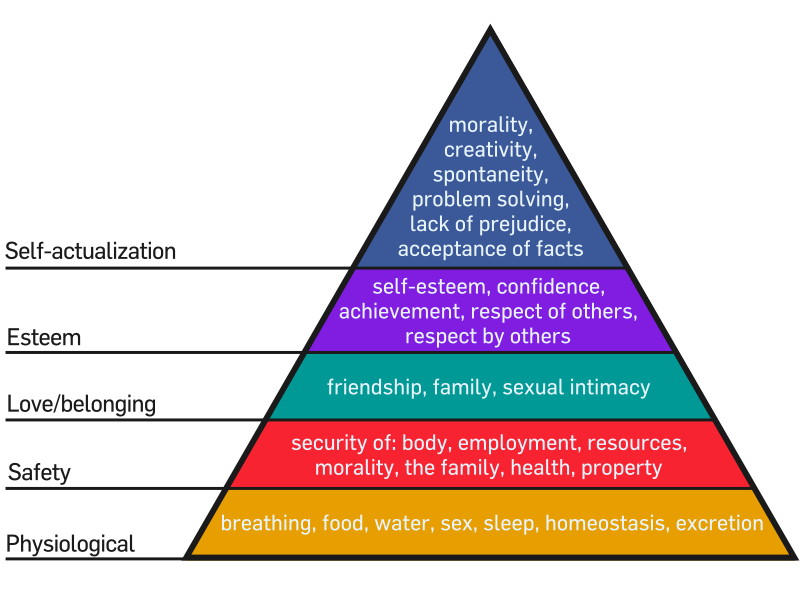
Maslow's hierarchy of needs
theory in developmental psychology proposed by Abraham Maslow, comprising a five-tier model of human needs: physiological, safety, love and belonging, esteem, and self-actualization

self-esteem
Self-esteem is confidence in one's own worth, abilities, or morals. Self-esteem encompasses beliefs about oneself (for example, "I am loved", "I am worthy") as well as emotional states, such as triumph, despair, pride, and shame. Smith and Mackie define it by saying "The self-concept is what we think about the self; self-esteem, is the positive or negative evaluations of the self, as in how we feel about it (see self)."

cogito ergo sum
philosophical statement made by René Descartes

ecstasy
advanced emotion, subjective experience of total involvement of the subject, with an object of their awareness
manipulation
type of social influence
psyche
psychological term refering to the group of acts and functions of the mind

confirmation bias
tendency of people to favor information that confirms their beliefs or hypotheses

schadenfreude
thumb|upright=1.4|alt=painting|Return to the Convent, by Eduardo Zamacois y Zabala, 1868. The painting depicts a group of [[monks laughing while a lone monk struggles with a donkey. ]]
perfectionism
personality trait characterized by a person's striving for flawlessness and setting high performance standards
.svg)
judgment
thumb|Illustration of a judge evaluating evidence in court to make a judgement
dissociation
mild detachment from immediate surroundings to more severe detachment from physical and emotional experience
existential crisis
moment when individuals question whether their lives have meaning, purpose, or value, and are negatively impacted by the contemplation
naïve
Naivety (also spelled naïvety), naiveness, or naïveté is the state of being naive. It refers to an apparent or actual lack of experience and sophistication, often describing a neglect of pragmatism in favor of moral idealism. A naïve may be called a naïf.
locus of control
degree to which people believe that they, as opposed to external forces, have control over their lives
meaning
nebulously defined concept used in psychology as well as in other fields such as philosophy, linguistics, semiotics and sociology, in which an item, entity, or action represents, signals, or conveys
mental image
representation in an individual's mind of the physical world outside of that individual
self-actualization
Self-actualization, in Maslow's hierarchy of needs, is the highest personal aspirational human need in the hierarchy. It represents where one's potential is fully realized after more basic needs, such as for the body and the ego, have been fulfilled, and is recognised in psychological teaching as the peak of human needs. Maslow later added the category self-transcendence (which, strictly speaking, extends beyond one's own "needs").
inner peace
state of psychological or spiritual calm despite the potential presence of stressors

carnism
Carnism is a concept used in discussions of humanity's relation to other animals, defined as a prevailing ideology in which people support the use and consumption of animal products, especially meat. Carnism is presented as a dominant belief system supported by a variety of defense mechanisms and mostly unchallenged assumptions.
As a dominant ideological system of which meat consumption and animal exploitation are a part, it prescribes norms and beliefs about animal treatment. The term carnism was coined by social psychologist and author Melanie Joy in 2001 and popularized by her book Why We
cognitivism
theoretical psychological framework for understanding the mind that gained credence in the 1950s
human condition
characteristics and key events that compose the essentials of human existence
trait theory
approach to the study of human personality
mentalization
In psychology, mentalization is the ability to understand the mental state – of oneself or others – that underlies overt behaviour.
Mentalization can be seen as a form of imaginative mental activity that lets us perceive and interpret human behaviour in terms of intentional mental states (e.g., needs, desires, feelings, beliefs, goals, purposes, and reasons). It is sometimes described as "understanding misunderstanding." Another term that David Wallin has used for mentalization is "Thinking about thinking". Mentalization can occur either automatically or consciously.
pluralistic ignorance
situation in which a majority of group members privately reject a norm, but incorrectly assume that most others accept it, and therefore go along with it
openness to experience
personality trait

conatus
thumb|200px|Conatus is, for Baruch Spinoza, where "each thing, as far as it lies in itself, strives to persevere in its being."
In the philosophy of Baruch Spinoza, conatus (; :wikt:conatus; Latin for "effort; endeavor; impulse, inclination, tendency; undertaking; striving") is an innate inclination of a thing to continue to exist and enhance itself. This thing may be mind, matter, or a combination of both, and is often associated with God's will in a pantheist view of nature. The conatus may refer to the instinctive will to live of living organisms or to various metaphysical theories of motio
overview effect
experience of seeing the reality and fragility of the Earth in space
identity crisis
failure to achieve ego identity during adolescent development
ERG theory
theory

pedant
thumb|240px|The Pedant by caricaturist Thomas Rowlandson
Pedantry ( ) is an excessive concern with formalism, minor details, and rules that are not important.
intrusive thought
unwelcome involuntary thought, image, or unpleasant idea that may become an obsession
serial position effect
tendency of a person to recall the first and last items in a series best, and the middle items worst
posttraumatic growth
positive psychological change as a result of challenging life circumstances
descriptive knowledge
knowledge that can be expressed in a declarative sentence or an indicative proposition
Machiavellianism
psychological trait centered on manipulation, coldness, and indifference to morality
joint attention
when two people focus on something at once
procedural knowledge
ability to do something
psychoticism
Psychoticism is one of the three traits used by the psychologist Hans Eysenck in his outdated P–E–N (psychoticism, extraversion and neuroticism) model of personality. Psychoticism includes the traits of "aggression, coldness, egocentrism, impulsivity, lack of empathy, tough-mindedness, and being antisocial."
toxic positivity
ignoring negative emotions rather than dealing with them
numinous
Numinous () means "arousing spiritual or religious emotion; mysterious or awe-inspiring"; also "supernatural" or "appealing to the aesthetic sensibility." The term was given its present sense by the German theologian and philosopher Rudolf Otto in his influential 1917 German book The Idea of the Holy. He also used the phrase mysterium tremendum as another description for the phenomenon. Otto's concept of the numinous influenced thinkers including Carl Jung, Mircea Eliade, and C. S. Lewis. It has been applied to theology, psychology, religious studies, literary analysis, and descriptions of psy
open-mindedness
Open-mindedness is receptiveness to new ideas. Open-mindedness relates to the way in which people approach the views and knowledge of others. Jason Baehr defines an open-minded person as one who "characteristically moves beyond or temporarily sets aside his own doxastic commitments in order to give a fair and impartial hearing to the intellectual opposition". Jack Kwong's definition sees open-mindedness as the "willingness to take a novel viewpoint seriously".
zero-sum thinking
cognitive bias of assuming the situation is a zero-sum game
idée fixe
idea that preoccupies an individual
apeirophobia
Apeirophobia () (from ) is the specific phobia of infinity, eternity, endlessness, or the uncountable and is also known as the fear of infinity, the fear of eternity, or the fear of endlessness, causing discomfort and sometimes panic attacks from intrusive thoughts of the infinity. It normally starts in adolescence or earlier and it is currently not known how it normally develops over time. Apeirophobia may be caused by existential dread about eternal life or oblivion following death. Due to this, it is often connected with thanatophobia (the phobia of death), chronophobia (the phobia of time
Conation
In the philosophy of mind, and in psychology, conation refers to the ability to apply intellectual energy to a task to achieve its completion or reach a solution. Conation may be distinguished from other mental phenomena, particularly cognition, and sensation, and has been described as "neglected" in comparison with these phenomena. It may overlap to some extent with the concept of motivation, but "the ability to focus and maintain persistent effort" has been seen as more pertinent to conation.
Illusion of transparency
psychological trait
pronoia
phenomenon akin to the opposite of paranoia
oceanic feeling
a feeling of being one with the world