Category
page 1Quantum measurement

reality
Reality is the state of everything that exists, not how they might be imagined. Different cultures and academic disciplines conceptualize it in various ways.
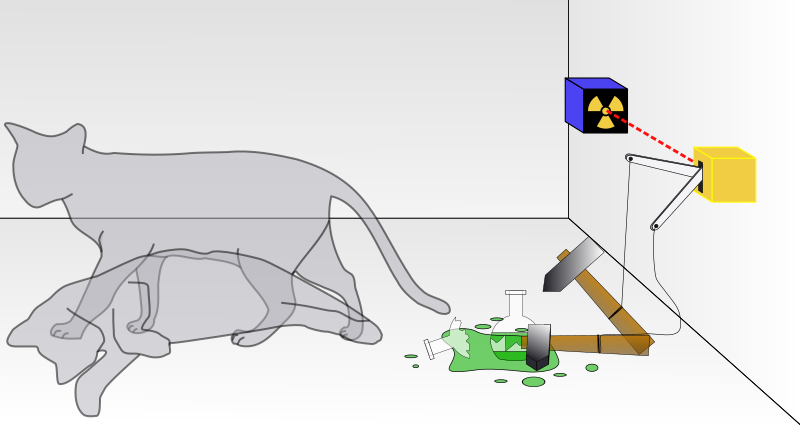
Schrödinger's cat
thought experiment

quantum entanglement
correlation between measurements of quantum subsystems, even when spatially separated

quantum number
notation for conserved quantities in physics and chemistry

EPR paradox
early and influential critique leveled against quantum mechanics

Stern–Gerlach experiment
physical experiment that demonstrated the quantization of angular momentum
Copenhagen interpretation
probabilistic interpretation of quantum mechanics involving wavefunction collapse
many-worlds interpretation
interpretation of quantum mechanics which denies the collapse of the wavefunction
Bell's theorem
in quantum physics, the theorem that locally causal hidden-variable theories cannot reproduce correlations predicted by quantum mechanics
wave function collapse
process by which a quantum system takes on a definitive state
quantum decoherence
loss of quantum coherence due to interaction with the environment
interpretation of quantum mechanics
set of statements which attempt to explain how quantum mechanics informs our understanding of nature
probability amplitude
complex number whose squared absolute value is a probability
De Broglie–Bohm theory
interpretation of quantum mechanics
principle of locality
physical principle that only immediate surroundings can influence an object
measurement in quantum mechanics
interaction of a quantum system with a classical observer
hidden-variable theory
any theory of quantum mechanics where probabilistic outcomes are actually determined precisely by unobservable internal variables
Born rule
in quantum mechanics, the rule that the probability of observing an eigenvalue is the square of the modulus of the inner product between the quantum state and the eigenstate corresponding to the eigenvalue
quantum Zeno effect
effect in quantum mechanics which disallows certain conditions in the decaying of a quantum state
measurement problem
in quantum mechanics, the problem of how or whether wave function collapse occurs during measurement
Wigner's friend
thought experiment in theoretical quantum physics
quantum suicide
Bohr–Einstein debates
Series of public disputes between physicists Niels Bohr and Albert Einstein
quantum eraser experiment
quantum experiment in which photons are shone at a double-slit interferometer; whether interference patterns occur depends on whether the information about which slit the photon went through marked is erased or not
pilot wave theory
interpretation of quantum mechanics
Elitzur–Vaidman bomb tester
quantum mechanics thought experiment that uses interaction-free measurements to verify that a bomb is functional without having to detonate it
consistent histories
Interpretation of quantum mechanics based on a consistency criterion that assigns probabilities to various alternative histories of a system
quantum immortality
thought experiment in which one plays Russian roulette with the trigger connected to the Geiger counter measuring the decay of a radioactive atom
relational quantum mechanics
interpretation of quantum mechanics which treats the state of a quantum system as the relation between the observer and the system
delayed-choice quantum eraser
physics experiment that combines the quantum eraser experiment with concepts in Wheeler's delayed-choice experiment
Bell test experiments
experiments in quantum mechanics
ensemble interpretation
interpretation of quantum mechanics that considers the quantum state description to apply only to an ensemble of similarly prepared systems, rather than supposing that it exhaustively represents an individual physical system
weak measurement
quantum measurement that results in an observer obtaining very little information about the system on average, but also disturbs the state very little
quantum Darwinism
theory of the emergence of classicality by environment-induced selection of quantum states
objective-collapse theory
theory according to which wavefunction collapse happens under well-defined, objective conditions

positive-operator-valued measure
In functional analysis and quantum information science, a positive operator-valued measure (POVM) is a measure whose values are positive semi-definite operators on a Hilbert space. POVMs are a generalization of projection-valued measures (PVM) and, correspondingly, quantum measurements described by POVMs are a generalization of quantum measurement described by PVMs (called projective measurements).
Ghirardi–Rimini–Weber theory
objective collapse theory in quantum mechanics
quantum nonlocality
deviations from local realism characteristic of quantum mechanics
Afshar experiment
Controversial physics experiment
transactional interpretation
interpretation of quantum mechanics according to which retarded (forward in time) and advanced (backward in time) waves form a quantum interaction as a Wheeler–Feynman handshake
Aspect's experiment
quantum mechanics experiment
interaction-free measurement
non-invasive measurement of a quantum system
quantum clock
atomic clock with laser cooled single ions confined together in an electromagnetic ion trap
local hidden variable theory
hidden-variable theory that is with local realism
no-communication theorem
no-go theorem in quantum information theory, forbidding some communication during measurement of entangled states
universal wavefunction
a wavefunction describing the quantum state of the entire universe
Popper's experiment
experiment proposed by Karl Popper to put to the test different interpretations of quantum mechanics
Hardy's paradox
thought experiment in quantum mechanics in which a particle and its antiparticle may interact without annihilating each other
Penrose interpretation
objective collapse theory that uncertainty in spacetime curvature causes collapse of the quantum state
CHSH inequality
testable implication of local hidden variable theories
Gleason's theorem
theorem giving a justification of the Born rule in quantum mechanics
mutually unbiased bases
a set of orthonormal bases, where each vector of a given basis has the same overlap with all the vectors of other bases