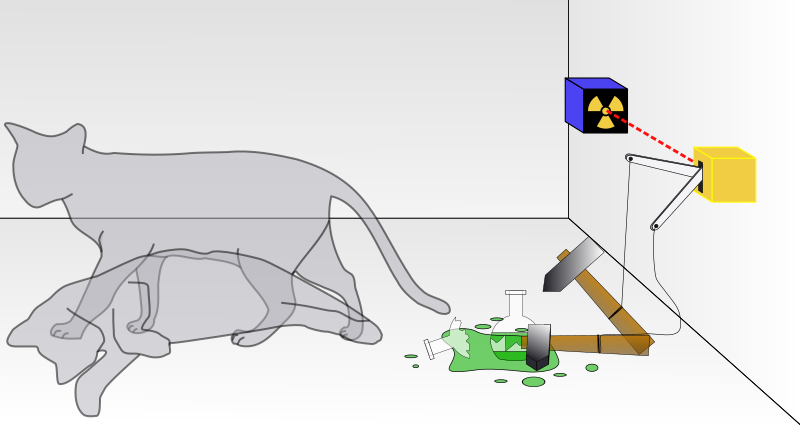
File:Schrodingers_cat.svg · Wikimedia Commons · See Wikimedia Commons
I don't have sufficient context provided to write an accurate overview of Schrödinger's cat. While you've identified it as a thought experiment, I would need additional information about its specific purpose, the physics concepts it illustrates, or its historical significance to write an accurate and neutral 2-sentence explanation suitable for a general reader.
AI-generated from the Wikipedia summary — may contain errors.
Wikidata facts
- Instance of
- paradox
- Named after
- Erwin Schrödinger
- Creator
- Erwin Schrödinger
- Image
- Schrodingers cat.svg
Show 4 more facts
- Commons category
- Schrödinger's Cat
- publication date
- 1935-01-01
- Stack Exchange tag
- physics.stackexchange.com/tags/schroedingers-cat
- on focus list of Wikimedia project
- Wikipedia:Vital articles/Level/4
via Wikidata · CC0
~23 min read
Encyclopedic overview
Schrödinger's cat: a cat, a flask of poison, and a radioactive source connected to a Geiger counter are placed in a sealed box. As illustrated, the quantum description uses a superposition of an alive cat and one that has died. In quantum mechanics, Schrödinger's cat is a thought experiment concerning quantum superposition. In the thought experiment, a hypothetical cat in a closed box may be considered to be simultaneously both alive and dead while it is unobserved, as a result of its fate being linked to a random subatomic event that may or may not occur. This experiment, viewed this way, is described as a paradox. This thought experiment was devised by physicist Erwin Schrödinger in 1935, in a discussion with Albert Einstein, to illustrate what Schrödinger saw as the problems of Niels Bohr and Werner Heisenberg's philosophical views on quantum mechanics.
In Schrödinger's original formulation, a cat, a flask of poison, and a radioactive source are placed in a sealed box. If an internal radiation monitor such as a Geiger counter detects radioactivity (a single atom decaying), the flask is shattered, releasing the poison, which kills the cat. If no decaying atom triggers the monitor, the cat remains alive. Mathematically, the wave function that describes the contents of the box is a combination, or quantum superposition, of these two possibilities. Yet, when one looks in the box, one sees the cat either alive or dead, not both alive and dead. This poses the question of when exactly quantum superposition ends and reality resolves into one possibility or the other.
Excerpted from Wikipedia’s “Schrödinger's cat” article, available under the CC BY-SA 4.0 licence.
Gallery (4)
Available in 80 languages
- Español
- Français
- Deutsch
- 中文
- 日本語
- Русский
- Português
- Italiano
- العربية
- हिन्दी
- Afrikaans
- Armenian
- Asturian
- azb
- Azerbaijani
- Bahasa Indonesia
- Bangla
- Basque
Show 61 more
- Belarusian
- Bishnupriya
- Bulgarian
- Catalan
- Chuvash
- Croatian
- Czech
- Danish
- Esperanto
- Estonian
- Filipino
- Finnish
- Galician
- Georgian
- Greek
- Hebrew
- Hungarian
- Interlingua
- Irish
- Kurdish
- Latvian
- Lithuanian
- Macedonian
- Malay
- Malayalam
- Marathi
- Mazanderani
- Nederlands
- Norwegian
- Norwegian Nynorsk
- Occitan
- Odia
- Polski
- Punjabi
- Romanian
- Serbian
- Serbian (Latin)
- Sicilian
- Silesian
- simple
- Slovenian
- Svenska
- Tamil
- Tatar
- Telugu
- Tiếng Việt
- Türkçe
- Turkmen
- Ukrainian
- Uzbek
- Venetian
- Waray
- Western Panjabi
- Wu Chinese
- Yakut
- Zaza
- zh_classical
- zh_yue
- فارسی
- ไทย
- 한국어
via Wikidata sitelinks · CC0