Category
page 1Quantum mechanics

quantum mechanics
fundamental theory in physics describing the properties of nature on an atomic scale

elementary particle
quantum particle having no known substructure; quark, electron, photon, etc.
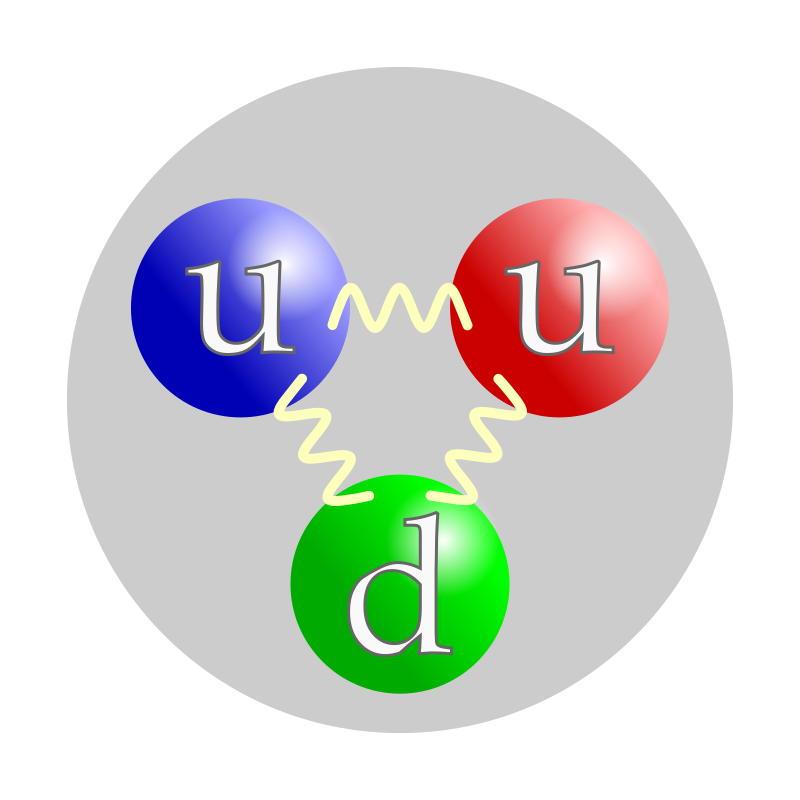
subatomic particle
particle smaller than an atom

photoelectric effect
emission of electrons when light hits a material

uncertainty principle
fundamental principle in quantum physics
.jpg)
quantum
In physics, a quantum (: quanta) is the minimum amount of any physical entity (physical property) involved in an interaction. The fundamental notion that a property can be "quantized" is referred to as "the hypothesis of quantization". This means that the magnitude of the physical property can take on only discrete values consisting of integer multiples of one quantum. For example, a photon is a single quantum of light of a specific frequency (or of any other form of electromagnetic radiation). Similarly, the energy of an electron bound within an atom is quantized and can exist only in certain

quantum field theory
theoretical framework combining classical field theory, special relativity, and quantum mechanics

multiverse
The multiverse is the hypothetical set of all universes. Together, these universes are presumed to comprise everything that exists: the entirety of space, time, matter, energy, information, and the physical laws and constants that describe them. The different universes within the multiverse are called "parallel universes", "flat universes", "other universes", "alternate universes", "multiple universes", "plane universes", "parent and child universes", "many universes", or "many worlds". One common assumption is that the multiverse is a "patchwork quilt of separate universes all bound by the sa

electron shell
principal energy levels in atomic physics
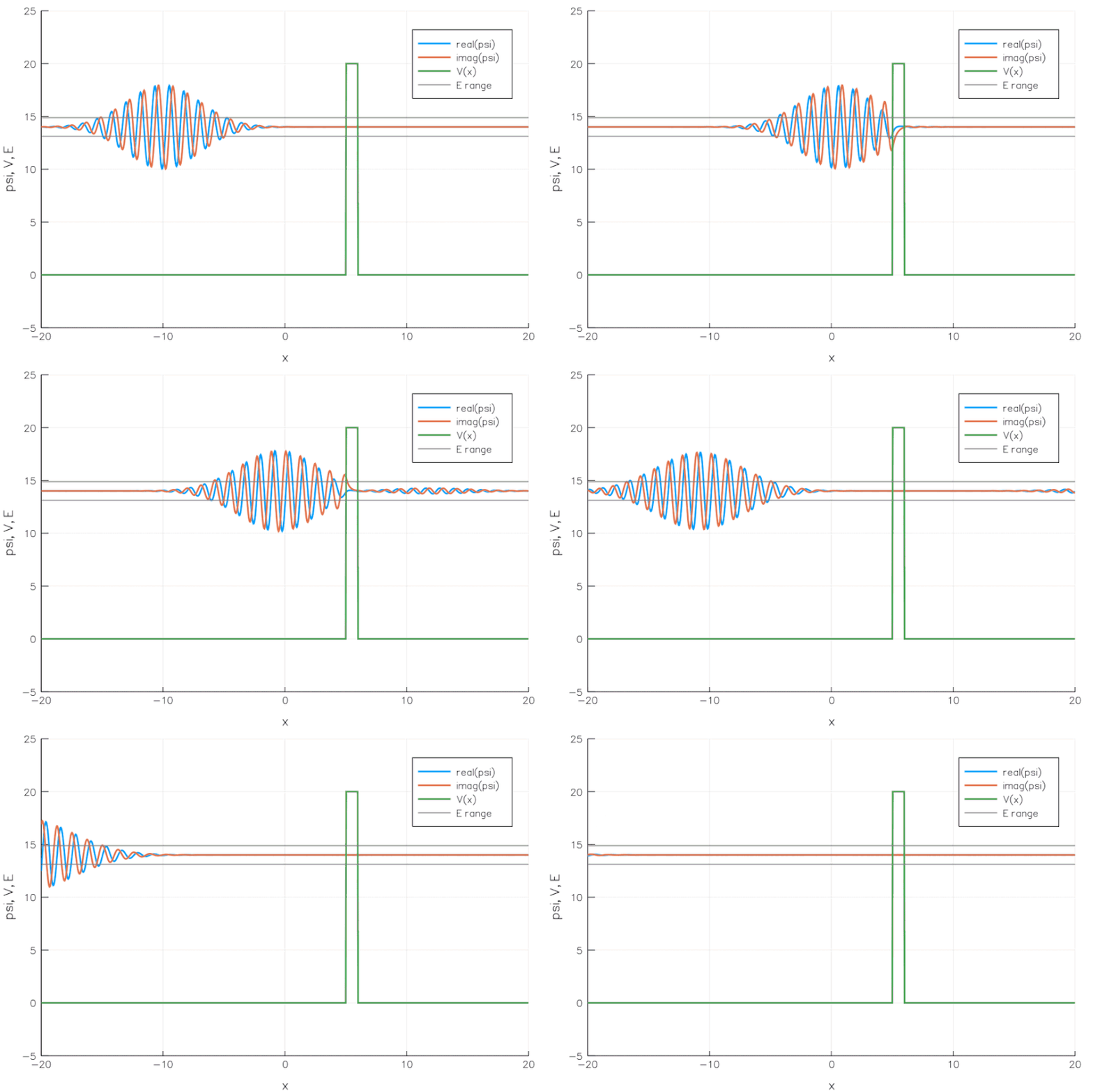
quantum tunneling
quantum mechanical phenomenon

coherence
ideal property of waves that enables stationary (i.e. temporally and spatially constant) interference
quantum superposition
principle of quantum mechanics
parity
flip in the sign of one spatial coordinate, in classical and quantum physics
band gap
energy range in a solid where no electron states can exist
correspondence principle
physics principle that quantum theories reproduce classical physics in the limit of large quantum numbers, formulated by Niels Bohr in 1920
quantum fluctuation
random change in the energy inside a (typically sub-microscopic) volume
Electron diffraction
Bending of electron beams due to electrostatic interactions with matter
quantum physics
theories, models and concepts that go back to the quantum hypothesis of Max Planck
mathematical formulation of quantum mechanics
mathematical structures that allow quantum mechanics to be explained
matrix mechanics
Formulation of quantum mechanics
Aharonov–Bohm effect
electromagnetic quantum-mechanical effect in regions of zero magnetic and electric field
complementarity
quantum objects have complementary properties that cannot all be measured simultaneously
wave packet
short "burst" or "envelope" of restricted wave action that travels as a unit
path integral
formal sum or integral over all histories of a quantum system
Introduction to quantum mechanics
non-technical introduction to the basic concepts of quantum physics
normal mode
pattern of motion in which all parts of the system move sinusoidally with the same frequency and with a fixed phase relation
hydrogen-like atom
atomic nucleus with one electron that behaves like hydrogen

spinor
thumb|upright=1.5|A spinor visualized as a vector pointing along the Möbius band, exhibiting a sign inversion when the circle (the "physical system") is continuously rotated through a full turn of 360°.
Pauli equation
quantum mechanical equation of motion of charged particles in magnetic field
Bose gas
quantum-mechanical phase of matter, analogous to a classical ideal gas
degenerate energy level
energy level of a quantum system that corresponds to two or more different measurable states
time crystal
quantum system whose ground state is one in which the particles are in repetitive motion
field electron emission
emission of electrons induced by an electrostatic field
coupling constant
parameter describing the strength of a force
Bloch sphere
geometrical representation of the space of pure and mixed states of a qubit
observable
In physics, an observable is a physical property or physical quantity that can be measured. In classical mechanics, an observable is a real-valued "function" on the set of all possible system states, e.g., position and momentum. In quantum mechanics, an observable is described by a linear operator.
For example, these operators might represent submitting the system to various electromagnetic fields and eventually reading a value.
stationary state
in quantum mechanics
Fock space
algebraic construct for studying identical particles in quantum mechanics
Clebsch–Gordan coefficient
coefficients in angular momentum eigenstates of quantum systems
quantum jump
abrupt transition of a quantum system from one quantum state to another, from one energy level to another
mesoscopic physics
a subdiscipline of condensed matter physics that deals with materials of an intermediate length
interaction picture
intermediate representation between the Schrödinger picture and the Heisenberg picture
Slater determinant
expression that describes the wave function of a multi-fermionic system
Heisenberg picture
formulation of quantum mechanics in which observable operators evolve over time, while the state vector does not change
probability density current
quantity describing the flow of probability per unit time per unit area

propagator
In quantum mechanics and quantum field theory, the propagator is a function that specifies the probability amplitude for a particle to travel from one place to another in a given period of time, or to travel with a certain energy and momentum. In Feynman diagrams, which serve to calculate the rate of collisions in quantum field theory, virtual particles contribute their propagator to the rate of the scattering event described by the respective diagram. Propagators may also be viewed as the inverse of the wave operator appropriate to the particle, and are, therefore, often called ''(causal) Gre
relativistic quantum mechanics
quantum mechanics taking into account particles near or at the speed of light
imaginary time
Wick-rotated time coordinates in relativistic field theory
selection rule
formal constraint on the possible transitions of a system from one quantum state to another
potential energy surface
a mapping of possible energy states of a system
attophysics
physics on extremely short timescales, approximately 10⁻¹⁸ seconds
evanescent wave
oscillating electric and/or magnetic field that does not propagate as an electromagnetic wave but whose energy is spatially concentrated in the vicinity of the source
strangelet
A strangelet (pronounced ) is a hypothetical particle consisting of a bound state of roughly equal numbers of up, down, and strange quarks. An equivalent description is that a strangelet is a small fragment of strange matter, small enough to be considered a particle. The size of an object composed of strange matter could, theoretically, range from a few femtometers across (with the mass of a light nucleus) to arbitrarily large. Once the size becomes macroscopic (on the order of meters across), such an object is usually called a strange star. The term "strangelet" originates with Edward Farhi a
quantum thermodynamics
study of quantum-mechanical thermodynamic systems and processes
Spin echo
response of spin to electromagnetic radiation

retrocausality
Retrocausality, or backwards causation, is a concept of cause and effect in which an effect precedes its cause in time and so a later event affects an earlier one. In quantum physics, the distinction between cause and effect is not made at the most fundamental level and so time-symmetric systems can be viewed as causal or retrocausal. Philosophical considerations of time travel often address the same issues as retrocausality, as do treatments of the subject in fiction, but the two phenomena are distinct.
scattering theory
method for studying scattering of waves and particles
adiabatic invariant
property of a physical system that stays approximately constant when changes occur slowly, e.g. entropy
Landau quantization
quantum phenomenon
many-body problem
physical problem pertaining to the properties of microscopic systems made of a large number of interacting particles