Category
page 1Quark matter
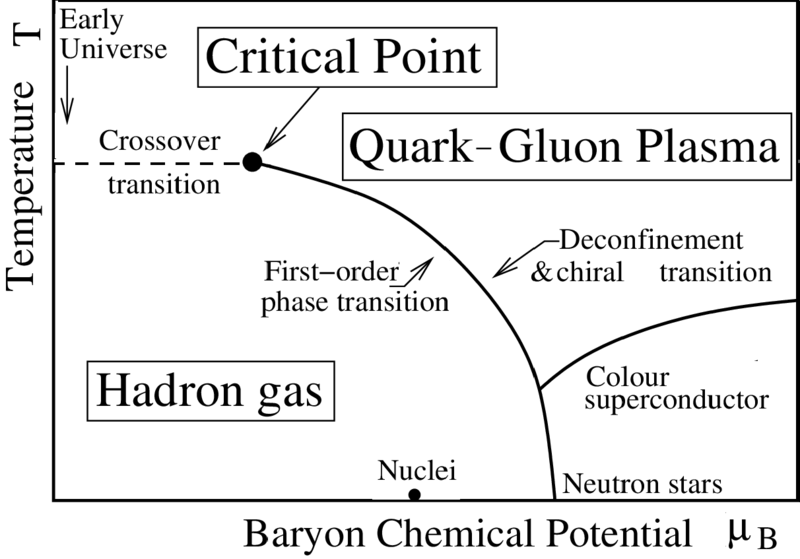
quark–gluon plasma
phase of quantum chromodynamics characterised by an assembly of quarks and gluons at thermal and chemical equilibrium
flavour
type of elementary particles occurring in the Standard Model
color confinement
phenomenon preventing hadrons (quarks bound by the strong force using gluons) from being separated into free individual quarks
strange matter
Degenerate matter made from strange quarks
strangelet
A strangelet (pronounced ) is a hypothetical particle consisting of a bound state of roughly equal numbers of up, down, and strange quarks. An equivalent description is that a strangelet is a small fragment of strange matter, small enough to be considered a particle. The size of an object composed of strange matter could, theoretically, range from a few femtometers across (with the mass of a light nucleus) to arbitrarily large. Once the size becomes macroscopic (on the order of meters across), such an object is usually called a strange star. The term "strangelet" originates with Edward Farhi a
QCD matter
number of theorized phases of matter whose degrees of freedom include quarks and gluons
QCD vacuum
lowest-energy state of in quantum chromodynamics
Deconfinement
In physics, deconfinement (in contrast to confinement) is a phase of matter in which certain particles are allowed to exist as free excitations, rather than only within bound states. Essentially like the early universe, "strongly interacting particles at high temperature or density are expected to produce weakly interacting “deconfined” quarks and gluons [...] the famous quarkgluon plasma."
color superconductivity
phenomenon in quark matter where matter carries color charge without loss