Category
page 1Quechua words and phrases

guanaco
The guanaco ( ; Lama guanicoe) is a camelid native to South America, closely related to the domesticated llama. Guanacos are one of two wild South American camelids; the other species is the vicuña, which lives at higher elevations.
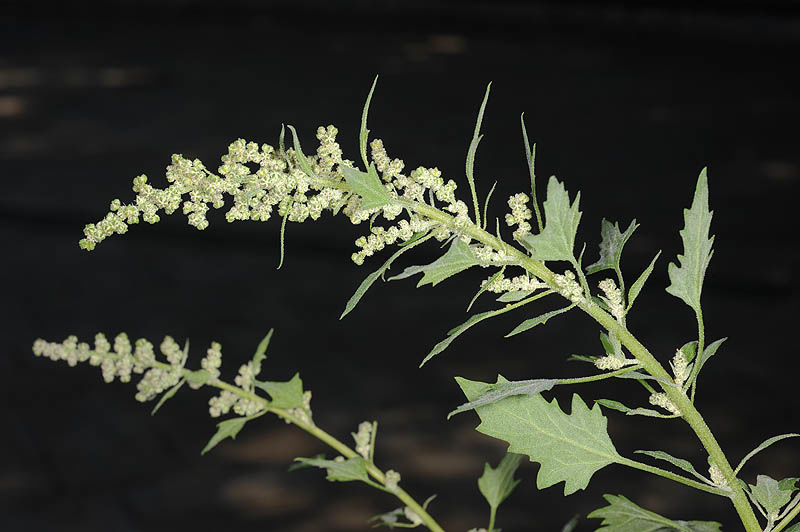
Chenopodium quinoa
Quinoa (Chenopodium quinoa; , from Quechua ' or ') is a flowering plant in the amaranth family. It is an herbaceous annual plant grown as a crop primarily for its edible seeds; the seeds are high in protein, dietary fiber, B vitamins and dietary minerals especially potassium and magnesium in amounts greater than in many grains. Quinoa is not a grass but rather a pseudocereal botanically related to spinach and amaranth (Amaranthus spp.), and originated in the Andean region of northwestern South America. It was first used to feed livestock 5,2007,000 years ago, and for human consumption 3,0004,0

pampa
The Pampas (; from Quechua 'plain'), also known as the Pampas Plain, are fertile South American low grasslands that cover more than and include the Argentine provinces of Buenos Aires, La Pampa, Santa Fe, Entre Ríos, and Córdoba; all of Uruguay; and Brazil's southernmost state, Rio Grande do Sul. The vast plains are a natural region, interrupted only by the low Ventana and Tandil hills, near Bahía Blanca and Tandil (Argentina), with a height of and , respectively. This ecoregion has been changed by humans, especially since the release of animals like cattle, pigs, and especially sheep onto the

Gran Chaco
region of Southern America
.jpg)
jerky
thumb|upright=1.35|Jerky
thumb|upright=1.35|Orange-marinated beef jerky
thumb|Meat drying to make jerky. Gandhola Monastery, [[Lahaul, India]]

Supay
thumb|200px|Supay, as interpreted in a Peruvian festival
In the Quechua, Aymara, and Inca mythologies, '''''' (from "shadow"; ) was originally an ambivalent spirit, both benevolent and harmful, a denizen of the Incan netherworld (Hurin Pacha) who might enter the world of the living as "shadow", perhaps attempting to bring someone as companion into the world of the dead.

chuño
'''''' () is a preserved potato product traditionally made by Quechua and Aymara communities of Bolivia and Peru, and is known in various countries of South America, including Bolivia, Peru, Chile and Northwest Argentina. It is a five-day process, obtained by exposing a bitter, frost-resistant variety of potatoes to the very low night temperatures of the Andean Altiplano, freezing them, and subsequently exposing them to the intense sunlight of the day (this being the traditional process). The word comes from Quechua , meaning 'frozen potato' ('wrinkled' in the dialects of the Junín Region).

yupana
thumb|A sketch of Quipucamayoc from [[El primer nueva corónica y buen gobierno. A yupana is shown in the bottom left.]]
thumb|An Inca "table yupana" artifact, possibly unrelated to the historical calculating instrument
Takanakuy
Takanakuy (Quechua for "to hit each other") is an annual established practice of fighting fellow community members held on 25 December, by the inhabitants of Chumbivilcas Province, near Cuzco, in Peru. The practice started in Santo Tomás, the capital of Chumbivilcas, and subsequently spread to other villages and cities, the prominent ones being Cuzco and Lima. The festival consists of dancing and of individuals fighting each other to settle old conflicts.
Yanaconas
Yanakuna were originally individuals in the Inca Empire who left the ayllu system and worked full-time at a variety of tasks for the Inca, the quya (Inca queen), or the religious establishment. A few members of this serving class enjoyed high social status and were appointed officials by the Sapa Inca. They could own property and sometimes had their own farms, before and after the conquest. The Spanish continued the yanakuna tradition developing it further as yanakuna entered Spanish service as Indian auxiliaries or encomienda Indians.
Ayni
Ayni (Quechua and Aymara; also spelled Ayniy or Aini) can refer to either the concept of reciprocity or mutualism among people of the Andean mountain communities or the practice of this concept. As a noun, the law of ayni states that everything in the world is connected, and is the only commandment that rules daily life in many communities like the Q'ero. As a verb, this often refers to the cooperation between the members of a community when one member gives to another, he or she is entitled to receive something back. Well-known practitioners of Ayni include the Quechuas and Aymara, as well as
chacra
thumb|Cerro Shumba
Chacra is an Andean term (a loanword from the Quechua word chakra, meaning "farm, agricultural field, or land sown with seed"; Hispanicized spellings include chacra, chajra, and chagra) for a small garden or farm, often on the outskirts of a city, which produces food for the inhabitants of the city. The term is most commonly used to refer to farms located on ejidos (agricultural commons) in parts of Latin America. Chacras today are frequently used for horticulture as well.