Category
page 1Radio astronomy

quasar
thumb|upright=1.35|Artist's image of the accretion disc in ULAS J1120+0641, a very distant quasar containing a supermassive black hole with a mass two billion times that of the Sun
thumb|The Chandra X-ray Observatory|Chandra X-ray image of [[PKS 1127-145, a quasar about 10 billion light-years from Earth. An X-ray jet extends at least a million light-years from the quasar. Image is 60 arcseconds on a side. RA 11h 30m 7.10s Dec −14° 49' 27" in Crater. Observation date: May 28, 2000. Instrument: ACIS]]

pulsar
thumb|right|223x223px|PSR B1509−58 – [[X-rays from Chandra are gold; infrared from WISE in red, green and blue/max.]]
thumb|right|Animation of a rotating pulsar. The sphere in the middle represents the neutron star, the curves indicate the magnetic field lines and the protruding cones represent the emission zones.
thumb|Illustration of the "lighthouse" effect produced by a pulsar

cosmic microwave background
electromagnetic radiation as a remnant from an early stage of the universe in Big Bang cosmology

radio astronomy
subfield of astronomy that studies celestial objects at radio frequencies
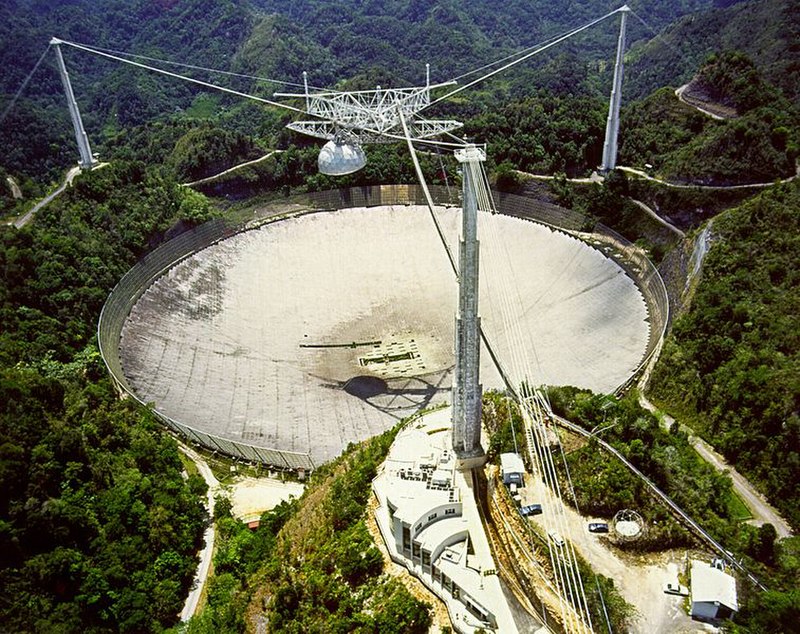
search for extra-terrestrial intelligence
effort to find civilizations not from Earth
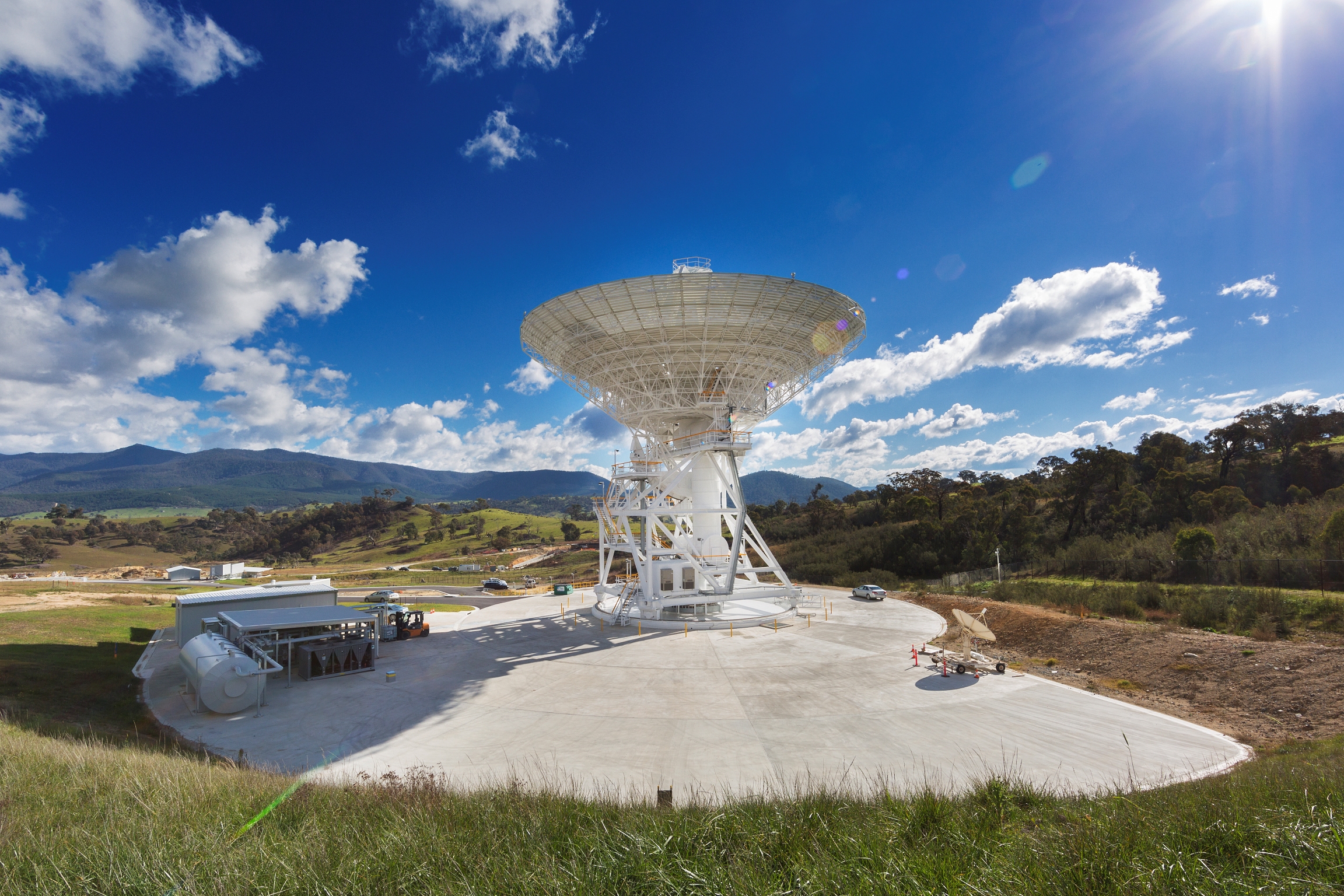
Deep Space Network
network of spacecraft communication facilities operated by NASA
fast radio burst
high-energy astrophysical phenomenon manifested as a transient radio pulse lasting only a few milliseconds
hydrogen line
spectral line of hydrogen state transitions
very-long-baseline interferometry
type of astronomical interferometry used in radio astronomy
jansky
The jansky (symbol Jy, plural janskys) is a non-SI unit of spectral flux density, or spectral irradiance, used especially in radio astronomy. It is equivalent to 10−26 watts per square metre per hertz.
Sunyaev-Zeldovich effect
distortion of cosmic microwave background in galaxy clusters
binary pulsar
pulsar with a binary companion, often a white dwarf or neutron star
Ecliptic alignment of CMB anisotropy
purported correlation of the cosmic microwave background with the Earth’s ecliptic
aperture synthesis
mixing signals from many telescopes to produce images with high angular resolution
astrophysical maser
naturally occurring source of stimulated spectral line emission, typically in the microwave portion of the electromagnetic spectrum
United States National Radio Quiet Zone
specific land area in which radio transmissions are heavily restricted
Chinese Deep Space Network
network of spacecraft communication facilities operated by China
Odd radio circle
unexplained circular astronomical object detected only by radio waves
brightness temperature
temperature associated with the measured intensity and frequency
spectral index
measure of the dependence of radiative flux density on frequency (astronomical term)
Fanaroff-Riley classification
fast blue optical transient
high-energy astrophysical process
peryton
short radio signals of terrestrial origin
radio quiet zone
area where radio transmissions are restricted in order to protect a radio telescope or a communications station from radio frequency interference
Discovery of cosmic microwave background radiation
aspect of the history of modern physical cosmology
radio spectrum pollution
straying of waves in the radio and electromagnetic spectrums outside their allocations that cause problems for some activities, of particular concern to radio astronomers
North American Nanohertz Observatory for Gravitational Waves
consortium of astronomers
Astro Space Center
institute of the Russian Academy of Sciences
Institute of Applied Astronomy
research institute in Saint Petersburg, Russia