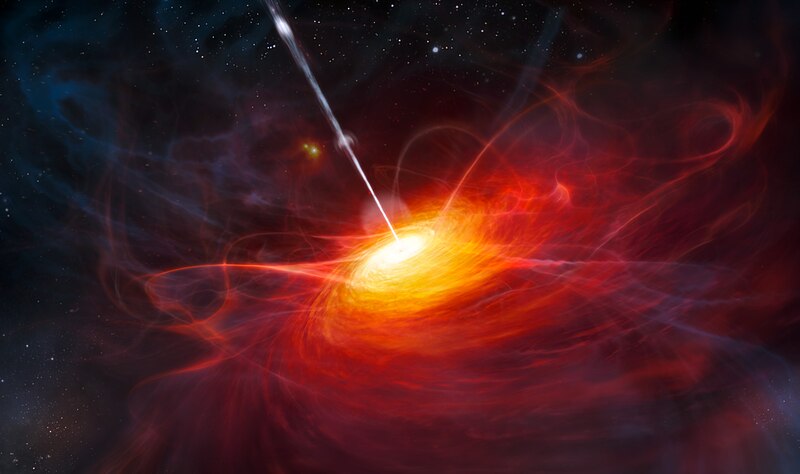
File:Artist's_rendering_ULAS_J1120+0641.jpg · Wikimedia Commons · See Wikimedia Commons
quasar
Sign in to saveAlso known as Quasi-Stellar Radio Source, Quasi-Stellar Object, QSO
thumb|upright=1.35|Artist's image of the accretion disc in ULAS J1120+0641, a very distant quasar containing a supermassive black hole with a mass two billion times that of the Sun thumb|The Chandra X-ray Observatory|Chandra X-ray image of [[PKS 1127-145, a quasar about 10 billion light-years from Earth. An X-ray jet extends at least a million light-years from the quasar. Image is 60 arcseconds on a side. RA 11h 30m 7.10s Dec −14° 49' 27" in Crater. Observation date: May 28, 2000. Instrument: ACIS]]
Quasars are extremely distant and luminous objects powered by supermassive black holes at their centers, some containing black holes billions of times more massive than our Sun. They are scientifically important because they are among the most distant objects we can observe, allowing astronomers to study the early universe and extreme physics near black holes.
AI-generated from the Wikipedia summary — may contain errors.
Wikidata facts
- Part of
- galaxy
- Has part
- electromagnetic radiation
- Image
- QuasarStarburst.jpg
Show 7 more facts
- Commons category
- Quasars
- topic's main category
- Category:Quasars
- Commons gallery
- Quasar
- topic has template
- Template:Infobox quasar
- on focus list of Wikimedia project
- Wikipedia:Vital articles/Level/4
- has list
- list of quasars
- model item
- ULAS J1120+0641
via Wikidata · CC0
~38 min read
Encyclopedic overview
18 sectionsContents
- Naming
- History of observation and interpretation
- Background
- Early observations (1960s and earlier)
- Development of physical understanding (1960s)
- Modern observations (1970s and onward)
- Current understanding
- Properties
- Spectral lines, reionization, and the early universe
- Subtypes
- Role in celestial reference systems
- Multiple quasars
- Lensed multiples
- Physical multiples
- Gallery
- See also
- References
- External links
thumb|upright=1.35|Artist's image of the accretion disc in ULAS J1120+0641, a very distant quasar containing a supermassive black hole with a mass two billion times that of the Sun thumb|The Chandra X-ray Observatory|Chandra X-ray image of [[PKS 1127-145, a quasar about 10 billion light-years from Earth. An X-ray jet extends at least a million light-years from the quasar. Image is 60 arcseconds on a side. RA 11h 30m 7.10s Dec −14° 49' 27" in Crater. Observation date: May 28, 2000. Instrument: ACIS]]
A quasar ( ) is an extremely luminous active galactic nucleus (AGN). It is sometimes known as a quasi-stellar object, abbreviated QSO. The emission from an AGN is powered by accretion onto a supermassive black hole with a mass ranging from millions to tens of billions of solar masses, surrounded by a gaseous accretion disc. Gas in the disc falling towards the black hole heats up and releases energy in the form of electromagnetic radiation. The radiant energy of quasars is enormous; the most powerful quasars have luminosities thousands of times greater than that of a galaxy such as the Milky Way. Quasars are usually categorized as a subclass of the more general category of AGN. The redshifts of quasars are of cosmological origin.
Excerpted from Wikipedia’s “quasar” article, available under the CC BY-SA 4.0 licence.
Gallery (32)
Available in 88 languages
- Español
- Français
- Deutsch
- 中文
- 日本語
- Русский
- Português
- Italiano
- العربية
- हिन्दी
- Afrikaans
- Armenian
- Asturian
- Azerbaijani
- Bahasa Indonesia
- Bangla
- Banjar
- Basque
Show 69 more
- be_x_old
- Belarusian
- Bosnian
- Breton
- Bulgarian
- Burmese
- Catalan
- Chuvash
- Croatian
- Czech
- Danish
- Esperanto
- Estonian
- Filipino
- Finnish
- Galician
- Georgian
- Greek
- Haitian Creole
- Hebrew
- Hungarian
- Icelandic
- Ido
- Igbo
- Irish
- Kannada
- Kazakh
- Kyrgyz
- Latin
- Latvian
- Limburgish
- Lithuanian
- Macedonian
- Malay
- Malayalam
- Manx
- Marathi
- Nederlands
- Norwegian
- Norwegian Nynorsk
- Occitan
- Oromo
- Polski
- Romanian
- Serbian
- Serbian (Latin)
- Sicilian
- simple
- Slovak
- Slovenian
- Svenska
- Swahili
- Tajik
- Tamil
- Tatar
- Tiếng Việt
- Türkçe
- Ukrainian
- Urdu
- Uzbek
- Waray
- Welsh
- Western Panjabi
- Wu Chinese
- zh_classical
- zh_yue
- فارسی
- ไทย
- 한국어
via Wikidata sitelinks · CC0