Category
page 1Radiology

magnetic resonance imaging
non-destructive technique for imaging internal structures of objects or organisms

radiology
Radiology ( ) is the medical specialty that uses medical imaging to diagnose diseases and guide treatment within the bodies of humans and other animals. It began with radiography (which is why its name has a root referring to radiation), but today it includes all imaging modalities. This includes technologies that use no ionizing electromagnetic radiation, such as ultrasonography and magnetic resonance imaging (MRI), as well as others that do use radiation, such as computed tomography (CT), fluoroscopy, and nuclear medicine including positron emission tomography (PET). Interventional radiology
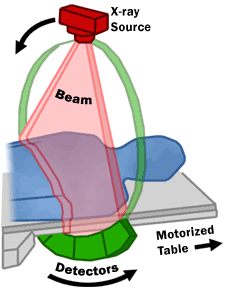
computed tomography
medical imaging procedure using X-rays to produce cross-sectional images

radiation syndrome
health problems caused by exposure to very high levels of ionizing radiation

nuclear medicine
medical specialty

echocardiography
Echocardiography, also known as cardiac ultrasound, is the use of ultrasound to examine the heart. It is a type of medical imaging, using standard ultrasound or Doppler ultrasound. The visual image formed using this technique is called an echocardiogram, a cardiac echo, or simply an echo.
X-ray tube
vacuum tube that converts electrical input power into X-rays

collimator
thumb|300px|Example of a particle collimator
A collimator is a device which narrows a beam of particles or waves. “To narrow” can mean either to cause the directions of motion to become more aligned in a specific direction (i.e., make collimated light or parallel rays), or to cause the spatial cross section of the beam to become smaller (beam limiting device).

neuroimaging
Neuroimaging is the use of quantitative (computational) techniques to study the structure and function of the central nervous system, developed as an objective way of scientifically studying the healthy human brain in a non-invasive manner. Increasingly it is also being used for quantitative research studies of brain disease and psychiatric illness. Neuroimaging is highly multidisciplinary involving neuroscience, computer science, psychology and statistics, and is not a medical specialty.
radioactive tracer
chemical compound
effective dose
measure of the cancer risk to an organism due to ionizing radiation adjusted by tissue type factor

radiographer
Radiographers (radiologic technologists) are healthcare professionals who perform medical imaging and radiation therapy. Medical imaging is used for the diagnosis of pathology, while radiation therapy is used for treatment.
dual-energy X-ray absorptiometry
diagnostic test for bone mineral density testing
bone scintigraphy
imaging technique used in nuclear medicine
Hounsfield scale
quantitative scale for describing radiodensity
Incidental imaging finding
an unanticipated finding which is not related to the original diagnostic inquiry
International Day of Radiology
International observance, 8 November
age determination by skeleton
establishment of the age of a human individual (for example by examination of their skeletal structure)
computer-aided diagnosis
type of diagnosis
radiodensity
Radiodensity (or radiopacity) refers to the degree of opacity to the radio wave and X-ray portion of the electromagnetic spectrum: that is, the relative inability of those kinds of electromagnetic radiation to pass through a particular material. Radiolucency or hypodensity indicates greater passage (greater transradiancy) to X-ray photons and is the analogue of transparency and translucency with visible light. Materials that inhibit the passage of electromagnetic radiation are called radiodense or radiopaque, while those that allow radiation to pass more freely are referred to as radiolucent.
radiology information system
system designed to support administration of radiology services and facilities
Teleradiology
right|thumb|alt=A CT scan of a patient's chest displayed|A CT scan of a patient's chest is displayed through teleradiology.
Teleradiology is the transmission of radiological patient images from procedures such as x-rays, Computed tomography (CT), and MRI imaging, from one location to another for the purposes of sharing studies with other radiologists and physicians. Teleradiology allows radiologists to provide services without actually having to be at the location of the patient. This is particularly important when a sub-specialist such as an MRI radiologist, neuroradiologist, pediatric radiol
John Thomas sign
Slang term
contrast-induced nephropathy
form of kidney damage in which there has been recent exposure to medical imaging contrast material
tomographic reconstruction
estimate object properties from a finite number of projections
aortopulmonary window
acquired or congenital anomaly in the aorta in which a communication exists between the ascending aorta and the pulmonary artery
anti-scatter grid
device for limiting radiation scatter
surgical planning
preoperative method
radiogenomics
The term radiogenomics is used in two contexts: either to refer to the study of genetic variation associated with response to radiation (radiation genomics) or to refer to the correlation between cancer imaging features and gene expression (imaging genomics).
history of radiation protection