Category
page 1Real analysis

limit
value that a function (or sequence) approaches as the argument (or index) approaches some value
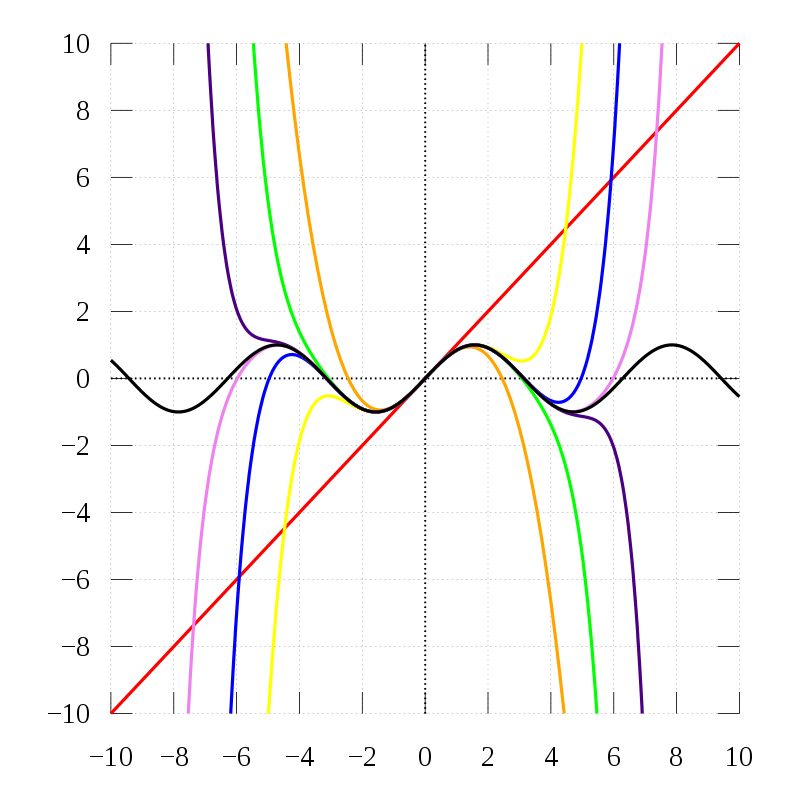
Taylor series
expression of a function as an infinite sum

0.999...
upright=1.35|class=skin-invert-image|thumb|alt=Stylistic impression of the repeating decimal 0.9999..., representing the digit 9 repeating infinitely
0.999... is a repeating decimal that represents the number 1. The three dots represent an infinite list of "9" digits. Following the standard rules for representing real numbers in decimal notation, its value is the smallest number greater than or equal to every number in the sequence 0.9, 0.99, 0.999, and so on. It can be proved that this number is1; that is,
0.999\ldots = 1.

real analysis
branch of mathematical analysis

power series
infinite sum of monomials
monotonic function
function between ordered sets that preserves or reverses the given order
indicator function
function that returns 1 if an element is present in a specified subset and 0 if absent; naturally isomorphic with a set's subsets
alternating series
infinite series in which the signs of the general terms alternate between positive and negative
Dirichlet function
indicator function of rational numbers
Weierstrass function
function that is continuous everywhere but differentiable nowhere
bounded function
function or sequence whose possible values form a bounded set
support
part of the domain of a mathematical function
upper and lower bounds
every element of a partially ordered set A which is greater (resp. lower) than every element of a subset B included in A
binomial series
Taylor series
Cauchy product
concept in mathematics
absolute continuity
form of continuity for functions
Gibbs phenomenon
peculiar manner in which the Fourier series of a piecewise continuously differentiable periodic function behaves at a jump discontinuity
Fatou's lemma
inequality relating the Lebesgue integral of the limit inferior of a sequence of functions to the limit inferior of integrals of these functions

càdlàg function
In mathematics, a càdlàg (), RCLL ("right continuous with left limits"), or corlol ("continuous on (the) right, limit on (the) left") function is a function defined on the real numbers (or a subset of them) that is everywhere right-continuous and has left limits everywhere. Càdlàg functions are important in the study of stochastic processes that admit (or even require) jumps, unlike Brownian motion, which has continuous sample paths. The collection of càdlàg functions on a given domain is known as Skorokhod space.
one-sided limit
limit of a function approaching a value point from values below or above the value point
summation by parts
theorem to simplify sums of products of sequences
piecewise linear function
real-valued function composed of straight line segments
ramp function
piecewise function that clamps its input to be non-negative
simple function
complex function on a measurable space that is piecewise constant with a finite number of measurable regions
Cantor's intersection theorem
theorem that a decreasing nested sequences of nonempty closed compact sets has nonempty intersection
almost periodic function
function that "converges" to periodicity
function of bounded variation
real function with finite total variation
Vitali covering lemma
logarithmically convex function
function thats composition with the logarithm is a convex function
quasiconvex function
function for which every set of inputs whose value is below a given threshold is convex
Baire function
functions obtained from continuous functions by transfinite iteration of the operation of forming pointwise limits of sequences of functions
Carleman's inequality
theorem
Maclaurin's inequality
inequality
Dini derivative
class of generalisations of the derivative
zero-product property
mathematical property shared by many number systems, that a product cannot be zero unless one of its factors is zero

Birnbaum–Orlicz space
topological space
least-upper-bound property
property of a partially ordered set
Steffensen's inequality
equation in mathematics
singular integral
integral operator whose kernel is singular along the diagonal

Hardy–Littlewood maximal function
Mathematical operator in real and harmonic analysis
Kakeya set
shape containing unit line segments in all directions
Cantor's first uncountability proof
first article on transfinite set theory
Luzin N property
Measure theory concept
Symmetric decreasing rearrangement
Type of mathematical function
projectively extended real line
extension of the set of the real numbers by a point denoted ∞
slowly varying function
function in mathematics
Littlewood's three principles of real analysis
heuristics in measure theory
Regulated function
oscillation
amount of variation between extrema of a function or sequence