File:Sintay_SVG.svg · Wikimedia Commons · See Wikimedia Commons
Taylor series
Sign in to saveAlso known as Taylor's series
expression of a function as an infinite sum
A Taylor series is a way to express a complicated function as an infinite sum of simpler terms, making it easier to work with mathematically. This matters because it allows mathematicians and scientists to approximate functions, solve equations, and perform calculations that would otherwise be difficult or impossible to do.
AI-generated from the Wikipedia summary — may contain errors.
Wikidata facts
- Subclass of
- Laurent series
- Named after
- Brook Taylor
- Image
- Sintay.svg
- Has use
- approximation
Show 5 more facts
- Commons category
- Taylor series
- discoverer or inventor
- Brook Taylor
- on focus list of Wikimedia project
- Wikipedia:Vital articles/Level/4
- maintained by WikiProject
- WikiProject Mathematics
- facet of
- series expansion
via Wikidata · CC0
~40 min read
Encyclopedic overview
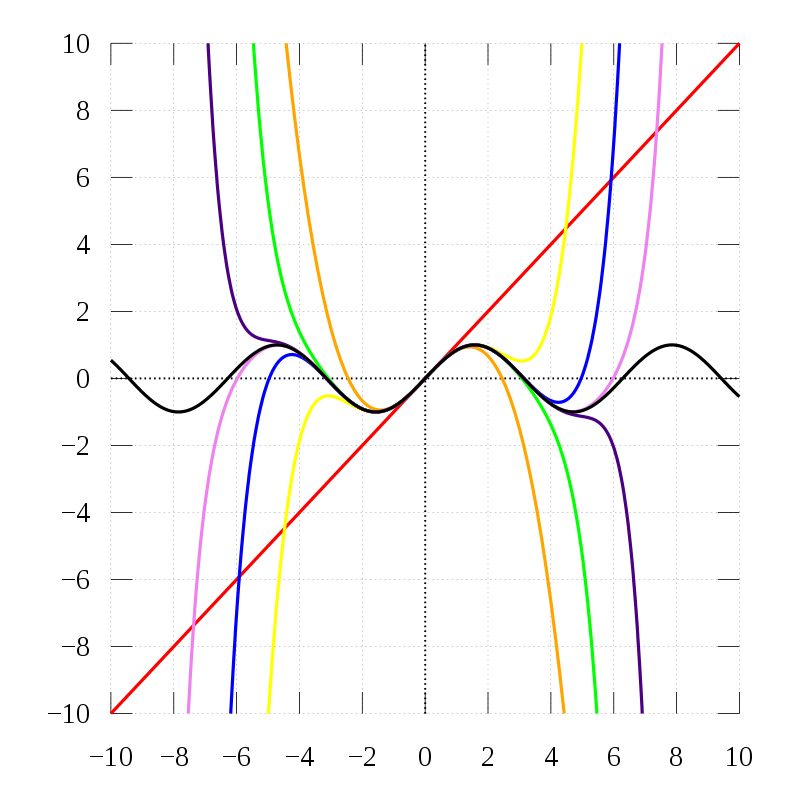
As the degree of the Taylor polynomial rises, it approaches the correct function. This image shows sin x and its Taylor approximations by polynomials of degree 1, 3, 5, 7, 9, 11, and 13 at x = 0.
In mathematical analysis, the Taylor series or Taylor expansion of a function is an infinite sum of terms that are expressed in terms of the function's derivatives at a single point. For most common functions, the function and the sum of its Taylor series are equal near this point. Taylor series are named after Brook Taylor, who introduced them in 1715. A Taylor series is also called a Maclaurin series when 0 is the point where the derivatives are considered, after Colin Maclaurin, who made extensive use of this special case of Taylor series in the 18th century.
Excerpted from Wikipedia’s “Taylor series” article, available under the CC BY-SA 4.0 licence.
Gallery (6)
Available in 67 languages
- Español
- Français
- Deutsch
- 中文
- 日本語
- Русский
- Português
- Italiano
- العربية
- हिन्दी
- Albanian
- Armenian
- Asturian
- Azerbaijani
- Bahasa Indonesia
- Bangla
- Bashkir
- Basque
Show 48 more
- Bavarian
- Belarusian
- Bosnian
- Bulgarian
- Catalan
- Central Kurdish
- Chuvash
- Croatian
- Czech
- Danish
- Esperanto
- Estonian
- Finnish
- Galician
- Greek
- Hebrew
- Hungarian
- Icelandic
- Kazakh
- Latvian
- Lithuanian
- Macedonian
- Malay
- Nederlands
- Norwegian
- Norwegian Nynorsk
- Piedmontese
- Polski
- Romanian
- Serbian
- Serbian (Latin)
- simple
- Sinhala
- Slovak
- Slovenian
- Svenska
- Tajik
- Tamil
- Tatar
- Tiếng Việt
- Türkçe
- Ukrainian
- Urdu
- Welsh
- Wu Chinese
- zh_yue
- فارسی
- 한국어
via Wikidata sitelinks · CC0