Category
page 1Red algae genera

Porphyra
Porphyra is a genus of coldwater seaweeds that grow in cold, shallow seawater. More specifically, it belongs to red algae phylum of laver species (from which comes laverbread), comprising approximately 70 species. It grows in the intertidal zone, typically between the upper intertidal zone and the splash zone in cold waters of temperate oceans. In East Asia, it is used to produce the sea vegetable products nori (in Japan) and gim (in Korea). There are considered to be 60–70 species of Porphyra worldwide and seven around Britain and Ireland, where it has been traditionally used to produce edibl

Gracilaria
Gracilaria, also known as Irish moss or ogonori, is a genus of red algae in the family Gracilariaceae. It is notable for its economic importance as an agarophyte meaning that it is used to make agar, as well as its use as a food for humans and various species of shellfish. Various species in the genus are cultivated among Asia, South America, Africa and Oceania. They produce over 90% of the world's agar.
Bangia
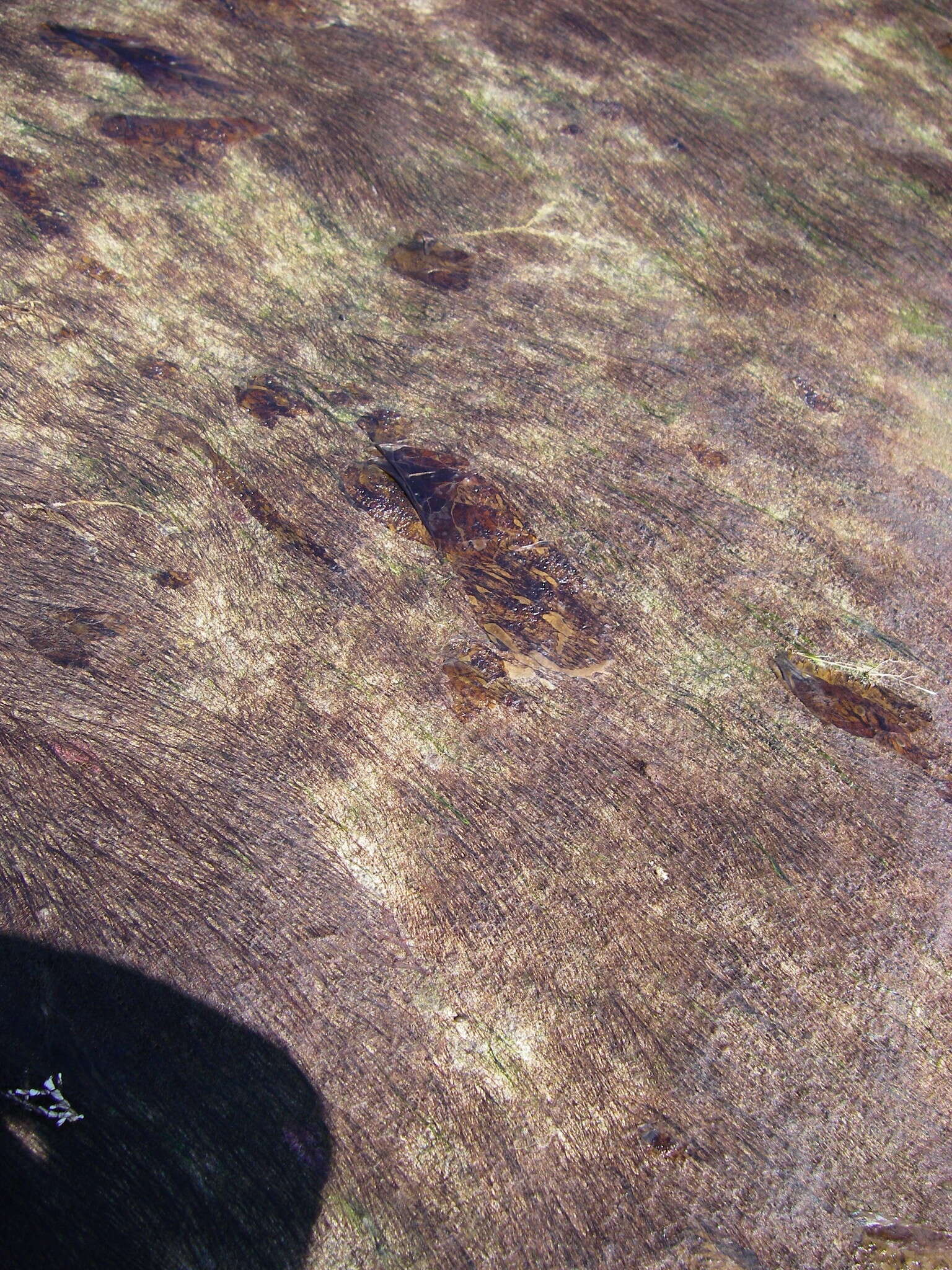
Bangia is an extant genus of division Rhodophyta that grows in marine or freshwater habitats. Bangia has small thalli with rapid growth and high reproductive output, and exhibits behavior characteristic of r-selected species. The plants are attached by down-growing rhizoids, usually in dense purple-black to rust-colored clumps. The chloroplasts of Bangia, like others in the division Rhodophyta, contain chlorophyll a and sometimes chlorophyll d, as well as accessory pigments such as phycobilin pigments and xanthophylls. Depending on the relative proportions of these pigments and the light condi
Gelidium
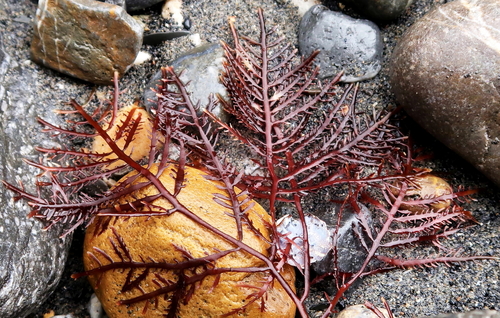
Gelidium is a genus of thalloid red algae comprising 134 species. Its members are known by a number of common names.

Batrachospermum
Batrachospermum is a genus of red algae from the family Batrachospermaceae. Due to its complex biological life cycle, descriptions of the taxon typically focus on gametophytes, while sporophytes, i.e., carposporophytes, are filamentous structures growing on the gametophyte, on which they depend. Independently living sporophytes have sometimes been described as separate species within the genus ''. Additionally, differences may occur in the descriptions of the genus due to variations in taxonomic approaches, as new taxonomic techniques, as with other algae, result in changes in the assignment o
.jpg)
Pyropia
Pyropia is a genus of red algae in the family Bangiaceae. It is found around the world in intertidal zones and shallow water. The genus has folding frond-like blades which are either red, brown or green. Some Pyropia species are used to create nori, and are thus important subjects for aquaculture.
Audouinella
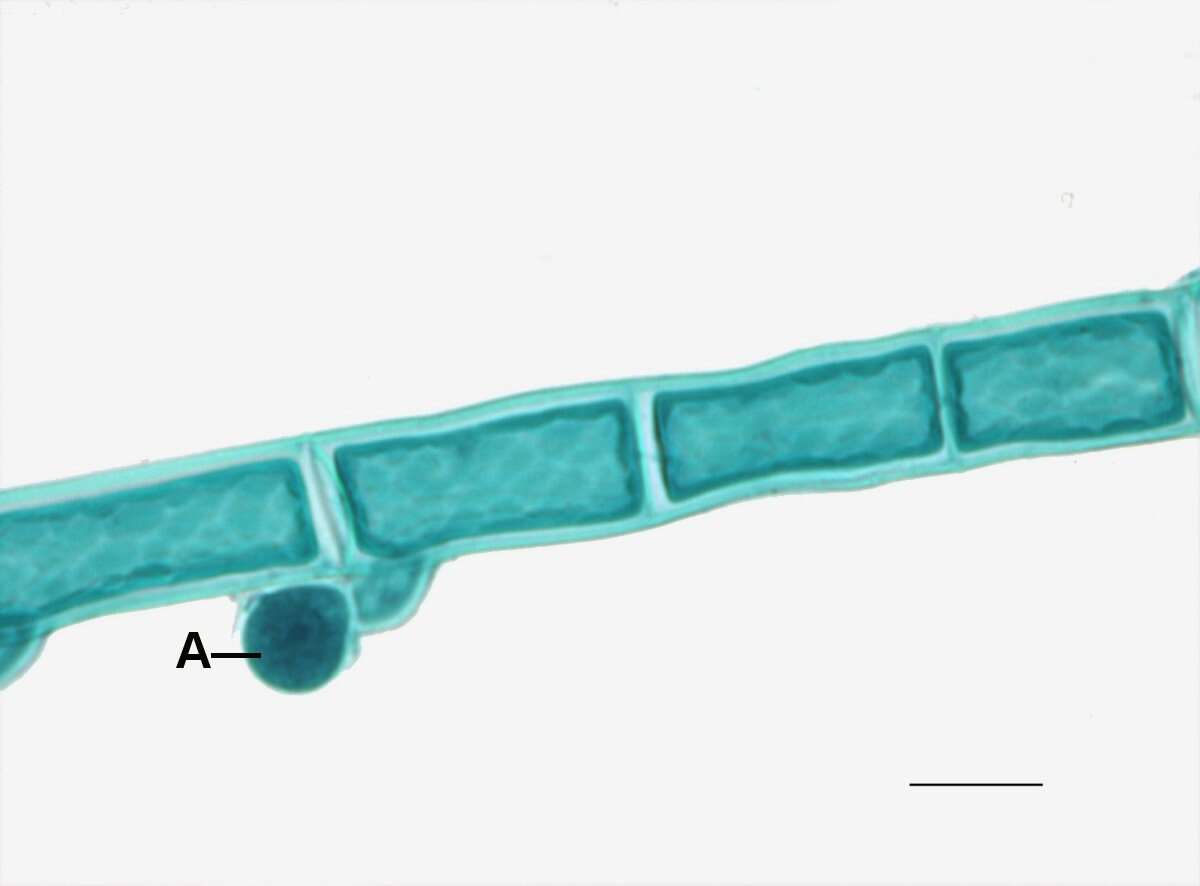
Audouinella, also known as black algae, is a widespread genus of red algae, found in marine and freshwater environments.

Chondrus
Chondrus is a genus of red algae containing 11 accepted species:
Chondrus armatus (Harvey) Okamura
Chondrus canaliculatus (C.Agardh) Greville
Chondrus crispus Stackhouse
Chondrus elatus Holmes
Chondrus giganteus Yendo
Chondrus ocellatus Holmes
Chondrus pinnulatus (Harvey) Okamura
Chondrus uncialis Harvey & Bailey
Chondrus verrucosus Mikami
Chondrus yendoi Yamada & Mikami

Corallina
Corallina is a genus of red seaweeds with hard, abrasive calcareous skeletons in the family Corallinaceae. They are stiff, branched frond-like protists with articulated stipes. Corallina, like all red algae, are not considered plants under some definitions, but can be considered as belonging to plants in a broad sense.

Eucheuma
Eucheuma, commonly known as sea moss or gusô (), is a rhodophyte seaweed that may vary in color (purple, brown, and green). Eucheuma species are used in the production of carrageenan, an ingredient for cosmetics, food processing, and industrial manufacturing, as well as a food source for people in the Philippines, Caribbean and parts of Indonesia and Malaysia. Eucheuma cottonii – which grows in the Caribbean and cultivated in the Philippines – is the particular species known as gusô. Other species include Betaphycus gelatinae, Eucheuma denticulatum, and several species of the genus Kappaphycus
%2C%20Parque%20natural%20de%20la%20Arr%C3%A1bida%2C%20Portugal%2C%202020-07-23%2C%20DD%2062.jpg)
Lithophyllum
Lithophyllum is a genus of thalloid red algae belonging to the family Corallinaceae.
250px|thumb|Lithophyllum stictaeforme.
thumb|250px|right|L. orbiculatum on a rock fragment; rock length ~3 cm.
thumb|250px|right|Lithophyllum okamurae
thumb|240px|right|Lithophyllum sp.

Polysiphonia
Polysiphonia, known as red hair algae, is a genus of filamentous red algae with about 19 species on the coasts of the British Isles and about 200 species worldwide, including Crete in Greece, Antarctica and Greenland. Its members are known by a number of common names. It is in the order Ceramiales and family Rhodomelaceae.

Galdieria
Galdieria is a genus of red algae belonging to the order Galdieriales; family Galdieriaceae. It was first described by Italian botanist Aldo Merola in 1981 to differentiate it from species of Cyanidium.
Mesophyllum
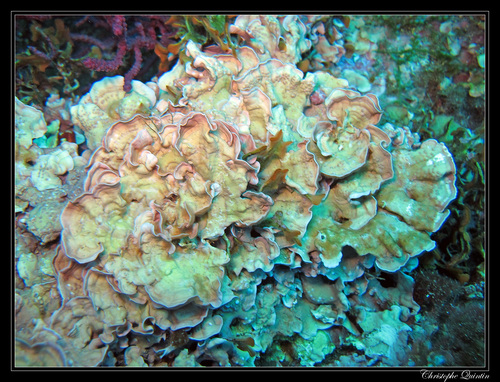
Mesophyllum is a genus of red alga belonging to the family Hapalidiaceae.

Ahnfeltia
Ahnfeltia is a genus of red algae.
Laurencia
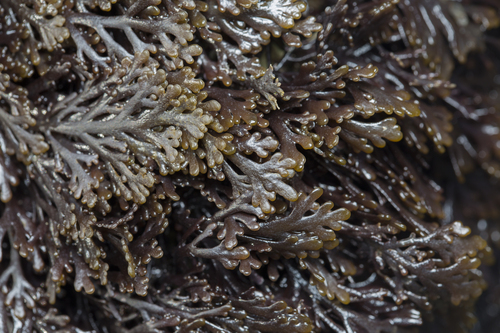
Laurencia is a genus of red algae that grows in temperate and tropical shore areas, in littoral to sublittoral habitats, at depths up to .

Phymatolithon
Phymatolithon is a genus of non geniculate coralline red algae, known from the UK, and Australia. It is encrusting, flat, and unbranched; it has tetrasporangia and bisporangia borne in multiporate conceptacles. Some of its cells bear small holes in the middle; this distinctive thallus texture is termed a "Leptophytum-type" thallus surface, and has been posited as a taxonomically informative character. It periodically sloughs off its epithallus, reducing its overgrowth by algae by as much as 50% compared to bare rock.

Ceramium
Ceramium is a genus of red algae (or Rhodophyta). It is a large genus with at least 15 species in the British Isles.

Lemanea
Lemanea is a genus of freshwater red algae, in the order Batrachospermales. Both species are considered to be widespread in the northern hemisphere. Although placed in the Rhodophyta (red algae) it in fact is green in colour.
%20Figure%208.jpeg)
Asparagopsis
Asparagopsis is a genus of edible red macroalgae (Rhodophyta). The species Asparagopsis taxiformis is found throughout the tropical and subtropical regions, while Asparagopsis armata is found in warm temperate regions. Both species are highly invasive, and have colonised the Mediterranean Sea. A third accepted species is A. svedelii, while others are of uncertain status.

Palmaria
genus of algae

Compsopogon
Compsopogon caeruleus, known as staghorn algae, is a species of red algae that lives in fresh water. It is a common nuisance in freshwater aquaria. It is the only species in the genus Compsopogon and the only representative of the family Compsopogonaceae. It is found in North America, South America, Europe, Africa, Asia, Australasia and Oceania. Compsopogon can tolerate a wide range of conditions in freshwater streams and occasionally in brackish lagoons and estuaries. It propagates by asexual spores.
Bangiomorpha
Bangiomorpha pubescens is a species of red algae in the order Bangiales.
It is the first known sexually reproducing organism. A multicellular fossil of Bangiomorpha pubescens was recovered from the Hunting Formation in Somerset Island, Canada that strongly resembles the modern red alga Bangia despite occurring in rocks dating to , during the Stenian period.
This species is the oldest example of an organism belonging to an extant phylum. The fossil includes differentiated reproductive cells that are the oldest evidence of sexual reproduction. Sexual reproduction increased genetic variation, whi
Colaconema
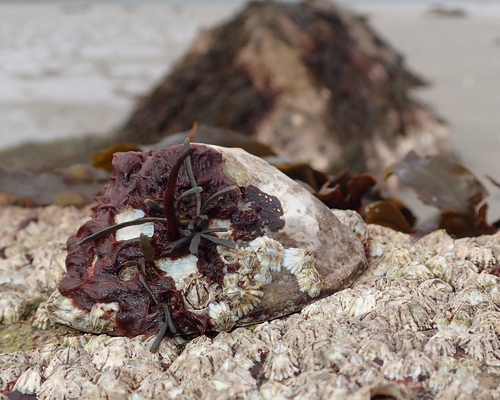
Colaconema is a genus of marine red algae. It is the only genus in the family Colaconemataceae which is the only family in Order Colaconematales .
Acrochaetium
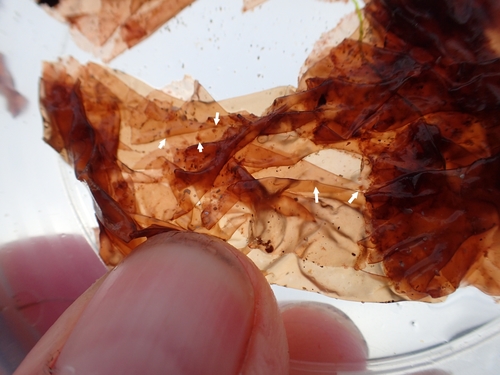
Acrochaetium is a genus of marine red alga.

Rhodella
Rhodella is a monotypic genus of red algae containing only one species, Rhodella violaceae. The genus has formerly included a few other species but have since been synonymized, such as Rhodella reticulata, Rhodella grisea (both synonyms of Dixoniella grisea), and Rhodella cyanea (synonym of Neorhodella cyanea).

Porolithon
Porolithon is a genus of coralline red algae. Porolithon are the primary reef building algae. When coral reefs reach sea level, many corals break under the high energy impact of the waves, while coralline red algae, primarily Porolithon, continuing building and cementing the reef structure.

Rhodochorton
Rhodochorton is a genus of filamentous red alga adapted to low light levels. It may form tufts or a thin purple "turf" up to 5 millimetres high. The filaments branch infrequently, usually at the tips.

Phyllophora
Phyllophora is a genus of red algae in the family Phyllophoraceae.

Asparagopsis taxiformis
species of alga
Bonnemaisonia
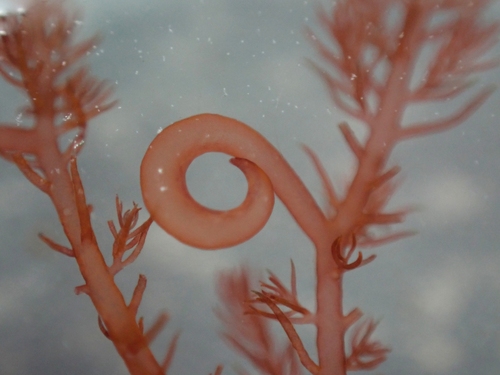
Bonnemaisonia is a genus of red algae belonging to the family Bonnemaisoniaceae.

Hildenbrandia
Hildenbrandia is a genus of thalloid red alga comprising about 26 species. The slow-growing, non-mineralized thalli take a crustose form. Hildenbrandia reproduces by means of conceptacles and produces tetraspores.

Delesseria
Delesseria is a genus of red algae belonging to the family Delesseriaceae.
Kappaphycus
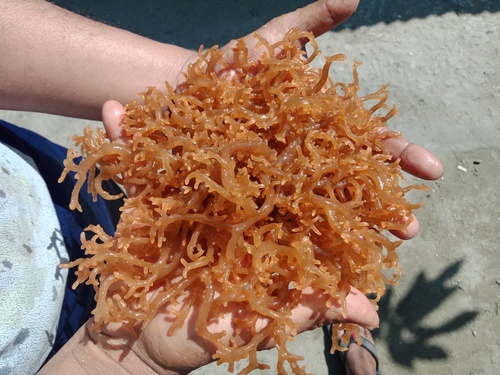
Kappaphycus is a genus of red algae. Species are distributed in the waters of East Africa, Indonesia, Malaysia, China (Hainan Island), the Philippines, and Micronesia.

Bostrychia
genus of algae

Peyssonnelia
Peyssonnelia is a genus of thalloid red alga, named after naturalist Jean-André Peyssonnel (1694–1759) It includes the algae commonly known as rumoi-iwanokawa, mayoi-iwanokawa and akase-iwanokawa. Specimens can reach around 20 cm in size. Peyssonnelia produces tetraspores.

Acanthophora
Acanthophora is also a synonym for Aralia. For the section of Solanum, see Solanum sect. Acanthophora.

Chondria
genus of algae

Bossiella
Bossiella is a genus of coralline algae with 5 recognised species. It reproduces via conceptacles; individual thalli only produce conceptacles of a single sex.

Brongniartella
genus of algae

Acrosorium
thumb|Acrosorium
Choreonema
Choreonema is a genus of red algae belonging to the family Hapalidiaceae.

Stylonema
Stylonema is a genus of red algae, common in Australian waters. It is distinguishable from other species of red algae by the width of the filaments of its thallus, being only one cell across.
Nemalion
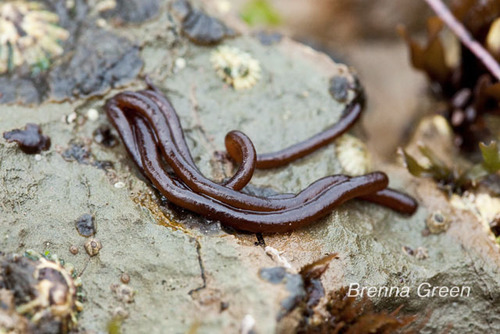
Nemalion is a genus of red algae that contains approximately ten species, including N. helminthoides. Its members are known by a number of common names. It is the source of the subclass name "Nemaliophycidae".

Aglaothamnion
Aglaothamnion is a genus of algae belonging to the family Callithamniaceae.

Pneophyllum
Pneophyllum is a genus of multicellular red algae in the family Corallinaceae and subfamily Chamberlainoideae.

Membranoptera
Membranoptera is a genus of red algae belonging to the family Delesseriaceae.

Delisea
Delisea is a genus of red algae in the family Bonnemaisoniaceae.

Gymnogongrus
Gymnogongrus is a genus of red algae belonging to the family Phyllophoraceae.

Calliarthron
Calliarthron is a genus containing two species of thalloid intertidal alga. Specimens can reach around 30 cm in size. The thalli take a crustose form. The organisms lack secondary pit connections. Calliarthron reproduces by means of conceptacles; it produces tetraspores, dispores and carpospores. The genus has lignin and contains secondary cell walls, traits which are normally associated with the vascular plants. It is similar to the genus Bossiella.

Crouania
Crouania is a genus of red algae (Rhodophyta) in the Callithamniaceae family.
The name of the genus honours the French born Crouan brothers, Pierre-Louis Crouan (1798 - 1871) and Hippolyte-Marie Crouan (1802 - 1871).
It was first described by Jacob Georg Agardh in 1842, and the type species is Crouania attenuata.

Jania
genus of algae

Amphiroa
Amphiroa is a genus of thalloid red algae under the family Corallinaceae.

Hypoglossum
Hypoglossum is a genus of red algae belonging to the family Delesseriaceae.

Galaxaura
Galaxaura is a genus of thalloid red algae.

Wrangelia
Wrangelia is a genus of red algae in the family Wrangeliaceae.

Martensia
Martensia is a genus of red algae, containing the following species:

Callophyllis
Callophyllis is a red algae genus in the family Kallymeniaceae. Several species are exploited as edible seaweeds under the common name carola, most commonly Callophyllis variegata.

Ganonema
Ganonema is a genus of red algae, from the Liagoraceae family, characterised by its dichotomously branched, multiaxial thalli, with terete axes." It is closely related to Liagora, but can be distinguished in two important respects. Its vegetative structure is distinct, as the basal cells of its cortical fascicles are isodiametric, whereas the cells of Liagora are elongate. Also, its reproductive development features "the occasional production of carpogonial branches in clusters and the production of spermatangia in dense heads."
Synarthrophyton
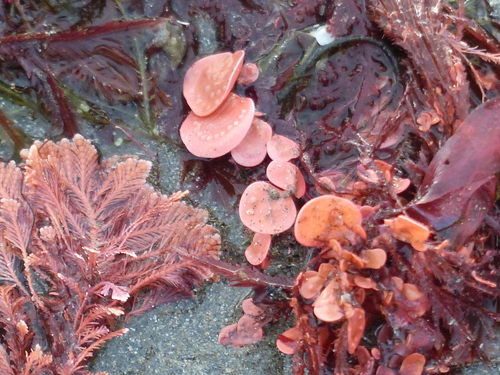
Synarthrophyton is a genus of thalloid red algae comprising eight species. The monomerous, crustose thalli are composed of a single system of filaments which grow close to the underlying surface. Synarthrophyton reproduces by means of flask-shaped multiporate conceptacles; it produces tetraspores and dispores. Mucus plugs the opening of young conceptacles, which open as they mature.