Category
page 1Reproduction

reproduction
thumb|350px|right|Production of new individuals along a leaf margin of the miracle leaf plant (Kalanchoe pinnata). The small plant in front is about 1 cm (0.4 in) tall. The concept of "individual" is obviously stretched by this asexual reproductive process.
Reproduction (or procreation or breeding) is the biological process by which new individual organisms – offspring – are produced from their parent or parents. There are two forms of reproduction: asexual and sexual.

sexual reproduction
reproduction process that creates a new organism by combining the genetic material of two organisms

fertilization

spore
thumb|300px|Spores produced in a sporic life cycle
thumb|300px|Fresh snow partially covers rough-stalked feather-moss (Bryopsida|Brachythecium rutabulum), growing on a thinned hybrid black poplar (Populus x canadensis). The last stage of the moss lifecycle is shown, where the [[sporophytes are visible before dispersion of their spores: the calyptra (1) is still attached to the capsule (3). The tops of the gametophytes (2) can be discerned as well. Inset shows the surrounding, black poplars growing on sandy loam on the bank of a kolk, with the detail area marked.]]

in vitro fertilization
assisted reproductive technology procedure (ART)

biological life cycle
period involving all different generations of a species succeeding each other through means of reproduction
amenorrhea
Amenorrhea or amenorrhoea is the absence of a menstrual period in a female organism which has reached reproductive age. Physiological states of amenorrhea are most commonly seen during pregnancy and lactation (breastfeeding). In humans, it is where a woman or girl who has reached reproductive age and who is not on birth control does not menstruate.
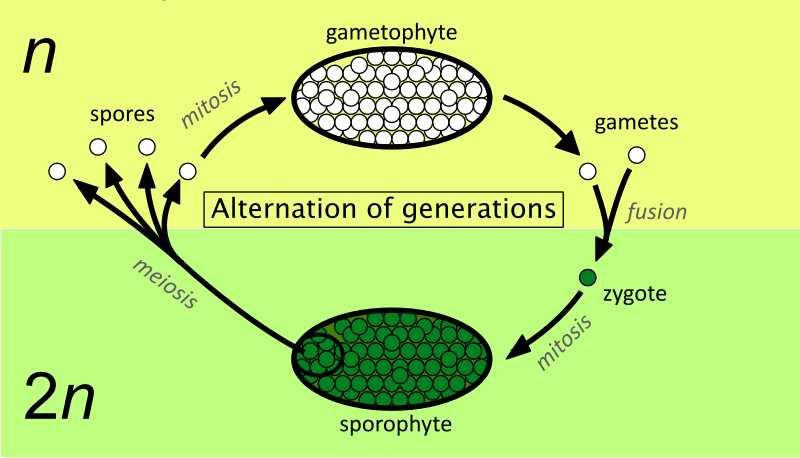
alternation of generations
reproductive strategy

offspring
right|thumb|A frog in frogspawn
In biology, offspring () are the young creation of living organisms, produced either by sexual or asexual reproduction. Collective offspring may be known as a brood or progeny. This can refer to a set of simultaneous offspring, such as the chicks hatched from one clutch of eggs, or to all offspring produced over time, as with the honeybee. Offspring can occur after mating, artificial insemination, or as a result of cloning.

chimera
single organism composed of two or more different populations of genetically distinct cells
sexual maturity
portion of a life cycle in which an organism is capable of sexual reproduction

anisogamy
thumb|Different forms of anisogamy: A) anisogamy of motile cells, B) oogamy ([[egg cell and sperm cell), C) anisogamy of non-motile cells (egg cell and spermatia).|283x283px]]

isogamy
[[File:Isogamy.svg|thumb|Different forms of isogamy:
reproductive isolation
evolutionary mechanism for speciation
sequential hermaphroditism
sex change as part of the normal life cycle of a species
biological dispersal
movement of individuals (animals, plants, fungi, bacteria, etc.) from their birth site to their breeding site, as well as the movement from one breeding site to another
litter
animal offspring

gametangium
thumb|Light micrograph of a whole-mount slide of gametangia of [[Equisetum]]
A gametangium (: gametangia) is a sex organ or cell in which gametes are produced that is found in many multicellular protists, algae, fungi, and the gametophytes of plants. In contrast to gametogenesis in animals, a gametangium is a haploid structure and formation of gametes does not involve meiosis.
autogamy
Autogamy or self-fertilization refers to the fusion of two gametes that come from one individual. Autogamy is predominantly observed in the form of self-pollination, a reproductive mechanism employed by many flowering plants. However, species of protists have also been observed using autogamy as a means of reproduction. Flowering plants engage in autogamy regularly, while the protists that engage in autogamy only do so in stressful environments.

gonochorism
In biology, gonochorism is a sexual system where there are two sexes and each individual organism is either male or female. The term gonochorism is usually applied in animal species, the vast majority of which are gonochoric.

megaspore
thumb|Microscopic photo of spores (in red) of Selaginella. The large three spores at the top are megaspores whereas the numerous smaller red spores at the bottom are microspores.
superfecundation
Superfecundation is the fertilization of two or more ova from the same menstrual cycle by sperm from the same or different males, whether through separate acts of intercourse or during a single sexual encounter with multiple males. This can result in twin babies that have different biological fathers.
self-replicating machine
device able to make copies of itself
Allogamy
Allogamy or cross-fertilization is the
fertilization of an ovum from one individual with the spermatozoa of another. By contrast, autogamy is the term used for self-fertilization. In humans, the fertilization event is an instance of allogamy. Self-fertilization occurs in hermaphroditic organisms where the two gametes fused in fertilization come from the same individual. This is common in plants (see Sexual reproduction in plants) and certain protozoans.

microchimerism
right|thumb|220px|During pregnancy, a two-way traffic of immune cells may occur through the placenta. Exchanged cells can multiply and establish long-lasting cell lines that are immunologically active even decades after giving birth.
Microchimerism is the presence of a small number of cells in an individual that have originated from another individual and are therefore genetically distinct. This phenomenon may be related to certain types of autoimmune diseases although the responsible mechanisms are unclear. The term comes from the prefix "micro" + "chimerism" based on the hybrid Chimera of G

spermatheca
thumb|Spermatheca of Acanthoscurria geniculata (Brazilian Giant White Knee Tarantula)
thumb|Variety of the structure of spermathecae in Phlebotominae (Diptera, Psychodidae)
thumb|Female tarantula molt

Polyspermy
In biology, polyspermy describes the fertilization of an egg by more than one sperm. Diploid organisms normally contain two copies of each chromosome, one from each parent. The cell resulting from polyspermy, on the other hand, contains three or more copies of each chromosome—one from the egg and one each from multiple sperm. Usually, the result is an unviable zygote. This may occur because sperm are too efficient at reaching and fertilizing eggs due to the selective pressures of sperm competition. Such a situation is often deleterious to the female: in other words, the male–male competition a

oospore
thumb|right|300px|Oospores of Hyaloperonospora parasitica, agent of the [[downy mildew (in the middle)]]
An oospore is a thick-walled sexual spore that develops from a fertilized oosphere in some algae, fungi, and oomycetes. They are believed to have evolved either through the fusion of two species or the chemically induced stimulation of mycelia, leading to oospore formation.

Voltinism
thumb|A Lycaena phlaeas (small copper butterfly) perching on a plant
semelparity and iteroparity
classes of possible reproductive strategies

heterothallism
Heterothallic species have sexes that reside in different individuals. The term is applied particularly to distinguish heterothallic fungi, which require two compatible partners to produce sexual spores, from homothallic ones, which are capable of sexual reproduction from a single organism.
reproductive biology
branch of biology studying reproduction
Gametogamia
Gametogamy is sexual fusion – copulation or fertlization – of two single-celled gametes of different sex and the union of their gamete nuclei (and corresponding extranuclear structures) giving the zygote nucleus, as well as whole zygotic content.
homothallism
In fungi and algae, homothallism refers to the condition in which a single individual or thallus carries the genetic determinants (i.e., both mating types or sexes) required to undergo sexual reproduction without the need for a distinct mating partner. The opposite sexual functions are performed by different cells of a single mycelium.
adelphogamy
thumb|250px|Amnon committed both rape and incest when he assaulted his half-sister Tamar
Adelphogamy is a form of sexual partnership between sibling eukaryotes, especially in some species of fungi, flowering plants or ants, or in humans. In flowering plants, adelphogamy refers to sibling pollination: pollen and stigma belong to two individuals which derives from same mother plant.
telium
thumb|right|Close-up of Gymnosporangium clavariiforme telia emerging from [[Juniperus communis bark]]
thumb|right|Micrograph of two teliospores from telia of Gymnosporangium clavariiforme
Telium, plural telia, are structures produced by rust fungi as part of the reproductive cycle. They are typically yellow or orange drying to brown or black and are exclusively a mechanism for the release of teliospores which are released by wind or water to infect the alternate host in the rust life-cycle. The telial stage provides an overwintering strategy in the life cycle of a parasitic heteroecious fungus
artificial reproduction
The creation of new life by other than the natural means available to an organism
parent–offspring conflict
Conflict with siblings for resources
Teleomorph, anamorph and holomorph
terminology used with fungi
biotic potential
the unrestricted growth of populations resulting in the maximum growth of that population
Oocyte selection
procedure performed prior to in vitro fertilization
sporogenesis
Sporogenesis is the production of spores in biology. The term is also used to refer to the process of reproduction via spores. Reproductive spores were found to be formed in eukaryotic organisms, such as plants, algae and fungi, during their normal reproductive life cycle. Dormant spores are formed, for example by certain fungi and algae, primarily in response to unfavorable growing conditions. Most eukaryotic spores are haploid and form through cell division, though some types are diploids or dikaryons and form through cell fusion.
fertility preservation
providing future reproductive opportunities before a medical treatment with known risk of loss of fertility
sperm sorting
means of choosing what type of sperm cell (X-chromosome or Y-chromosome) is to fertilize the egg cell
Apicomplexan life cycle
Apicomplexa life cycle
Worker policing
eusocial hymnopteran behavior where worker females eat or destroy eggs laid by other workers
Homogamy
biological term with multiple meanings
Operational sex ratio
A quantitative ratio of sexually active population
micropyle
external encapsulating structure part of the chorion. A single cone-shaped specialization that forms an opening in the chorion that allows sperm entry into the egg prior to fertilization
megagametogenesis
Megagametogenesis is the process of maturation of the female gametophyte, or megagametophyte, in plants. During the process of megagametogenesis, the megaspore, which arises from megasporogenesis, develops into the embryonic sac, in which the female gamete is housed. These megaspores then develop into the haploid female gametophytes. This occurs within the ovule, which is housed inside the ovary.