Category
page 1Roman Phrygia

Epistle to the Colossians
book of the New Testament traditionally attributed to Paul

Hierapolis
Hierapolis (; , lit. "Holy City") was a Hellenistic Greek city built on the site of a Phrygian cult center of the Anatolian mother goddess Cybele, in Phrygia in southwestern Anatolia, Turkey. It was famous for its hot springs, its high quality wool fabrics and dyes, and as the birthplace of the Stoic philosopher Epictetus. Its extensive remains are adjacent to modern Pamukkale in Turkey.
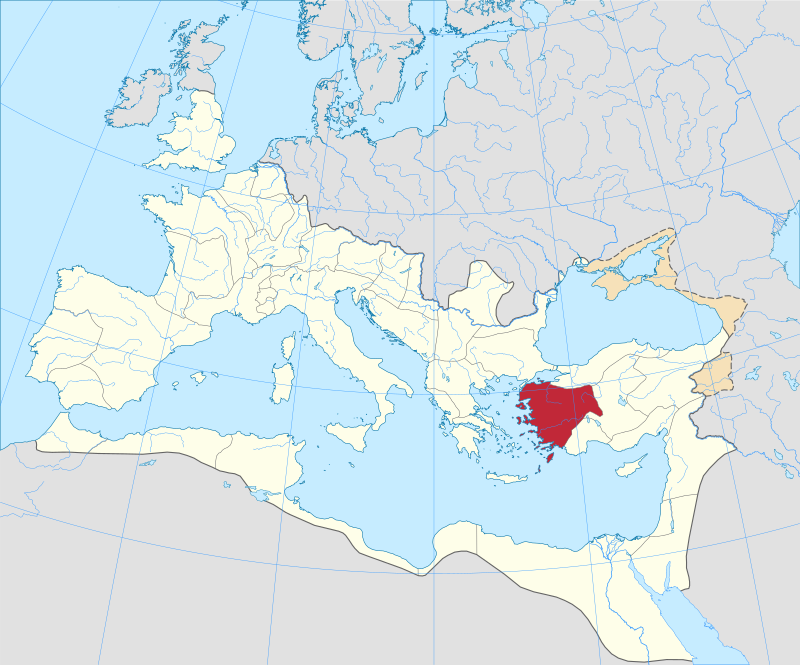
Asia
Roman province
.jpg)
Aizanoi
Aizanoi (), Latinized as Aezani, was an Ancient Greek city in western Anatolia. It was located at the site of the modern village of Çavdarhisar, near Kütahya, on both sides of the Penkalas river, c. above sea level. The city was an important political and economic centre in Roman times; surviving remains from the period include a well-preserved Temple of Zeus, a combined theatre-stadium complex, and a round building, probably a macellum, inscribed with a copy of the Price Edict of Diocletian. The city fell into decline in Late Antiquity. In 2012 the site was submitted for inclusion on the UNES
Polemon of Laodicea
Greek sophist (c. 90 – 144)
Ayazini
village in İhsaniye, Afyonkarahisar, western Turkey
Acts 14
chapter of the New Testament
Inscription of Abercius
Greek epitaph of Abercius
Ploutonion at Hierapolis
ancient shrine to god Pluto in Turkey
Eulamius
Eulamius (; ), born in Phrygia, was, along with Damascius, one of the Athenian philosophers who sought asylum at the court of Khosrau I (r. 531–579) of Persia in 531/532 when Byzantine emperor Justinian I (r. 527–565) closed down the last pagan philosophical schools in Athens. Eulamius was disappointed in Persia and ultimately returned to Byzantium in 532 together with other Greek philosophers, protected by a treaty that guaranteed their safety. His name appears as Eulalios (Greek: Eὐλάλιος) in the Suda and as Eulamios (Greek: Eὐλάμιος) in the historical works of Agathias.