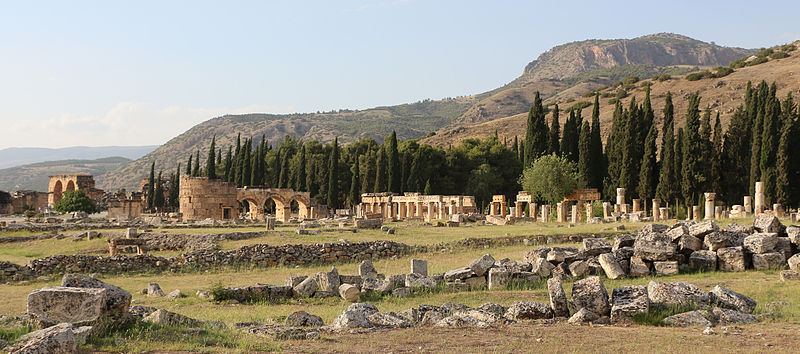
File:Hierapolis_01.jpg · Wikimedia Commons · See Wikimedia Commons
Hierapolis
Sign in to saveHierapolis (; , lit. "Holy City") was a Hellenistic Greek city built on the site of a Phrygian cult center of the Anatolian mother goddess Cybele, in Phrygia in southwestern Anatolia, Turkey. It was famous for its hot springs, its high quality wool fabrics and dyes, and as the birthplace of the Stoic philosopher Epictetus. Its extensive remains are adjacent to modern Pamukkale in Turkey.
Hierapolis was an ancient Greek city in what is now Turkey, built over a sacred site dedicated to the goddess Cybele and known for its hot springs, fine wool products, and as the birthplace of the philosopher Epictetus. Today, its well-preserved ruins near the town of Pamukkale make it an important archaeological site that offers insight into Hellenistic civilization and the blend of Greek and earlier Anatolian cultures.
AI-generated from the Wikipedia summary — may contain errors.
Key facts
- Ancient site.name
- Hierapolis
- Ancient site.native_name
- Ἱεράπολις
- Ancient site.alternate_name
- Hierapolis-Pamukkale
- Ancient site.image
- Hierapolis 01.jpg
- Ancient site.image_size
- 270
- Ancient site.map_type
- Turkey
- Ancient site.map_size
- 270
- Ancient site.location
- Pamukkale, Denizli Province, Turkey
- Ancient site.region
- Phrygia
- Ancient site.type
- Settlement
- Ancient site.built
- early 2nd century BC
- Ancient site.abandoned
- 14th century (final occasion)
- Ancient site.epochs
- Roman Republican to High Medieval
- Ancient site.excavations
- 1887, 1957–2008
- Ancient site.archaeologists
- Carl Humann, Paolo Verzone
via Wikipedia infobox
Wikidata facts
- Instance of
- archaeological site
- Part of
- Hierapolis-Pamukkale
- Named after
- Hiera
- Country
- Turkey
- Located in
- Denizli Province
- Location
- Phrygia
- Official website
- www.pamukkale.gov.tr/EN/content.asp?id=291
- Image
- The Roman theatre, built in the 2nd century AD under Hadrian on the ruins of an earlier theatre, later renovated under Septimius Severus, Hierapolis, Turkey - 17033895960.jpg
Show 6 more facts
- Commons category
- Hierapolis
- Commons gallery
- Hierapolis
- located in protected area
- Hierapolis-Pamukkale
- native label
- Ἱεράπολις
- P12749
- Milan Horvat
- located in/on physical feature
- Aegean Region
Sources (3)
via Wikidata · CC0
~35 min read
Encyclopedic overview
35 sectionsContents
- Geography
- History
- Iron Age
- Phrygian temple
- Hellenistic city
- Roman Hierapolis
- Ecclesiastic history
- Medieval Hierapolis
- Modern excavations
- Significant structures
- The Main Street and the gates
- Frontinus Gate
- North Byzantine Gate
- Theatre
- Temple of Apollo
- Ploutonion
- Nymphaeum
- Necropolis
- Northern Necropolis
- Sawmill
- Southern Necropolis
- Martyrium
- The Great Baths
- Antique Pool
- Cleopatra's Pool
- The Basilica Baths
- Museum
- Tombs and Statues Gallery
- Small Artifacts Gallery
- Theatre Gallery
- Notable residents
- See also
- Notes
- References
- External links
Hierapolis (; , lit. "Holy City") was a Hellenistic Greek city built on the site of a Phrygian cult center of the Anatolian mother goddess Cybele, in Phrygia in southwestern Anatolia, Turkey. It was famous for its hot springs, its high quality wool fabrics and dyes, and as the birthplace of the Stoic philosopher Epictetus. Its extensive remains are adjacent to modern Pamukkale in Turkey.
The hot springs have been used as a spa since at least the 2nd century BCE, with many patrons retiring or dying there as evidenced by the large necropolis filled with tombs, most famously that of Marcus Aurelius Ammianos, which bears a relief depicting the earliest known example of a crank and rod mechanism, and the Tomb of Philip the Apostle.
Excerpted from Wikipedia’s “Hierapolis” article, available under the CC BY-SA 4.0 licence.
Gallery (30)
On the map
2 mapped locations