Category
page 1Rotaliida

Nummulites
A nummulite is a large lenticular fossil, characterised by its numerous coils, subdivided by septa into chambers. They are the shells of the fossil and present-day marine protozoan Nummulites, a type of foraminiferan. Nummulites commonly vary in diameter from and are common in Eocene to Miocene marine rocks, particularly around southwest Asia and the Mediterranean in the area that once constituted the Tethys Ocean, such as Eocene limestones from Egypt or from Pakistan. Fossils up to six inches wide are found in the Middle Eocene rocks of Turkey. They are valuable as index fossils.
Nummulitidae
Nummulitidae is a family of foraminifera in the order Rotaliida. It was described in 1827 by Henri Marie Ducrotay de Blainville.
Rotaliida
The Rotaliida are an order of Foraminifera, characterized by multilocular tests (shells) composed of bilamellar perforate hyaline lamellar calcite that may be optically radial or granular.
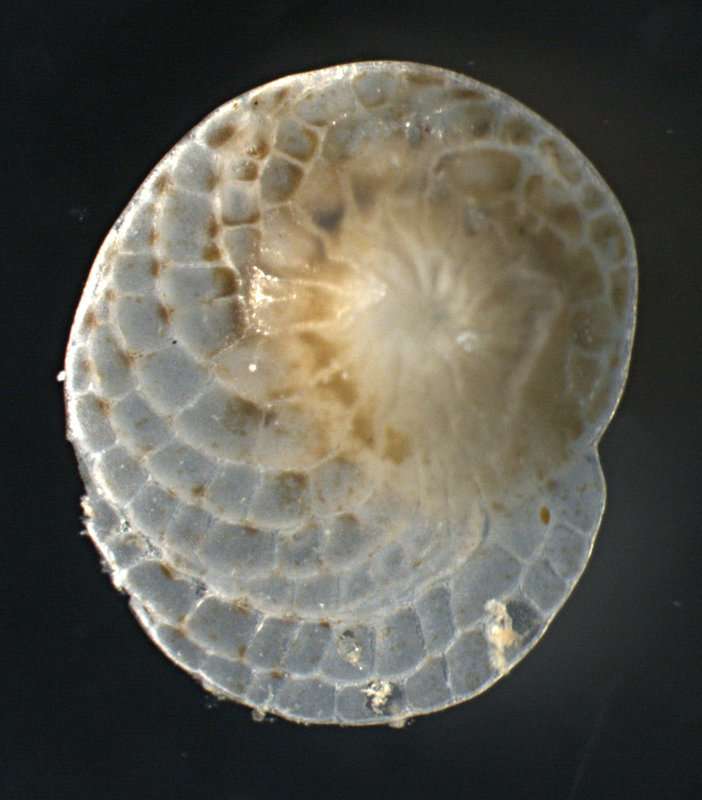
Amphistegina
Amphistegina is a genus of foraminiferal protists included in the Rotaliida with a stratigraphic range extending from the Eocene to recent and a cosmopolitan distribution. The test is an asymmetrically biconvex trochospiral that may be bi-involute or partially evolute on the spiral side. Chambers are numerous, broad. and low, strongly curved back at the periphery to form chamber prolongations. The umbilical side is stellate, like that of Asterigerina, and has a distinct umbilical plug. The wall is calcareous, optically radial; the surface finely perforate and smooth overall. The periphery angu
Globigerinina
The Globigerinina is a suborder of foraminiferans that are found as marine plankton. They produce hyaline calcareous tests, and are known as fossils from the Jurassic period onwards. The group has included more than 100 genera and over 400 species, of which about 30 species are extant. One of the most important genera is Globigerina; vast areas of the ocean floor are covered with Globigerina ooze (named by Murray and Renard in 1873), dominated by the shells of planktonic forms.

Cibicidoides
Cibicidoides is an extant genus of benthic foraminifera, with the oldest known species dating back to the Paleogene Period. (66 mya - 23 mya)

Gyroidina
Gyroidina is a genus of foraminifera belonging to the family Gavelinellidae of the superfamily Chilostomelloidea and the order Rotaliida. Its temporal range is the Holocene.
Discorboidea
Discorboidea, or Discorbacea in older taxonomies, is a superfamily of foraminifera, (testate protists), with a range extending from the Middle Triassic to the present, characterized by chambers arranged in a low trochospiral; an umbilical or interiomarginal aperture, with or without supplementary apertures; and a wall structure that is optically radial.