Category
page 1Sawfly families

Tenthredinidae
thumb|Xenapates larvae and pupae
Tenthredinidae is the largest family of sawflies, with well over 7,500 species worldwide, divided into 430 genera. Larvae are herbivores and typically feed on the foliage of trees and shrubs, with occasional exceptions that are leaf miners, stem borers, or gall makers. The larvae of externally feeding species resemble small caterpillars. As with all hymenopterans, common sawflies undergo complete metamorphosis.

Siricidae
Horntails or wood wasps are any of the 150 non-social species of the hymenopteran family Siricidae, a type of wood-eating sawfly. The common name "horntail" derives from the stout, spine-like structure at the end of the adult's abdomen which is present in both sexes. The ovipositor in females is typically longer and also projects posteriorly, but it is not the source of the name. Though they are not wasps, they are sometimes called wood wasps as the appearance of some species resembles one due to mimicry. A typical adult horntail is brown, blue, or black with yellow or red parts, and may often

Cimbicidae
Cimbicidae, the clubhorn sawflies, is a family of sawflies in the order Hymenoptera. There are more than 20 genera and 200 described species in Cimbicidae. Larvae are solitary herbivores.
.jpg)
Argidae
Argidae, commonly known as the argid sawflies, is a large family of sawflies, containing some 800 species worldwide, primarily in tropical regions. The larvae are phytophagous, and commonly can be found feeding (and often pupating) in groups, though very few attain pest status.
Diprionidae
thumbnail|Gilpinia video
Pamphiliidae
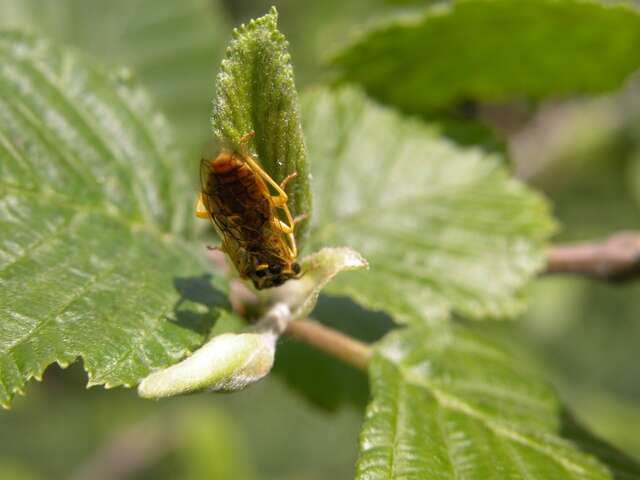
Pamphiliidae (sometimes incorrectly spelled Pamphilidae) is a small family within Symphyta, containing some 200 species from the temperate regions of North America and Eurasia. The larvae feed on plants (often conifers), using silk to build webs or tents, or to roll leaves into tubes in which they feed, thus earning them the common names leaf-rolling sawflies or web-spinning sawflies. Some species are gregarious and the larvae live in large groups. Fossils of Pamphiliidae have been dated to the Jurassic period.

Pergidae
The Pergidae are a moderate-sized family of sawflies occurring in the Western Hemisphere and the Australasian Region. The Pergidae are, with almost 450 described species, the third-largest family of Symphyta after the Tenthredinidae and the Argidae. Morphologically, most pergids are typically sawfly-like, but the form of the antennae varies considerably in number of segments and from simple to serrate and pectinate or even bipectinate. Sexual dimorphism is common and reflected in differences in type of antennae, colour, and size. Included are some of the few known apterous sawflies, those of t

Orussidae
thumb|Orussus abietinus; Narew river near Pułtusk, Poland
The Orussidae or the parasitic wood wasps represent a small family of sawflies ("Symphyta"). Currently, about 93 extant and four fossil species are known. They take a key position in phylogenetic analyses of Hymenoptera, because they form the sister taxon of the megadiverse apocritan wasps, and the common ancestor of Orussidae + Apocrita evolved parasitism for the first time in course of the evolution of the Hymenoptera. They are also the only sawflies with carnivorous larvae.
%20-%20Keila.jpg)
Xiphydriidae
Xiphydriidae are a family of wood wasps that includes around 150 species. They are located all over the world including North and South America, Australia, Europe, and others. Xiphydriidae larvae are wood borers in dead trees or branches of a range of trees. They are characterized as having long and skinny necks with dome-shaped heads. The oldest fossils of the group are from the mid Cretaceous.
Blasticotomidae
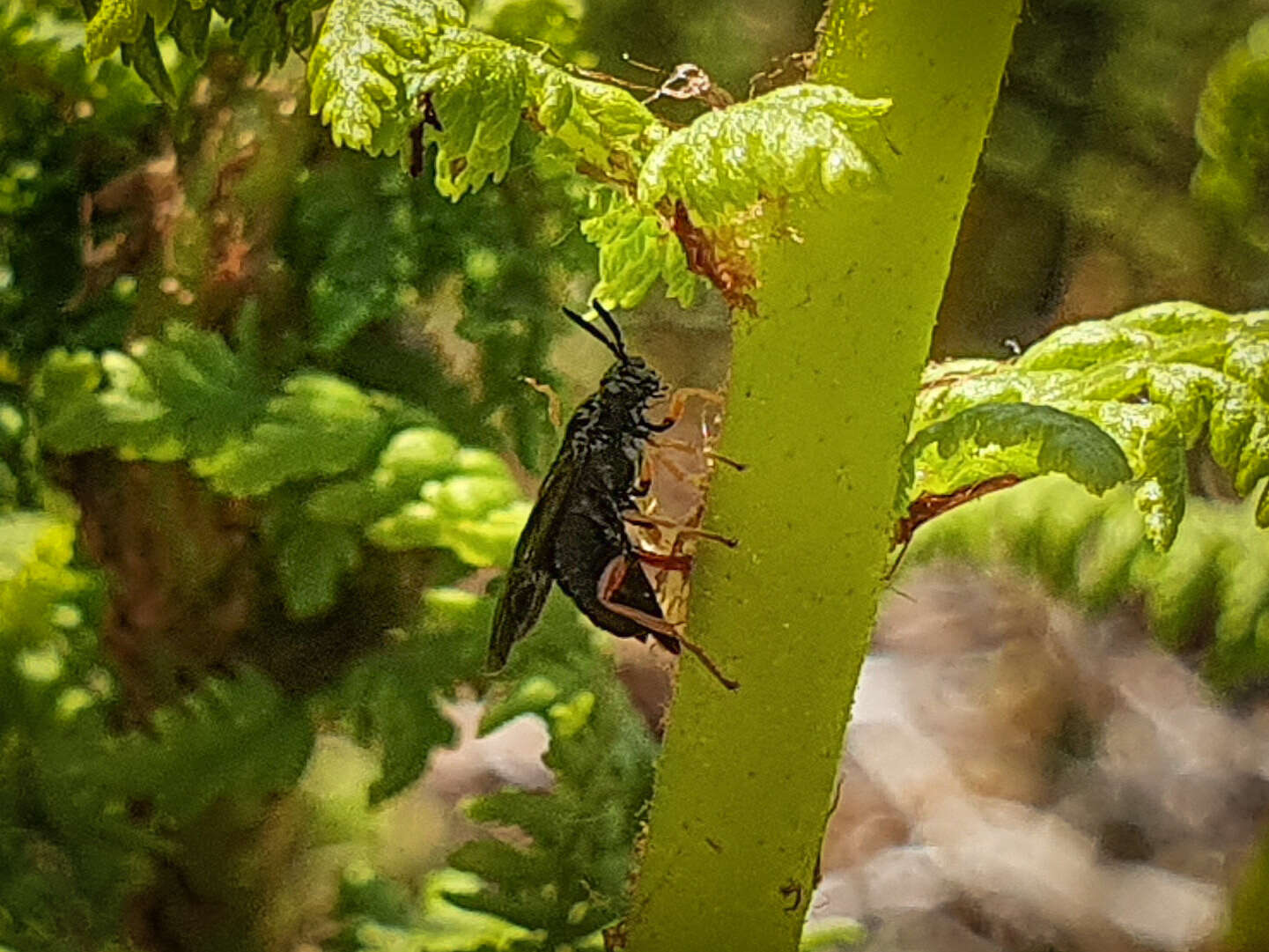
The Blasticotomidae are a very small family of sawflies, containing only 13 species in 3 genera worldwide, restricted to temperate regions of Eurasia where the larvae are specialized stem borers of ferns.
Megalodontesidae
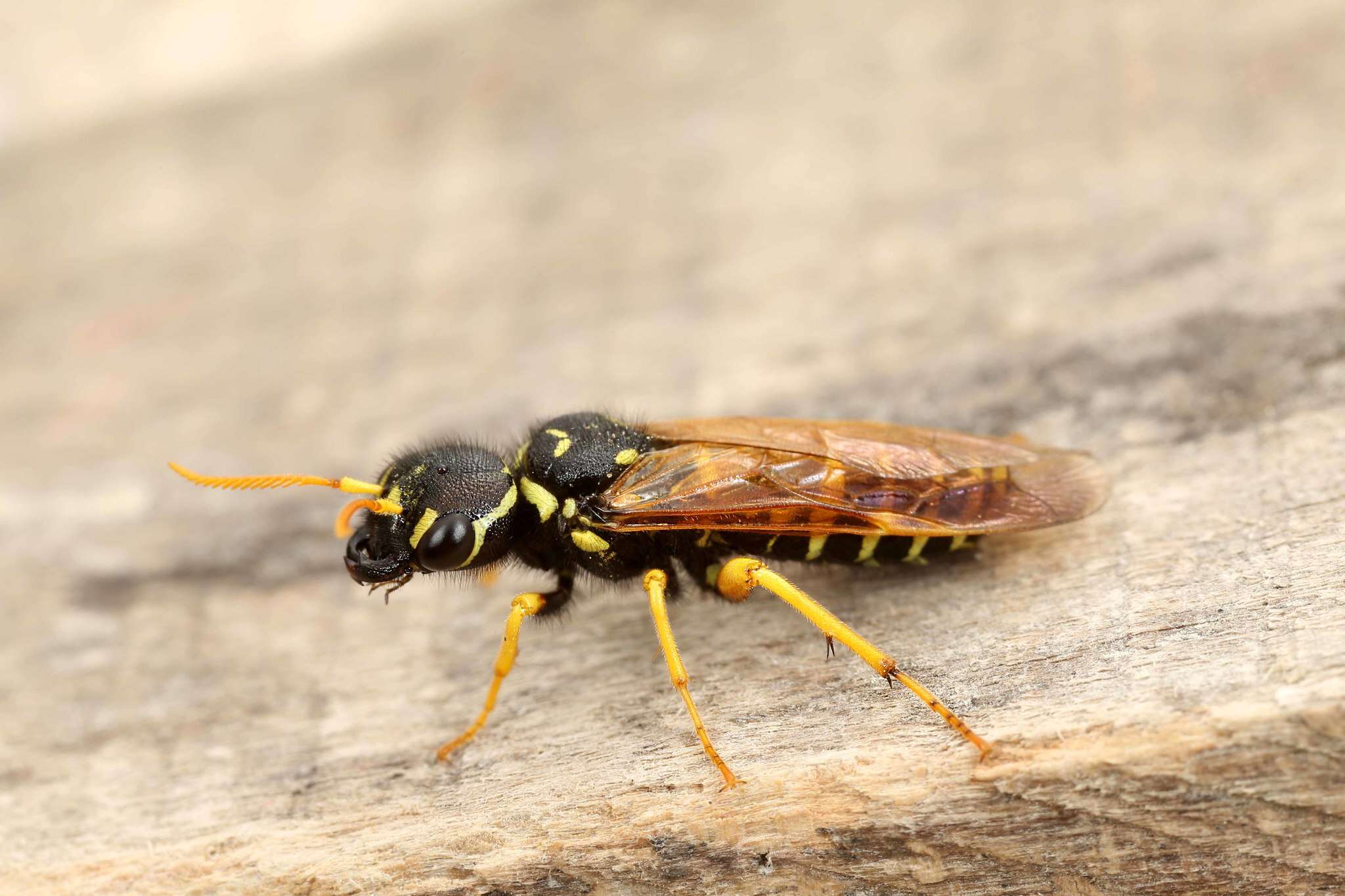
The Megalodontesidae (until recently spelled Megalodontidae, a name already in use for a family of fossil molluscs) are a small family of sawflies, containing a single living genus, Megalodontes, with some 40 species restricted to the temperate regions of Eurasia. Larvae of Megalodontesidae feed on herbaceous plants. They are distinguished from the closely related Pamphiliidae by their serrate or pectinate antennae.

Xyelidae
The Xyelidae are a comparatively species-poor family of sawflies, comprising about 80 extant species in five genera worldwide, and is the only family in the superfamily Xyeloidea. The fossil record of the family is extensive, comprising more than 120 species and including the oldest fossil Hymenoptera species dating back to the Triassic, between 245 and 208 million years ago. Xyelidae are sister to all other contemporary lineages of Hymenoptera and have many ancestral morphological features.

Anaxyelidae
Anaxyelidae is a family of incense cedar wood wasps in the order Hymenoptera. It contains only one living genus, Syntexis, which has only a single species, native to Western North America. Fossils of the family extend back to the Middle Jurassic, belonging to over a dozen extinct genera, with a particularly high diversity during the Early Cretaceous. Syntexis lay eggs in the sapwood of conifers, preferring recently burnt wood.
Sepulcidae
Sepulcidae is an extinct family of stem sawflies in the order Hymenoptera. The family is known primarily from late Mesozoic fossils found in 1968 in Transbaikalia. The insects were distant relatives of modern sawflies and are part of the living superfamily Cephoidea.