Category
page 1Science diplomacy

International Space Station
The International Space Station (ISS) is a space station in low Earth orbit (LEO). It is the product of the International Space Station program and is operated by five partner space agencies: NASA, Roscosmos (Russia), ESA (Europe), JAXA (Japan), and CSA (Canada). It is the first space station built, maintained and crewed through international cooperation and the largest human spacecraft ever constructed. It is an orbital research station, where scientific experiments in microgravity are conducted and the space environment is studied. Since 2 November 2000, it has hosted the longest continuous presence of humans in space. Alongside Tiangong, it is one of the only two currently operational space stations.

CERN
The European Organization for Nuclear Research, known as CERN (; ; ), is an intergovernmental organization that operates the largest particle physics laboratory in the world. Established in 1954, it is based in Meyrin, a western suburb of Geneva, on the France–Switzerland border. It comprises 24 member states. Israel, admitted in 2013, is the only full member geographically out of Europe. CERN is an official United Nations General Assembly observer.
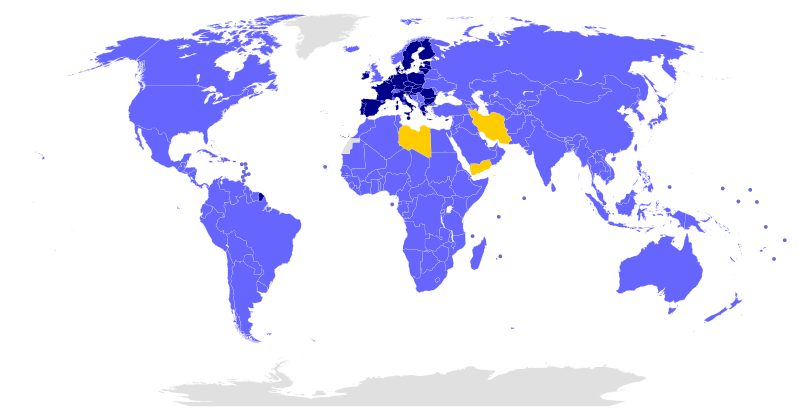
Paris Agreement
international agreement from 12 December 2015 within the United Nations Framework Convention on Climate Change (UNFCCC) dealing with greenhouse gas emissions mitigation, adaptation and finance starting in the year 2020

ITER
ITER (originally an acronym for International Thermonuclear Experimental Reactor, and also meaning "the way" or "the path" in Latin) is an international nuclear fusion research and engineering project designed to demonstrate the feasibility of fusion power. The facility is under construction near the Cadarache research center in southern France. ITER has been under construction since 2013. It is expected to achieve first plasma in 2033–2034, at which point it will be the world's largest fusion reactor, with a plasma volume about six times that of Japan's JT-60SA, previously the largest tokamak
Baruch Plan
proposed U.S. atomic energy plan following World War II by Bernard Baruch
Atoms for Peace
speech by Dwight D. Eisenhower to the UN General Assembly in New York City on December 8, 1953
science attaché
member of a diplomatic mission
science diplomacy
international scientific cooperation