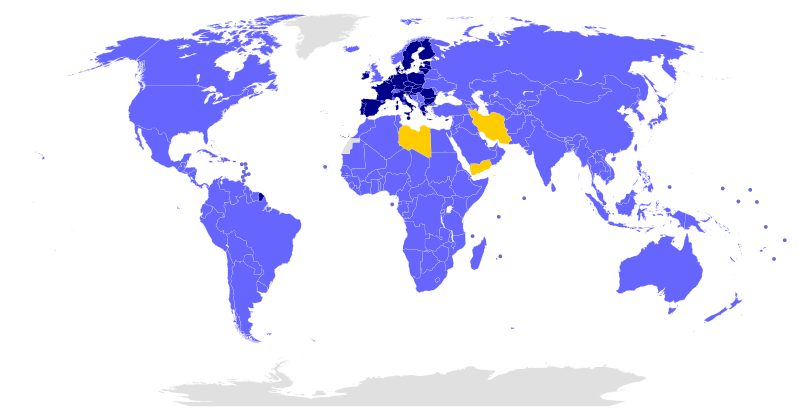
File:ParisAgreement.svg · Wikimedia Commons · See Wikimedia Commons
Paris Agreement
Sign in to saveAlso known as Paris Agreement under the United Nations Framework Convention on Climate Change, Paris Climate Accord, Paris Climate Agreement
international agreement from 12 December 2015 within the United Nations Framework Convention on Climate Change (UNFCCC) dealing with greenhouse gas emissions mitigation, adaptation and finance starting in the year 2020
The Paris Agreement is an international treaty signed in December 2015 that aims to address climate change by reducing greenhouse gas emissions and helping countries adapt to its effects, with financial support included as part of the commitment. The agreement, which began taking effect in 2020 under the United Nations Framework Convention on Climate Change, brings together countries around the world to work together on tackling global warming.
AI-generated from the Wikipedia summary — may contain errors.
Described at
Link to a page describing this subject · 40,000 chars · not written by Vinony
Wikidata facts
- Has part
- Global stocktake
- Named after
- Paris
- Country
- France
- Legal form
- climate change litigation
- Author
- United Nations
- Main subject
- climate finance
- Location
- New York City
- Image
- ParisAgreement.svg
Show 14 more facts
- on focus list of Wikimedia project
- WikiProject Climate change
- has cause
- global warming
- facet of
- climate change
- depositary
- United Nations Secretary-General
- Commons category
- Paris Agreement
- point in time
- 2015-12-12
- signatory
- European Union
- publication date
- 2015-12-12
- language of work or name
- Russian
- ratified by
- China
- work available at URL
- unfccc.int/resource/docs/2015/cop21/eng/l09r01.pdf
- effective date
- 2016-11-04
- P8168
- W50
Sources (6)
via Wikidata · CC0
~40 min read
Encyclopedic overview
The Paris Agreement (also called the Paris Accords or Paris Climate Accords) is an international treaty on climate change that was signed in 2016. The treaty covers climate change mitigation, adaptation, and finance. The Paris Agreement was negotiated by 196 parties at the 2015 United Nations Climate Change Conference near Paris, France. As of January 2026, 194 members of the United Nations Framework Convention on Climate Change (UNFCCC) are parties to the agreement. Of the three UNFCCC member states which have not ratified the agreement, the only major emitter is Iran. The United States, the second largest emitter, withdrew from the agreement in 2020, rejoined in 2021, and withdrew again in 2026 .
The Paris Agreement has a long-term temperature goal which is to keep the rise in global surface temperature to well below 2 °C (3.6 °F) above pre-industrial levels. The treaty also states that preferably the limit of the increase should only be 1.5 °C (2.7 °F). These limits are defined as averages of the global temperature as measured over many years.
Excerpted from Wikipedia’s “Paris Agreement” article, available under the CC BY-SA 4.0 licence.
Gallery (12)
Available in 71 languages
- Español
- Français
- Deutsch
- 中文
- 日本語
- Русский
- Português
- Italiano
- العربية
- हिन्दी
- Albanian
- Armenian
- azb
- Azerbaijani
- Bahasa Indonesia
- Bangla
- Basque
- Bhojpuri
Show 52 more
- Bikol
- Bulgarian
- Catalan
- Central Kurdish
- Cornish
- Croatian
- Czech
- dag
- Danish
- Esperanto
- Estonian
- Finnish
- Georgian
- Greek
- Hausa
- Hebrew
- Hungarian
- Icelandic
- Irish
- Latin
- Latvian
- Macedonian
- Malay
- Malayalam
- Marathi
- Mongolian
- Nederlands
- Nepali
- Norwegian
- Norwegian Nynorsk
- Pashto
- Polski
- Romanian
- Scots
- Scottish Gaelic
- Serbian
- simple
- Sinhala
- Somali
- Svenska
- Swahili
- Telugu
- Tiếng Việt
- Türkçe
- Ukrainian
- Urdu
- Welsh
- Wu Chinese
- zh_min_nan
- فارسی
- ไทย
- 한국어
via Wikidata sitelinks · CC0